Trummy Young: The Swing Era Trombonist and Louis Armstrong Collaborator
James "Trummy" Young was a cornerstone of the swing era—a period of jazz characterized by large ensembles and danceable rhythms—serving as a premier trombonist and vocalist. Over a career spanning more than three decades, Young transitioned from a promising young musician in Georgia and Virginia to an international star, most notably through his long-term partnership with the legendary Louis Armstrong.
Key Facts
- Full Name: James Osborne Young
- Active Years: 1928–1964
- Primary Instrument: Trombone (originally a trumpeter)
- Major Collaborations: Louis Armstrong, Jimmie Lunceford, Benny Goodman, and Earl Hines
- Notable Composition: Co-wrote "'Tain't What You Do (It's the Way That You Do It)"
- Film Appearances: High Society (1956) and The Glenn Miller Story (1954)
Early Career and Rise to Fame
Born on January 12, 1912, in Savannah, Georgia, and raised in Richmond, Virginia, Young began his musical journey on the trumpet. However, by the time he made his professional debut in 1928, he had switched to the trombone. His early professional years saw him honing his craft with the Earl Hines orchestra from 1933 to 1937.
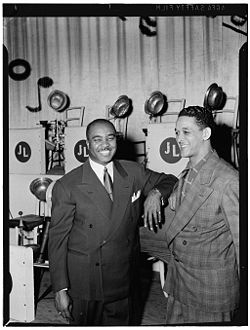
Young's profile rose significantly when he joined the Jimmie Lunceford orchestra in 1937. During his tenure there, which lasted until 1943, he achieved commercial success with his vocal and instrumental version of "Margie" on Decca Records. He also proved himself as a skilled songwriter, co-writing the hit "'Tain't What You Do (It's the Way That You Do It)" with Sy Oliver in 1939, a track that became a success for both Lunceford and Ella Fitzgerald.
Compositional Contributions
Beyond his performance skills, Young contributed several enduring pieces to the jazz canon. In addition to his work with Sy Oliver on "'Tain't What You Do" and "Easy Does It" (1939), he co-wrote "Trav'lin' Light" in 1942 alongside Jimmy Mundy, featuring lyrics by Johnny Mercer.
Collaborations with Jazz Giants
In 1945, Young joined Benny Goodman's ensemble, contributing solos to several hit records, including the No. 2 hit "Gotta Be This or That." That same year, he demonstrated his versatility by performing with bebop pioneers Charlie Parker and Dizzy Gillespie during a session led by Clyde Hart, as well as appearing with Jazz at the Philharmonic.
The most defining chapter of Young's career began in September 1952 when he joined the Louis Armstrong All-Stars. For the next twelve years, Young served as a perfect musical foil for Armstrong. He adapted his playing style to complement Armstrong's unique approach to jazz, a synergy evident in their recording of "St. Louis Blues" for Armstrong's W.C. Handy tribute album.
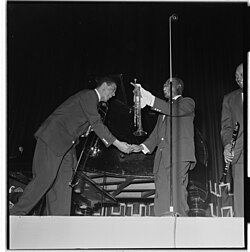
During his time with the All-Stars, Young's visibility extended to the silver screen. He appeared in the 1954 biopic The Glenn Miller Story alongside Gene Krupa and Barney Bigard, and later performed in the 1956 musical film High Society. He also participated in the ninth Cavalcade of Jazz concert at Wrigley Field in Los Angeles on June 7, 1953.
Later Life and Legacy
In 1964, Young decided to stop touring and settled in Hawaii. During this period, he became a Jehovah's Witness, a faith he discussed in a 1977 issue of Awake! magazine. While he largely stepped away from the professional circuit, he occasionally made special appearances at jazz parties.
Young was married to Sally Tokashiki, and they had two daughters, Barbara and Andrea, the latter of whom continued the family's musical legacy as a jazz singer. Trummy Young passed away on September 10, 1984, in San Jose, California, following a cerebral hemorrhage at the age of 72.
| Period | Affiliation/Project | Key Contribution/Role |
|---|---|---|
| 1933–1937 | Earl Hines Orchestra | Trombonist |
| 1937–1943 | Jimmie Lunceford Orchestra | Vocalist/Trombonist; hit with "Margie" |
| 1945 | Benny Goodman | Soloist on "Gotta Be This or That" |
| 1952–1964 | Louis Armstrong All-Stars | Core member and musical foil to Armstrong |
Frequently Asked Questions
What instrument did Trummy Young play?
Although he began his musical studies as a trumpeter, Trummy Young is best known as a master of the trombone.
Which famous jazz musician did Trummy Young work with for 12 years?
Young spent twelve years as a member of the Louis Armstrong All-Stars, where he modified his playing style to complement Armstrong's approach.
Did Trummy Young write any music?
Yes, he co-wrote several pieces, most notably "'Tain't What You Do (It's the Way That You Do It)" with Sy Oliver, as well as "Easy Does It" and "Trav'lin' Light."
In which movies did Trummy Young appear?
He appeared in the biopic The Glenn Miller Story (1954) and the musical film High Society (1956).
Why did Trummy Young stop touring in 1964?
Young ceased touring in 1964 to settle in Hawaii and focus on his personal life and faith as a Jehovah's Witness.