Bunk Johnson: The Resilient Voice of New Orleans Jazz
Willie Gary "Bunk" Johnson was a pivotal figure in the evolution of early jazz, a trumpeter whose life mirrored the dramatic rises and falls of the genre itself. Born in New Orleans, Louisiana, Johnson was a master of the trumpet who bridged the gap between the foundational sounds of the early 20th century and the jazz revival of the 1940s.
Key Facts
- Full Name: William Gary "Bunk" Johnson.
- Primary Instrument: Trumpet.
- Active Periods: 1905–1931 and 1942–1947.
- Key Associations: Buddy Bolden, George Lewis, and Louis Armstrong.
- Major Contribution: Preserving and recreating early New Orleans jazz tunes through recordings.
Early Life and Musical Foundations
There has been historical debate regarding Johnson's birth date; while he claimed 1879, his 1937 Social Security application listed December 27, 1889. Jazz critic Scott Yanow suggests the 1889 date is the most probable. The youngest of 14 children, Johnson developed his skills in sight reading (the ability to play music directly from a score) and improvisation (creating music spontaneously) early in his life.
By 1910, Johnson was playing professionally with the Eagle Band and the Superior Orchestra. He studied under Adam Olivier and performed in Olivier's orchestra. While Johnson claimed to have been a regular member of Buddy Bolden's Band, historians initially questioned this, though he likely performed occasional jobs with Bolden during his youth.
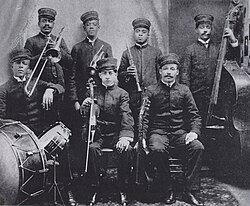
Rise in New Orleans
Between 1905 and 1915, Johnson established himself as one of the premier trumpeters in New Orleans. His career during this era was characterized by a balance of local prominence and touring with circus bands and minstrel shows.
Departure and the Silent Years
Johnson's trajectory changed abruptly in 1915. After missing a Mardi Gras parade engagement, he learned that members of the krewe intended to cause him physical harm. To ensure his safety, he left New Orleans and toured extensively before settling in New Iberia, Louisiana, in the early 1920s.
In New Iberia, Johnson balanced manual labor in rice mills and work within the public school system with his passion for music. He continued to perform with local ensembles, including the Banner Orchestra and the Black Eagle Band from Crowley.
The Career Hiatus
A violent altercation at a dance in Rayne, Louisiana, in 1931 resulted in a devastating loss for Johnson: he lost both his trumpet and his front teeth. Unable to play his instrument, he spent the next decade working in manual labor and occasionally teaching music, effectively ending his professional playing career for several years.
The Great Revival
Johnson's return to the spotlight was sparked by the writers of the jazz history book Jazzmen. In 1938 and 1939, they interviewed legends like Louis Armstrong and Sidney Bechet, who spoke highly of Johnson's early talent. Upon locating Johnson, the writers discovered he was willing to play again if he had the necessary equipment and dental work.
Through a collection organized by musicians and writers, Johnson received a new trumpet and dentures provided by Leonard Bechet, the dentist brother of Sidney Bechet. This generosity led to his first recordings in 1942 for Jazz Man Records.
Later Career and Performance Style
The 1942 recordings brought Johnson and clarinetist George Lewis back into the public eye. He toured major cities, including New York City, Boston, and San Francisco. Critics noted that on his best days, Johnson played with immense beauty and subtlety. However, his professional life was often complicated by an unpredictable temperament and a struggle with alcohol impairment.
Legacy and Historical Importance
Johnson passed away in New Iberia on July 7, 1949, following a stroke in late 1948. For years, historians debated the accuracy of his reminiscences. However, 2014 research by Vic Hobson provided evidence from Willy Cornish, a member of Buddy Bolden's band, affirming Johnson's membership in that early group.
This validation gives significant musicological weight to Johnson's recordings, as he actively recreated Bolden's tunes, providing a rare window into the origins of New Orleans jazz.
Commemorations
- Jazz Mass: An annual Jazz Mass and procession is held in New Iberia, starting at St Edward Catholic Church and ending at his grave.
- Bunk Johnson Park: Dedicated in 1996 in New Iberia, though it was dismantled in 2016 due to local criminal activity.
- Archival Collection: The Iberia Parish Library maintains a special exhibit room and a collection of his papers.
Summary of Career and Recordings
| Period | Key Activity | Notable Associations/Labels |
|---|---|---|
| 1905–1915 | Early professional rise in New Orleans | Superior Orchestra, Eagle Band |
| 1920s–1931 | Regional playing in New Iberia | Black Eagle Band, Banner Orchestra |
| 1931–1941 | Career hiatus (injury/loss of instrument) | Manual labor and music lessons |
| 1942–1947 | Career revival and recording era | Jazz Man Records, George Lewis |
Frequently Asked Questions
When was Bunk Johnson born?
While Johnson claimed to be born in 1879, his 1937 Social Security application stated December 27, 1889. Jazz critic Scott Yanow considers the 1889 date to be the most likely.
Why did Bunk Johnson stop playing in 1931?
Johnson stopped playing after a fight at a dance in Rayne, Louisiana, during which he lost his front teeth and his trumpet.
How did Bunk Johnson return to music in the 1940s?
Writers of the book Jazzmen and fellow musicians raised funds to provide him with a new trumpet and dentures, allowing him to record for Jazz Man Records in 1942.
Was Bunk Johnson actually a member of Buddy Bolden's band?
Although previously debated, 2014 evidence from band member Willy Cornish affirms that Johnson was indeed a member of the early jazz group led by Buddy Bolden.
Where can researchers find Bunk Johnson's papers?
The Iberia Parish Library hosts an archival collection of his papers and a dedicated special exhibit room.