Berlin Palace: The Resurrection of a Prussian Landmark
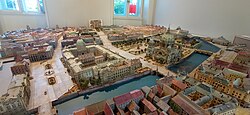
The Berlin Palace (German: Berliner Schloss), once the opulent heart of Prussian power, stands today as a striking blend of historical restoration and modern design. Located in the Mitte district of Berlin, adjacent to the Berlin Cathedral and Museum Island, this architectural marvel served as the primary residence for the Electors of Brandenburg, the Kings of Prussia, and the German Emperors for nearly five centuries.
From its humble beginnings as a 15th-century fortification to its total demolition in 1950 and its eventual reconstruction as the Humboldt Forum, the palace's history mirrors the turbulent political shifts of Germany itself.
Key Facts
- Original Construction: Started in 1443; completed in 1894.
- Architectural Style: Primarily Prussian Baroque.
- Demolition: Razed by East German authorities in 1950.
- Reconstruction: Began in 2013 and completed in 2020.
- Current Use: Houses the Humboldt Forum museum.
- Key Architects: Andreas Schlüter (original) and Franco Stella (reconstruction).
The Evolution of a Royal Residence
Early Fortifications and Renaissance Influence
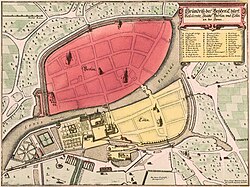
The palace originated in 1443 when Frederick II "Irontooth" laid the foundations for a fortification on Fishers' Island to secure the crossing of the Spree. This early castle was designed to assert the authority of the margraves over the citizens of Berlin and Cölln. By 1538, Elector Joachim II replaced the castle with a grander residence in the Italian Renaissance style, a movement characterized by symmetry and classical proportions.
The Baroque Transformation
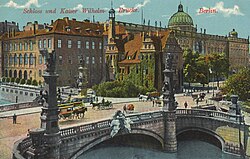
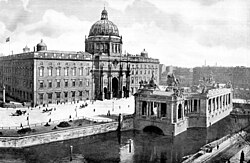
The palace reached its architectural peak under the direction of Andreas Schlüter, who began a massive redesign in 1689. Schlüter envisioned a regular cube enclosing a magnificently ornamented courtyard, establishing the palace as a masterpiece of Prussian Baroque architecture. Later expansions by Johann Friedrich Eosander von Göthe doubled the building's size, while the addition of a 60-meter-high dome in 1845—designed by Karl Friedrich Schinkel and built by Friedrich August Stüler—defined the city's skyline.
Imperial Era and Decline
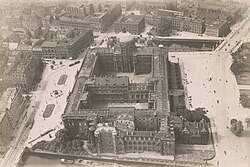
Following the unification of Germany in 1871, the palace became the central residence for the German Emperors. However, the 1918 revolution abolished the Hohenzollern monarchy, and the building transitioned into a museum. During World War II, the palace suffered heavy damage from Allied bombing, leaving it a scarred shell of its former self.
Demolition and the Socialist Era
After the war, the new socialist government of East Germany viewed the palace as a symbol of Prussian militarism. Despite reports suggesting the building could have been repaired for 32 million East German marks, Walter Ulbricht ordered its demolition in 1950. The process took four months and required 19 tons of dynamite.
In the 1970s, the site was occupied by the Palace of the Republic, a modernist parliamentary and cultural center. This building remained until after German reunification, when it was closed due to asbestos contamination and eventually demolished in 2009.
The Modern Reconstruction
The drive to rebuild the Berlin Palace was led by the Berlin City Palace Sponsoring Association, which used surviving photos and drawings to create precise architectural plans. Construction of the "Humboldt Forum" officially began in 2013 with a budget of €590 million.
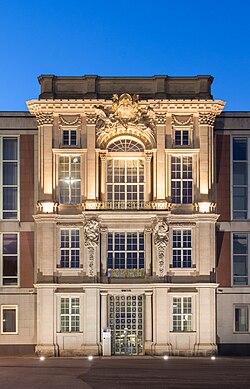
The reconstruction, overseen by architect Franco Stella, is a hybrid project. While the north, south, and west façades were meticulously restored to their Baroque glory, the east façade features a modernist design. The interior similarly blends historicist and modernist elements. The final decorative touches, including the installation of 19 balustrade statues, were completed in 2025.
Summary of the Berlin Palace Timeline
| Period/Year | Event | Key Figure/Architect |
|---|---|---|
| 1443–1451 | Original fortification built | Frederick II "Irontooth" |
| 1689–1713 | Baroque expansion | Andreas Schlüter |
| 1845 | Dome construction | Karl Friedrich Schinkel |
| 1950 | Complete demolition | East German Authorities |
| 1973–1976 | Palace of the Republic built | Erich Honecker (Govt) |
| 2013–2020 | Reconstruction for Humboldt Forum | Franco Stella |
Frequently Asked Questions
Why was the original Berlin Palace demolished?
The East German government declared the palace a symbol of Prussian militarism and ordered its demolition in 1950, despite the fact that the building was considered repairable.
What is the Humboldt Forum?
The Humboldt Forum is the museum and cultural center now housed within the reconstructed Berlin Palace, serving as a site for global art and culture.
Is the reconstructed palace an exact replica?
Not entirely. While three of the exterior façades are historical reconstructions, the east façade is modernist, and the interior combines both modern and historicist elements.
What happened to the Palace of the Republic?
The Palace of the Republic was a modernist building that stood on the site from the 1970s until 2009, when it was demolished to make way for the reconstruction of the original palace.
Who was the primary architect of the original Baroque palace?
Andreas Schlüter was the primary architect responsible for the palace's Baroque design, creating the rhythmic composition of the façades and the central courtyard.