Berlin Conference of 1884–1885: The Formalization of the Scramble for Africa
The Berlin Conference of 1884–1885 was a pivotal diplomatic gathering of colonial powers that fundamentally reshaped the map of Africa. Organized by German Chancellor Otto von Bismarck at the request of King Leopold II of Belgium, the meeting sought to regulate European colonization and trade during the era of New Imperialism. The conference concluded with the signing of the General Act of Berlin, an agreement that established the legal framework for European territorial claims on the continent.
While often remembered as the moment Africa was "carved up," the conference served more as a formalization of an existing race for territory. By establishing a common framework for the recognition of colonial claims, it reduced direct conflict between European rivals while accelerating the annexation of African lands.
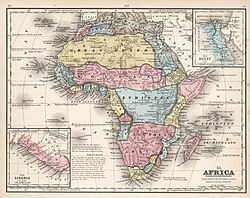
Key Facts
- Dates: November 15, 1884, to February 26, 1885.
- Organizer: Otto von Bismarck, the first Chancellor of Germany.
- Participants: 14 countries, including major powers like Great Britain, France, Germany, and Portugal.
- Primary Outcome: The General Act of Berlin, which regulated trade and colonization.
- Core Principle: The concept of effective occupation, requiring nations to physically demonstrate control over a territory to claim it.
- Major Result: The recognition of the International Congo Society's claims, leading to the creation of the Congo Free State.
Economic Drivers of the Scramble
The drive toward African colonization was fueled by the needs of the Industrial Revolution. European industries required vast quantities of raw materials to sustain growth, making Africa's natural resources highly valuable. Key commodities included rubber, minerals, ivory, and cotton.
Beyond raw materials, Africa offered expansive new markets for European manufactured goods. This created a cycle of economic dominance where European powers secured resources and then sold finished products back to the colonies. Intense rivalries, particularly between Britain and France, created an urgent atmosphere where nations raced to secure strategic regions, such as the Congo Basin, to prevent competitors from establishing monopolies.
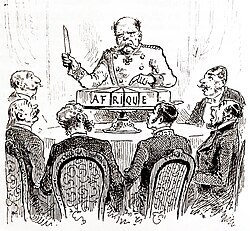
The Road to Berlin: Conflict in the Congo
The immediate catalyst for the conference was the tension surrounding the Congo River Basin. Between 1878 and 1885, Henry Morton Stanley acted as an agent for King Leopold II, secretly organizing what would become the Congo Free State. This sparked a reaction from other powers:
- France: Dispatched Pierre de Brazza to central Africa, who founded Brazzaville in the western Congo basin.
- Portugal: Claimed the area based on historical treaties and attempted to block access to the Atlantic via a treaty with Great Britain in February 1884.
Stanley's charting of the Congo River Basin (1874–1877) had removed the last terra incognita (unknown land) from European maps, providing the geographical data necessary for these nations to race for annexation.
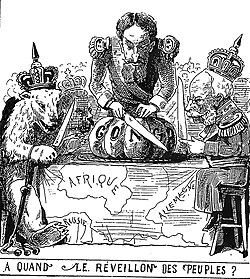
The Conference and the General Act
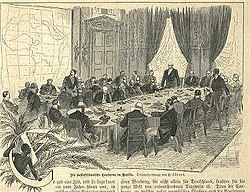
The conference took place at Wilhelmstrasse in Berlin. While 14 nations sent plenipotentiaries (representative diplomats), the discussions focused on creating a legal structure to avoid war between Europeans while they partitioned the continent.
A major outcome was the confirmation of the properties occupied by Leopold II's International Congo Society. Shortly after the conference, on August 1, 1885, this territory was declared the Congo Free State, with Leopold II as its sovereign.
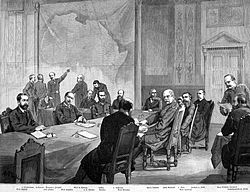
The Principle of Effective Occupation
To prevent nations from claiming vast tracts of land they did not actually control, the conference established the principle of effective occupation. This meant a power could only claim a coastal territory if it could prove it had sufficient authority and presence to maintain order and protect trade.
Territorial Agreements: France and Britain
Specific borders were negotiated to settle disputes. For example, a line from Say in Niger to Maroua on Lake Chad divided territory between France (north) and Britain (south). Britain secured the Nile basin, while France took the Lake Chad basin.
Aftermath and Historical Analysis
By 1914, approximately 90% of Africa was under European control. The legacy of this era is visible in the modern boundaries of African nations, which were largely drawn by colonial powers without regard for local ethnic or political structures.
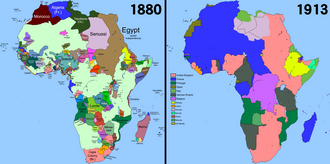
However, modern historical analysis suggests the conference's role is often overstated. A 2024 study indicates that most African borders did not take their final form until two decades after the conference, and the only borders actually set in Berlin were those of the Congo region. Much of the partitioning occurred through separate bilateral agreements.
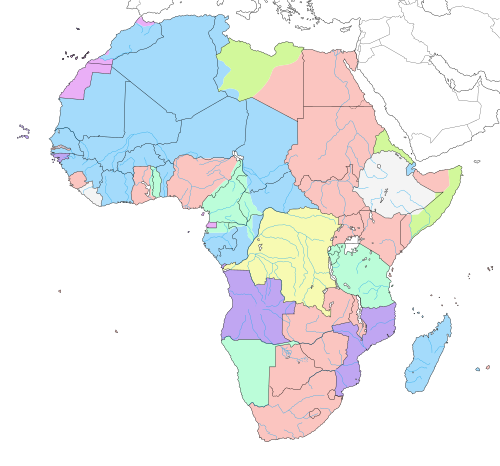
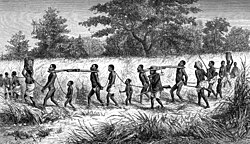
Despite the legal frameworks, the colonial era was marked by violence and exploitation. The conquest of the Boer republics (1899–1902), the Italian occupation of Libya (1911), and the division of Morocco (1912) further cemented European dominance. Only Ethiopia and Liberia remained independent for significant periods, though Ethiopia faced Italian occupation in 1936.
| Category | Details |
|---|---|
| Primary Goal | Regulate European colonization and trade in Africa |
| Key Figure | Otto von Bismarck (Organizer) |
| Legal Instrument | General Act of Berlin |
| Key Concept | Effective Occupation |
| Major Territory | Congo Free State (Leopold II) |
| Long-term Impact | 90% of Africa under European control by 1914 |
Frequently Asked Questions
Did the Berlin Conference create all the borders of modern Africa?
No. While it established the framework for colonization, a 2024 study found that only the borders of the Congo region were set during the conference. Most other borders were determined by bilateral agreements over the following two decades.
What was the "Principle of Effective Occupation"?
It was a rule established to ensure that European powers could not claim territory simply by naming it. They had to demonstrate a physical presence and actual administrative control over the area to have their claim recognized internationally.
Why was King Leopold II so central to the conference?
Leopold II requested the conference to secure international recognition for his claims in the Congo. Through the General Act, his International Congo Society was confirmed as the owner of the territory, which he later turned into the Congo Free State.
What were the main economic motivations for the conference?
European powers sought control over raw materials essential for industrialization, such as rubber, ivory, cotton, and minerals. They also wanted to secure exclusive markets to sell their manufactured goods.
Which African nations remained independent?
Liberia and Ethiopia remained independent during the primary colonial era, although Ethiopia was later occupied by Italy in 1936 after the Second Italo-Ethiopian War.