Benzene and the Evolution of the Kekulé Structure
The determination of the structure of benzene stands as one of the most significant milestones in the history of organic chemistry. For years, the empirical formula of this substance was known, but its highly unsaturated nature—meaning it contained far fewer hydrogen atoms than expected for its carbon count—posed a daunting challenge to 19th-century scientists.
Early attempts to map the molecule were made by Archibald Scott Couper in 1858 and Joseph Loschmidt in 1861. They proposed various configurations involving multiple rings or multiple double bonds. However, because the study of aromatic compounds (stable, ring-shaped organic molecules) was in its infancy, there was insufficient evidence to confirm any specific model.
The Breakthrough of August Kekulé
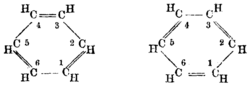
In 1865, August Kekulé published a seminal paper in French proposing that benzene consists of a six-membered ring of carbon atoms with alternating single and double bonds. He followed this with a more comprehensive paper in German the following year.
Kekulé based his theory on the observation of isomers—molecules with the same chemical formula but different structural arrangements. He noted that for every monoderivative of benzene (where one atom is replaced by a substituent like chlorine or a methyl group), only one isomer existed. This suggested that all six carbon atoms in the ring were equivalent.
The strength of his theory became evident when examining diderivatives, such as toluidines. In these cases, three distinct isomers were always observed. Kekulé explained this by proposing that the two substituents could be separated by one, two, or three carbon-carbon bonds. These were later classified as ortho, meta, and para isomers, respectively.
Refining the Model: From Oscillation to Resonance
Despite the success of the ring theory, Kekulé faced criticism from his former student, Albert Ladenburg. Ladenburg pointed out a logical flaw: if the bonds were strictly alternating, there should be two different types of "ortho" positions (one separated by a single bond and one by a double bond). Since only one ortho isomer was ever found, the static model was incomplete.
To resolve this, Kekulé modified his proposal in 1872, suggesting that the benzene molecule oscillates. He theorized that the single and double bonds continually interchange positions, making all six bonds equivalent over time.
This conceptual bridge paved the way for modern chemistry. In 1928, Linus Pauling provided a firmer theoretical foundation by introducing the concept of resonance. Rather than oscillating back and forth, Pauling proposed that the molecule exists as a hybrid of quantum-mechanical structures.
The Legend of the Ouroboros Dream
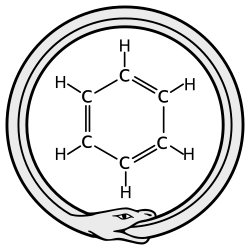
The discovery of the benzene ring is often associated with a famous anecdote. During a celebration organized by the German Chemical Society in 1890, Kekulé claimed that the idea of the ring structure came to him during a day-dream. He described seeing a snake seizing its own tail, a symbol known as the ouroboros.
Historians have debated the authenticity of this story. In 1886, a parody journal called the Berichte der Durstigen Chemischen Gesellschaft published a depiction of six monkeys seizing each other in a circle. Some suggest Kekulé's snake story was a response to this spoof, while others believe the anecdote was a later invention rather than a literal memory of an event from 1862.
Kekulé also recounted a separate vision of "dancing atoms" that allegedly inspired his general theory of chemical structure in 1858, which he claimed occurred while riding a horse-drawn omnibus in London around 1855.
Key Facts
- Proposed Structure: A six-membered carbon ring with alternating single and double bonds.
- Isomerism: The ring model explains why diderivatives form exactly three isomers (ortho, meta, and para).
- Evolution of Theory: Moved from a static ring (1865) to an oscillating ring (1872) to quantum resonance (1928).
- Key Figures: August Kekulé (proposer), Albert Ladenburg (critic), and Linus Pauling (resonance theorist).
- The Ouroboros: The ancient symbol of a snake eating its tail that inspired the ring concept.
| Year | Contributor | Key Contribution/Concept |
|---|---|---|
| 1858-1861 | Couper & Loschmidt | Early suggestions of multiple bonds or rings |
| 1865 | August Kekulé | Proposed the six-membered carbon ring |
| 1872 | August Kekulé | Proposed oscillating bonds to explain isomer equivalence |
| 1928 | Linus Pauling | Introduced quantum-mechanical resonance |
Frequently Asked Questions
Why was the benzene structure so difficult to determine?
Benzene's highly unsaturated structure was a challenge because it did not behave like other unsaturated compounds of the time, and there was initially very little empirical evidence available to distinguish between various proposed ring or chain structures.
What are ortho, meta, and para isomers?
These terms describe the relative positions of two substituents on a benzene ring. Ortho refers to substituents separated by one bond, meta by two bonds, and para by three bonds.
How did Linus Pauling improve upon Kekulé's theory?
While Kekulé suggested the molecule physically oscillated between two forms, Pauling used quantum mechanics to propose resonance, meaning the molecule is a hybrid of structures rather than switching between them.
Is the story about the snake dream true?
It is debated. While Kekulé shared the story in 1890, some historians believe it may have been a re-parody of a contemporary joke involving monkeys in a circle, rather than a factual recollection.
What is the significance of the 1890 German Chemical Society event?
The event celebrated the 25th anniversary of Kekulé's first benzene paper and highlighted the immense impact his work had on both pure and applied chemistry.