Terpenes: The Diverse Chemical Building Blocks of Nature
In the vast chemical landscape of the natural world, few groups of compounds are as diverse or as essential as terpenes. These unsaturated hydrocarbons, characterized by the general formula (C5H8)n (where n ≥ 2), serve as fundamental biosynthetic building blocks for countless organisms. With an estimated 55,000 chemical entities including both terpenes and their derivatives, these compounds play vital roles in everything from plant defense to ecological signaling.
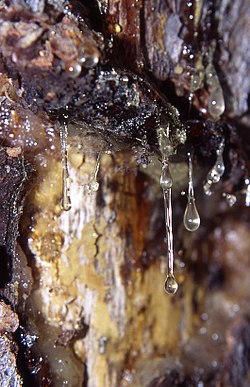
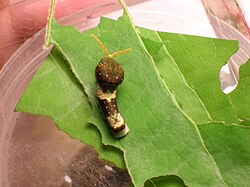
Predominantly produced by plants—particularly conifers—terpenes act as mediators for ecological interactions. They assist in functions such as cell growth modulation, light harvesting, photoprotection, and the control of membrane fluidity. Beyond plants, some insects even utilize terpenes as a sophisticated form of defense.
Key Facts
- Diversity: There are over 30,000 known terpene compounds.
- Classification: They are categorized by the number of carbon atoms they contain.
- Building Blocks: All terpenes are conceptually derived from five-carbon isoprene units.
- Physical Properties: They are typically colorless, non-polar, highly flammable, and insoluble in water.
- Biological Role: They function in plant growth, defense, and attracting pollinators.
Terminology: Terpenes vs. Terpenoids
While the terms are often used interchangeably in casual conversation, a scientific distinction exists. Terpenes are pure hydrocarbons. Terpenoids (also known as isoprenoids) are modified terpenes that contain additional functional groups, most commonly oxygen. Because terpenes can be converted into terpenoids and vice versa, the two groups are deeply interconnected.
The term "Terpen" was originally coined in 1866 by German chemist August Kekulé. He sought to reduce confusion among various hydrocarbons that shared the empirical formula C10H16, deriving the name from the German word for turpentine, "Terpentin."

Classification by Carbon Count
Terpenes are organized into groups based on the number of carbon atoms in their structure. This classification follows the number of isoprene units required to assemble the molecule.
Monoterpenes (C10)
Consisting of two isoprene units, monoterpenes like limonene (citrus) and pinene (pine) are common. Alpha-pinene is a primary component of turpentine, a widely used solvent.
Sesquiterpenes (C15)
These contain three isoprene units. Examples include geosmin and farnesol.
Diterpenes (C20)
Composed of four isoprene units, diterpenes include biologically significant compounds like retinol (Vitamin A) and the precursor to the drug taxol, taxadiene.
Higher Terpenes
- Triterpenes (C30): Six isoprene units. Squalene, found in shark liver oil, is a major triterpene and a precursor to steroids.
- Sesquarterpenes (C35): Seven isoprene units, typically of microbial origin.
- Tetraterpenes (C40): Eight isoprene units. This class includes the carotenoids, such as lycopene and beta-carotene.

| Class | Isoprene Units | Carbon Count | Common Examples |
|---|---|---|---|
| Monoterpene | 2 | C10 | Limonene, Pinene |
| Sesquiterpene | 3 | C15 | Geosmin, Humulene |
| Diterpene | 4 | C20 | Retinol, Taxadiene |
| Triterpene | 6 | C30 | Squalene |
| Tetraterpene | 8 | C40 | Lycopene, Carotenes |
Biosynthesis and the Isoprene Rule
The construction of terpenes follows the biogenetic isoprene rule (or C5 rule), established by Leopold Ružička. This rule states that terpenes are built from five-carbon isoprene units provided by two structural isomers: isopentenyl pyrophosphate (IPP) and dimethylallyl pyrophosphate (DMAPP).
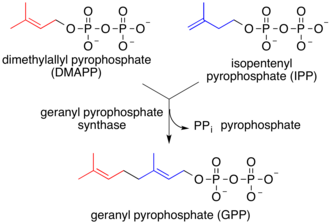
These building blocks are produced via two distinct metabolic pathways:
- Mevalonate (MVA) pathway: Used by most eukaryotes (including animals and fungi) and archaea.
- Non-mevalonate (MEP) pathway: Used by most bacteria and green algae.
In plants, both pathways are utilized. The synthesis of higher terpenoids proceeds through intermediate stages, moving from geranyl pyrophosphate (C10) to farnesyl pyrophosphate (C15) and finally to geranylgeranyl pyrophosphate (C20).
![Biosynthetic conversion of geranylpyrophosphate to the terpenes α-pinene and β-pinene and to the terpinoid α-terpineol.[2]](/images/05/a1/05a12f3b2392e4a0be4ec2fa41877ce2a35e4c772911824f088e5e3394b20dbb.webp)
Physical and Chemical Properties
Terpenes are generally colorless, though impurities can give them a yellow tint. Because they are highly non-polar hydrocarbons, they are insoluble in water and highly flammable. They possess a low specific gravity, meaning they will float on water. In terms of texture, they are light oils with a viscosity significantly lower than vegetable oils, ranging from 1 cP (similar to water) to 6 cP.
While many terpenes possess pleasant aromas used to attract pollinators, they can be local irritants and may cause gastrointestinal distress if ingested.

Frequently Asked Questions
What is the difference between a terpene and a terpenoid?
Terpenes are pure hydrocarbons, whereas terpenoids are modified terpenes that contain additional functional groups, usually oxygen.
How are terpenes classified?
They are classified based on the number of five-carbon isoprene units that make up their structure, which determines their total carbon count.
Are terpenes safe to touch or eat?
Terpenes can act as local irritants to the skin and can cause gastrointestinal disturbances if they are ingested.
What role do terpenes play in nature?
They serve various roles, including mediating ecological interactions, protecting plants through defense, modulating cell growth, and attracting pollinators via scent.
Which organisms produce terpenes?
Terpenes are produced by a wide range of organisms, including plants, bacteria, fungi, and animals, using different metabolic pathways like the MVA or MEP pathways.
What are carotenoids?
Carotenoids are a specific class of tetraterpenes, meaning they are composed of eight isoprene units (C40).