Benthos: The Diverse Life of the Ocean Floor
The benthos refers to the entire community of organisms that inhabit the benthic zone—the lowest level of a body of water. Whether in a shallow stream, a freshwater lake, or the deepest reaches of the ocean, these organisms live on, in, or near the bottom sediment. From the sun-drenched tide pools of the foreshore to the crushing pressures of the abyssal depths, the benthos represents one of the most biologically diverse environments on Earth.
The term was coined in 1891 by Haeckel, derived from the Greek word βένθος, meaning "depth of the ocean." While often informally called "bottom dwellers" or "bottom feeders," the benthos encompasses a vast array of life forms adapted to conditions that would be lethal to most other marine species.
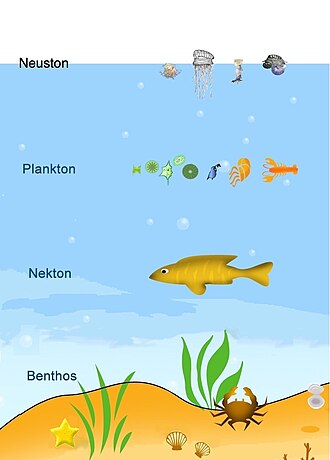
Key Facts
- Species Diversity: There are over one million benthic animal species, far exceeding the number of pelagic (open water) species.
- Energy Sources: Shallow systems rely on sunlight, while deep-sea systems depend on marine snow (drifting organic matter) or chemosynthesis.
- Pressure Adaptation: Benthic organisms in deep water are adapted to extreme pressure, which increases by approximately one atmosphere every 10 meters.
- Habitat Variety: Benthic environments range from soft mud and sand to hard rocky substrates and hydrothermal vents.
Energy and Survival in the Benthic Zone
Energy availability varies drastically by depth. In shallow waters, sunlight fuels photosynthesis, supporting a lush array of life. However, as light is absorbed by the water column, deep-sea ecosystems must rely on alternative energy sources. Most deep-benthic organisms are scavengers or detritivores that feed on marine snow—a continuous shower of dead and decaying organic matter drifting down from the surface.
In some extreme environments, such as hydrothermal vents, microorganisms utilize chemosynthesis to produce biomass without any sunlight. Survival in these depths also requires specialized physiological adaptations to withstand immense hydrostatic pressure; consequently, many deep-sea species cannot survive if moved to the upper water column.
Classifying Benthic Organisms
Scientists categorize the benthos based on size, trophic type, and where exactly they live within the sediment.
Classification by Size
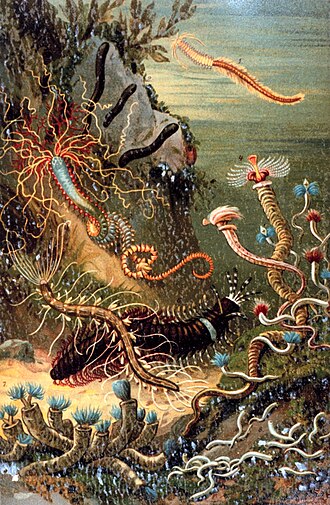
- Macrobenthos: Organisms larger than 1 mm, visible to the naked eye. Examples include crabs, lobsters, corals, sponges, and polychaete worms.
- Meiobenthos: Tiny organisms between 0.1 mm and 1 mm, such as nematodes, tardigrades, and copepods.
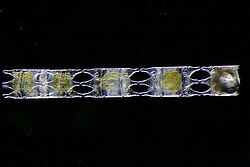
- Microbenthos: Microscopic organisms smaller than 0.1 mm, including bacteria, ciliates, and benthic diatoms.
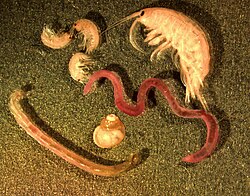
Classification by Location and Trophic Type
Benthic life is further divided by its relationship to the seafloor:
- Epibenthos (Epifauna): Organisms living on the surface of the sediment, such as sea snails or sea cucumbers.
- Endobenthos (Infauna): Organisms that burrow into the sediment, such as sand dollars or sea pens.
- Hyperbenthos: Organisms that live just above the sediment, such as rock cod.
Trophically, the benthos is split into Zoobenthos (animals like starfish and anemones) and Phytobenthos (plants and algae, primarily macroalgae and benthic diatoms).
Benthic Habitats and Geomorphology
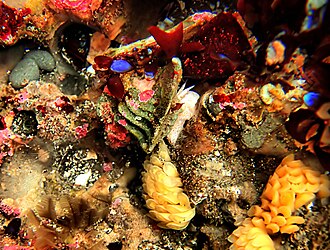
The physical structure of the seafloor—its geomorphology—directly influences the types of communities that thrive there. Soft sediments like mud and clay provide protection for burrowing animals, while hard rocky substrates allow sessile species, such as oysters and barnacles, to attach themselves securely.
Habitats are often zoned by depth:
- Epipelagic: Less than 200 meters.
- Mesopelagic: 200 to 1,000 meters.
- Bathyal: 1,000 to 4,000 meters.
- Abyssal: 4,000 to 6,000 meters.
- Hadal: Below 6,000 meters.
Specialized environments include seamounts, which often host cold-water coral communities, and hydrothermal vents, which support unique microbial ecosystems. In coastal areas, tide pools create a demanding environment where organisms like mussels and sea stars must survive fluctuating salinity, temperature, and exposure to the sun.
Scientific Importance of Benthic Life
Benthic organisms are invaluable for climate research. The shells of benthic foraminifera and diatoms sink to the seafloor after death, acting as climate proxies. By analyzing the chemical composition and stable oxygen isotope ratios in these shells, researchers can infer past ocean temperatures and chemical conditions. For example, deep-sea benthic forams provided critical data to build a detailed climate record of Earth following the mass extinction event 66 million years ago.
Some benthic life exhibits extraordinary longevity. Certain endoliths (organisms living inside rock) in the ocean floor are estimated to be millions of years old, with generation times spanning 10,000 years.
| Category | Sub-type | Size/Location | Examples |
|---|---|---|---|
| By Size | Macrobenthos | > 1 mm | Crabs, Corals, Sponges |
| Meiobenthos | 0.1 mm to 1 mm | Nematodes, Tardigrades | |
| Microbenthos | < 0.1 mm | Bacteria, Diatoms | |
| By Location | Epibenthos | On the surface | Sea snails, Sea cucumbers |
| Endobenthos | Burrowed in | Sand dollars, Sea pens | |
| Hyperbenthos | Just above surface | Rock cod |
Frequently Asked Questions
What is the difference between benthos and plankton?
Benthos are organisms that live on or in the bottom of a body of water, whereas plankton are organisms that drift with the water currents in the open water column.
How do deep-sea benthic organisms get energy without sunlight?
They primarily rely on marine snow, which is organic matter that drifts down from the surface. Some also use chemosynthesis, a process of producing biomass using chemical energy instead of light.
Why is there more species diversity in the benthic zone than the pelagic zone?
The benthic zone offers a much wider variety of physical habitats, including different sediment types (mud, sand, rock) and diverse geomorphic settings, which allows more specialized species to evolve.
How do scientists study the benthos in the deepest parts of the ocean?
Because of the extreme pressure and depth, most observations are conducted using Remotely Operated Vehicles (ROVs) or, more rarely, crewed submersibles.
What are climate proxies in the context of the benthos?
Climate proxies are physical or chemical markers, such as the shells of benthic foraminifera, that allow scientists to reconstruct past environmental conditions, like water temperature, based on their chemical composition.