Benthic Zone: The Complex Ecosystem of the Ocean Floor
The benthic zone—derived from the Ancient Greek word bénthos, meaning "the depths of the ocean"—is the ecological region located at the lowest level of any body of water. Whether in a small stream, a vast lake, or the depths of the global ocean, this zone encompasses the sediment surface and the layers immediately beneath it.
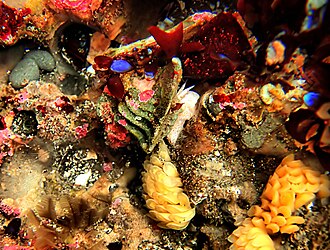
Organisms that inhabit this region are known as benthos, or more informally, bottom dwellers. These creatures range from microscopic bacteria and fungi to larger invertebrates like crustaceans and polychaetes. Most benthos maintain a close relationship with the substrate, and many are permanently attached to the bottom. A critical component of this environment is the benthic boundary layer, which consists of the bottom layer of water and the uppermost sediment layer; this interface is where much of the region's biological activity is concentrated.
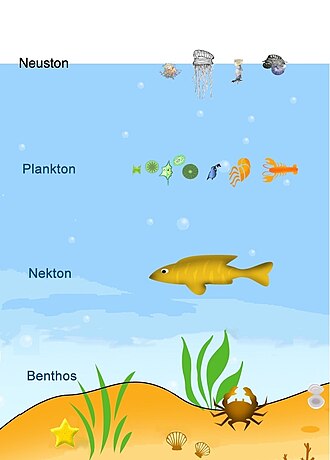
Key Facts
- Species Diversity: Benthic animal species exceed one million, far surpassing the number of pelagic (open water) species.
- Habitat Range: Spans from shallow tide pools to the hadal zone, which exists below 6,000 meters.
- Food Source: Deep-sea communities rely heavily on "marine snow," a descent of organic detritus from the upper water columns.
- Biomass: In the deep sea, which covers 90–95% of the ocean floor, prokaryotes make up 90% of the total biomass.
- Substrates: Habitats vary from soft mud, clay, and sand to hard rocky outcrops and coral reefs.
Physical Structure of the Benthic Zone
Oceanic Topography
In the ocean, the benthic zone is categorized by its geological features and depth. The continental shelf is the shallow region extending from the shoreline. At approximately 200 meters deep, the gradient steepens into the continental slope, which eventually leads to the abyssal plain—the vast, flat areas of the deep-sea floor typically found at 4,000 meters.
The ocean floor is not entirely uniform; it is punctuated by submarine ridges, seamounts, and the deepest ocean trenches, known as the hadal zone. This contrasts with the pelagic zone, which refers to the entire water column above the benthos.
Diverse Habitats and Biodiversity
Unlike the relatively featureless pelagic zone, the benthic zone offers a wide array of physical habitats. Variations in light, warmth, and water depth create distinct niches. Burrowing animals find food and shelter in soft sediments like mud and sand, while sessile species (organisms fixed in one place), such as barnacles and oysters, anchor themselves to rocky substrates.
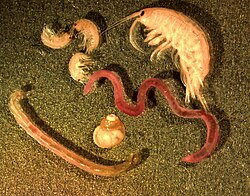
This environmental diversity supports an immense variety of life. While there are only about 22,000 pelagic fish species and 110 marine mammal species, the benthic zone hosts over a million animal species.
Classifying Benthos
Benthic organisms are categorized by size, trophic level, and their location relative to the sediment.
Classification by Size
- Macrobenthos: Larger organisms visible to the naked eye.
- Meiobenthos: Tiny animals, such as gastrotrichs (0.06–3.0 mm), that live between sediment particles.
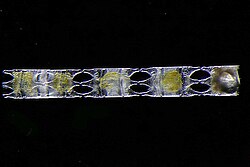
- Microbenthos: Microscopic organisms, including benthic foraminifera.
Classification by Trophic Level and Location
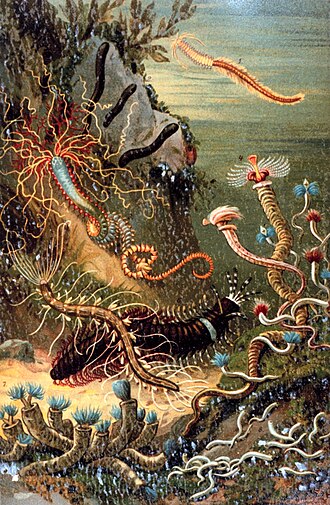
Benthos are divided into zoobenthos (animal-based) and phytobenthos (plant/algae-based). Based on their position, they are further classified as endobenthos (living inside the sediment), epibenthos (living on the surface), or hyperbenthos (living just above the sediment).
Depth Zoning
In oceanic environments, habitats are zoned by depth:
- Epipelagic: Less than 200 meters.
- Mesopelagic: 200–1,000 meters.
- Bathyal: 1,000–4,000 meters.
- Abyssal: 4,000–6,000 meters.
- Hadal: Below 6,000 meters.
Ecological Roles and Nutrient Flux
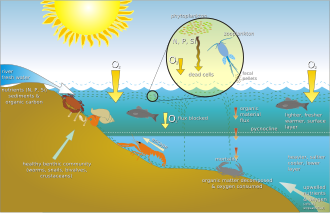
Food in the benthic zone primarily arrives from the water column above as marine snow—aggregations of detritus, inorganic matter, and living organisms. On average, 307,000 aggregates per square meter may sink daily, though this varies by depth and the degree of benthic-pelagic coupling (the exchange of energy and nutrients between the bottom and the open water).
In the deep sea, microbes such as dinoflagellates and foraminifera rapidly colonize this detritus. Because prokaryotes dominate the biomass here, viruses play a vital role in breaking down these microbes to release locked nutrients back into the environment.
![Abiotic and biotic responses to a territory-wide trawl ban in Hong Kong waters. Abiotic responses: (1) lower bottom water suspended-solid loads, (2) higher sedimentary organic contents; and biotic responses include: (3) higher site-based abundance, species richness, functional diversity, niche occupancy and among-site similarity of macrobenthos.[68]](/images/38/10/3810b0c435047e988a1afbecd6b3564e8c78fc9a3ed80e402e701368e5a965f7.png)
Summary of Benthic Zones
| Zone | Depth Range | Key Characteristics |
|---|---|---|
| Epipelagic | < 200m | Shallow, high light, high food availability |
| Mesopelagic | 200m – 1,000m | Twilight zone, decreasing light |
| Bathyal | 1,000m – 4,000m | Continental slope, aphotic (no light) |
| Abyssal | 4,000m – 6,000m | Flat abyssal plains, high prokaryote biomass |
| Hadal | > 6,000m | Deepest ocean trenches |
Frequently Asked Questions
What is the difference between benthos and plankton?
Benthos are organisms that live on or in the bottom sediment of a body of water, whereas plankton are organisms that drift with the water currents in the pelagic zone.
What is marine snow?
Marine snow consists of falling aggregates of detritus, inorganic matter, and dead organisms that sink from the upper layers of the ocean to provide essential nutrients for benthic communities.
Why is there more biodiversity in the benthic zone than the pelagic zone?
The benthic zone offers a much wider variety of physical habitats, including different sediment types (mud, sand, rock) and complex structures like coral reefs, which create more ecological niches for species to evolve.
What is the hadal zone?
The hadal zone is the deepest part of the ocean, consisting of deep ocean trenches that extend below 6,000 meters.
What role do viruses play in the deep-sea benthos?
Since 90% of the biomass in the deep sea consists of prokaryotes, viruses are essential for lysing these microbes, which releases nutrients back into the ecosystem for other organisms to use.