The Genus Pecten: Exploring the History and Diversity of Scallops
When people think of the ocean's most iconic shells, the fan-shaped scallop often comes to mind. In the scientific world, these marine bivalve molluscs—animals with a shell composed of two hinged parts—belong to the genus Pecten. As the type genus of the family Pectinidae, Pecten serves as the foundational reference for the broader group of scallops.
Etymology and Cultural Significance
The name Pecten is derived from the Latin word for a "comb" or "rake," a reference to the characteristic ribbed texture of the shell. This distinct aesthetic has not only fascinated biologists but also corporate branding; since 1904, a Pecten shell has served as the basis for the logo of the Shell energy company.
Biological Classification
To understand where Pecten fits into the natural world, it is helpful to look at its taxonomic hierarchy. This classification system organizes living things into increasingly specific groups based on shared characteristics.
- Kingdom: Animalia
- Phylum: Mollusca
- Class: Bivalvia
- Order: Pectinida
- Family: Pectinidae
- Genus: Pecten (O. F. Müller, 1776)
The type species—the species used to formally define the genus—is Pecten maximus, first described by Linnaeus in 1758.
Evolutionary Timeline and Species Diversity
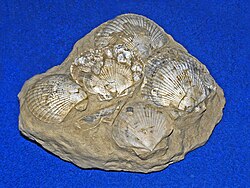
The genus Pecten has a vast temporal range, appearing in the fossil record as far back as the Cretaceous period and continuing into the Recent (modern) era. This longevity indicates a highly successful evolutionary design capable of adapting to various marine environments over millions of years.
The diversity within the genus is immense, spanning numerous extant (currently living) and extinct species. Living species include Pecten maximus, Pecten jacobaeus, and Pecten novaezelandiae. However, the fossil record reveals an even larger number of extinct species, such as Pecten alessii, Pecten barretti, and Pecten nigromagnus.
Throughout scientific history, various other names have been used to describe these organisms. Synonyms—different scientific names applied to the same taxon—include Argus, Vola, and Chlamys. These shifts in nomenclature reflect the ongoing refinement of biological classification as new evidence emerges.
Key Facts
- Common Name: Large scallops or saltwater clams.
- Temporal Range: From the Cretaceous period to the present day.
- Type Species: Pecten maximus.
- Meaning: The name comes from the Latin word for "comb" or "rake."
- Corporate Link: The genus is the inspiration for the Shell energy company logo.
- Classification: It is the type genus of the family Pectinidae.
Summary of Pecten Classification
| Rank | Classification |
|---|---|
| Kingdom | Animalia |
| Phylum | Mollusca |
| Class | Bivalvia |
| Order | Pectinida |
| Family | Pectinidae |
| Genus | Pecten |
| Temporal Range | Cretaceous – Recent |
Frequently Asked Questions
What is the type species of the genus Pecten?
The type species is Pecten maximus, which was designated by Linnaeus in 1758.
How long has the genus Pecten existed?
The genus has a temporal range extending from the Cretaceous period to the present day (Recent).
What does the word "Pecten" mean?
Pecten is the Latin word for a comb or a rake, referring to the ribbed appearance of the scallop's shell.
Is Pecten still found in the wild today?
Yes, while there are many extinct species, there are numerous extant species still living in marine environments, such as Pecten jacobaeus and Pecten raoulensis.
Which famous company uses a Pecten shell in its logo?
The Shell energy company has used a Pecten shell as the basis for its logo since 1904.