Bass Clarinet: History, Musical Range, and Evolution
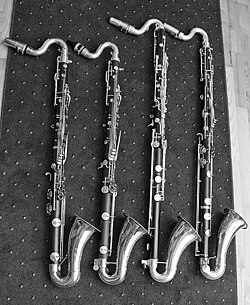
The bass clarinet is a versatile woodwind instrument known for its rich, dark timbre and expansive range. As a single-reed aerophone—an instrument that produces sound via a vibrating reed—it serves as the deeper voice of the clarinet family. While it has been a staple of orchestral and concert band scoring since the mid-19th century, its role has expanded from a supporting orchestral color to a powerful solo instrument in classical, jazz, and contemporary music.
Modern bass clarinets, such as the Buffet Crampon Prestige 1193 and Yamaha YCL 622 II, typically feature a range extending down to low C or low E℃. This depth allows the instrument to bridge the gap between the soprano clarinets and the contrabass instruments, providing a somber, powerful foundation to an ensemble's sound.
Key Facts
- Classification: Single-reed woodwind (Hornbostel–Sachs 422.211.2–71).
- Standard Range: Typically reaches down to low C or low E℃.
- Primary Use: Essential in concert bands; common in orchestras, jazz, and film scores.
- Key Pioneers: Josef Horák is credited with the first solo bass clarinet recital in 1955.
- Tuning: Most modern instruments are in Bℑ, though historical instruments in A were used by composers like Wagner and Mahler.
Historical Evolution
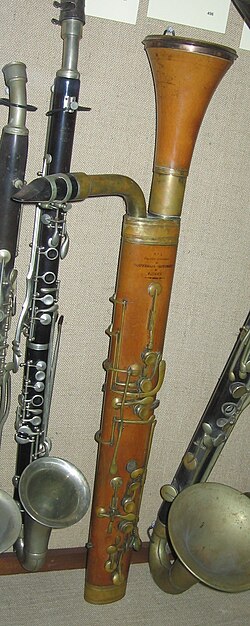
The origins of the bass clarinet are marked by various experimental designs. Early records mention a "basse-tube" invented by G. Lott in Paris in 1772, though some historians suggest this may have been a basset horn. By 1793, Heinrich Grenser developed the Klarinetten-Bass, which featured a folded shape similar to a bassoon to make the instrument more manageable for military bands.
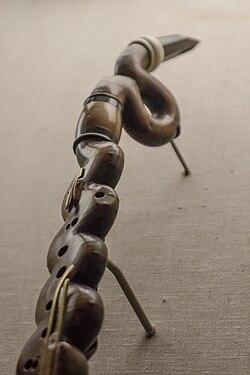
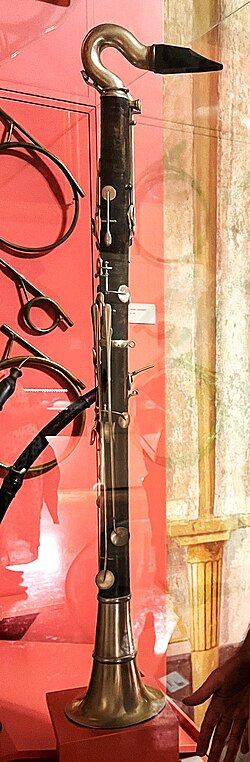
Throughout the early 19th century, makers experimented with diverse forms. Nicola Papalini created a serpentine design around 1810, while Catterino Catterini introduced the "glicibarifono" in the 1830s. It wasn't until 1832 that Isaac Dacosta and Auguste Buffet produced a straight-bodied instrument without an extended range, paving the way for the modern silhouette.
The instrument's design continued to evolve, with Adolphe Sax contributing his own version of the Bℑ bass clarinet, further refining the keywork and intonation.
The Bass Clarinet in Classical Music
The bass clarinet's integration into the orchestra was driven by Romantic-era composers who sought to exploit its melancholy and dark tones. Richard Wagner was instrumental in making the bass clarinet a permanent member of the opera orchestra, using it extensively in Tannhäuser, Tristan und Isolde, and Parsifal.
Other notable composers who utilized the instrument include:
- Hector Berlioz: One of the first Romantics to use it in large-scale works like Les Troyens.
- Pyotr Ilyich Tchaikovsky: Wrote prominent solos for the instrument in The Nutcracker.
- Gustav Mahler: Featured the instrument prominently in all his symphonies, particularly Symphony No. 6.
- Richard Strauss: Often pushed the instrument into its high registers, as seen in Also Sprach Zarathustra.
In the 20th century, the Second Viennese School (Schoenberg, Webern, and Berg) often preferred the bass clarinet over the bassoon. Modern composers like Dmitri Shostakovich and Sergei Prokofiev utilized the low concert C and Bℑ to create powerful, dark textures in their symphonies.
Jazz, Rock, and Contemporary Applications
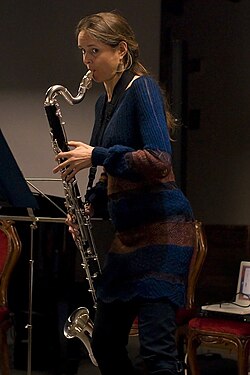
In the realm of jazz, the bass clarinet was initially rare but found a champion in Harry Carney, Duke Ellington's long-time baritone saxophonist. However, it was avant-garde musician Eric Dolphy who truly revolutionized the instrument, establishing a technical vocabulary that utilized the instrument's entire range.
The instrument has also made surprising appearances in rock and pop music. George Martin scored a prominent bass clarinet ostinato for The Beatles' "It's All Too Much," and the instrument appears on Captain Beefheart's Trout Mask Replica and Paramore's 2023 album This Is Why.
Technical Specifications and Notation
Most orchestral music for the bass clarinet is written for the Bℑ instrument. Historically, instruments in A were used, particularly by Wagner and Mahler. While Selmer produced Boehm system bass clarinets in A during the 1970s, they were expensive and heavy, leading most modern players to use a Bℑ instrument and transpose the music down a semitone.
| Feature | Details |
|---|---|
| Family | Clarinet (Woodwind) |
| Reed Type | Single Reed |
| Common Pitch | Bℑ (Historically A) |
| Typical Range | Low C to high registers |
| Key Materials | Grenadilla wood, Boxwood, or Metal |
Frequently Asked Questions
What is the difference between a bass clarinet and a regular clarinet?
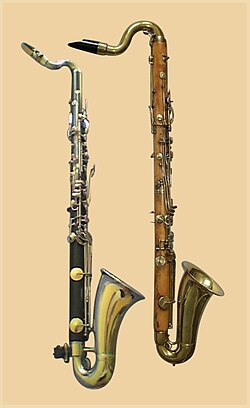
The bass clarinet is larger, pitched an octave lower than the soprano clarinet, and typically features a curved metal neck (bocal) and a larger bell to project its deeper frequencies.
Who was the first person to perform a solo bass clarinet recital?
Czech performer Josef Horák is credited with performing the first-ever solo bass clarinet recital on March 23, 1955, helping establish the instrument as a solo vehicle.
Why are there bass clarinets in A and Bℑ?
Instruments in A were common in the 19th century for specific orchestral colors. However, due to the weight and cost of carrying two instruments, most modern musicians use the Bℑ version and transpose A parts.
Which jazz musician is most famous for the bass clarinet?
While Harry Carney was a pioneer in the Ellington orchestra, Eric Dolphy is regarded as the most influential jazz soloist on the instrument, expanding its technical and harmonic possibilities.
Is the bass clarinet used in modern popular music?
Yes, it has been used by artists ranging from The Beatles and Steely Dan to contemporary bands like Paramore, often to add a unique, "inky" or dark texture to the arrangement.