Ban Ki-moon: A Legacy of Global Diplomacy and UN Leadership
Ban Ki-moon is a distinguished South Korean diplomat who served as the 8th Secretary-General of the United Nations from January 1, 2007, to December 31, 2016. Throughout his decade-long tenure, he navigated some of the most complex geopolitical challenges of the 21st century, focusing heavily on environmental sustainability, human rights, and international peace.
Before ascending to the world's most prominent diplomatic role, Ban established a rigorous academic and professional foundation. He earned a Bachelor of Arts from Seoul National University and a Master of Public Administration (MPA) from Harvard University. His rise through the ranks of South Korean governance culminated in his appointment as the Minister of Foreign Affairs and Trade from 2004 to 2006 under President Roh Moo-hyun.
Key Facts
- Role: 8th Secretary-General of the United Nations (2007–2016).
- Nationality: South Korean.
- Education: Seoul National University (BA) and Harvard University (MPA).
- Prior Office: Minister of Foreign Affairs and Trade of South Korea (2004–2006).
- Major Focus: Global warming, humanitarian action, and UN reform.
- Succession: Preceded by Kofi Annan and succeeded by António Guterres.
The Path to the United Nations
Ban Ki-moon's campaign for the position of Secretary-General in 2006 was a competitive process. He faced candidates from various nations, including Shashi Tharoor of India, Vaira Vīķe-Freiberga of Latvia, and Ashraf Ghani of Afghanistan. Ban eventually emerged victorious, taking office on New Year's Day 2007.
First Term: Foundations and Reform
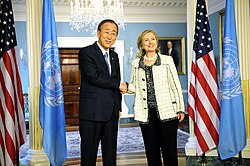
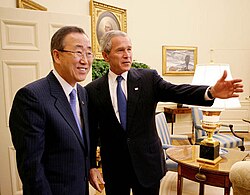
During his first term, Ban focused on a comprehensive reform agenda to modernize the UN's operations. He prioritized global warming, identifying climate change as a critical threat to international security and human survival. His early meetings with world leaders, including U.S. President George W. Bush, emphasized the urgency of confronting environmental degradation.
Beyond the environment, his first term was marked by efforts to manage volatile conflicts in the Middle East, the crisis in Darfur, and the political instability in Myanmar.
Second Term: Expanding the Global Agenda
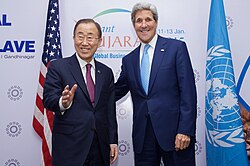
After being unanimously re-elected in 2011, Ban's second term saw an expansion of his humanitarian and social focus. He became a vocal advocate for LGBT rights, stating that the time had come to protect these individuals from violence and discrimination.
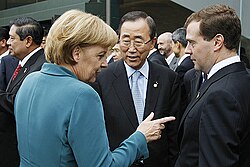
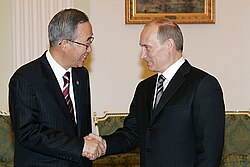
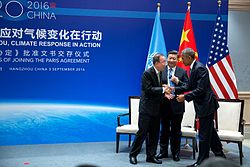
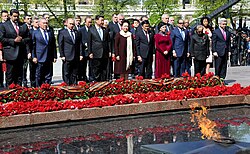
His second term was also defined by the Syrian conflict and the crisis in Ukraine, where he sought to mediate peace and provide humanitarian aid. He worked closely with global leaders, including U.S. Presidents Barack Obama and George W. Bush, as well as Chinese President Xi Jinping and Russian leaders, to maintain international stability.
Humanitarian Action and Global Outreach
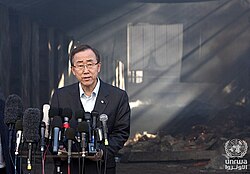
Ban's commitment to humanitarianism took him to some of the world's most distressed regions, including visits to Gaza in 2009 to assess the humanitarian situation. He consistently pushed for a gap to be closed between the world as it is and the world as it should be.
Post-UN Career and Personal Life
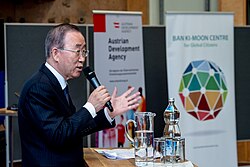
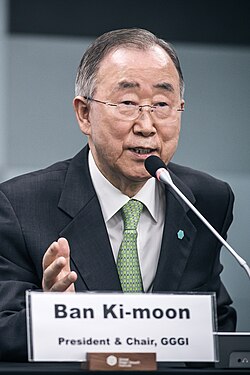
Following his departure from the UN in 2016, Ban remained active in global affairs. He joined The Elders, a group of former world leaders promoting peace, and became the President and Chair of the Global Green Growth Institute (GGGI). He also founded the Ban Ki-moon Centre for Global Citizens to inspire a new generation of leadership.
While there was significant speculation regarding a 2017 presidential candidacy in South Korea, Ban ultimately dropped his bid. In his personal life, he has been married to Yoo Soon-taek since 1971, and they have three children.
Summary of Career and Honors
| Period/Category | Detail |
|---|---|
| Minister of Foreign Affairs | 2004 – 2006 (South Korea) |
| UN Secretary-General | 2007 – 2016 |
| Key Global Focus | Climate Change, LGBT Rights, Syrian Conflict |
| Notable Awards | Order of Service Merit (South Korea), Order of Friendship (Russia) |
| Academic Honors | Honorary Doctorates from Cambridge, Columbia, and others |
Frequently Asked Questions
Who succeeded Ban Ki-moon as UN Secretary-General?
Ban Ki-moon was succeeded by António Guterres, who took office on January 1, 2017.
What were the primary focuses of Ban Ki-moon's UN tenure?
His primary focuses included combating global warming, promoting LGBT rights, managing conflicts in Syria and Ukraine, and implementing UN internal reforms.
Did Ban Ki-moon run for President of South Korea?
Although there was widespread speculation and initial intent to run for the presidency in 2017, he eventually dropped his bid.
What is the Ban Ki-moon Centre for Global Citizens?
It is an organization founded by Ban after his UN tenure to foster global citizenship and empower a new generation to solve global challenges.
Which academic institutions granted him honorary degrees?
He received numerous honorary doctorates, including those from the University of Cambridge, Columbia University, the University of Washington, and Seoul National University, among others.