Baden: The Post-War State of South Baden (1945–1952)
Following the conclusion of World War II, the geopolitical landscape of Germany underwent a radical transformation. Among the most unique developments was the creation of South Baden (German: Südbaden), a short-lived but significant state established within the French-administered zone of post-war Germany. From its inception in 1945 to its eventual merger in 1952, this region navigated the complexities of military occupation and the birth of the Federal Republic of Germany.
Key Facts
- Established: December 1, 1945, as South Baden.
- Capital: Freiburg im Breisgau.
- Status: Founding state of the Federal Republic of Germany (West Germany) in 1949.
- Population (1950): 1,399,000.
- Area (1950): 6,646 km².
- Successor: Merged into Baden-Württemberg on April 25, 1952.
The Formation of South Baden
The origins of the state trace back to the 1945 Yalta Conference, where France was allocated an occupation zone to administer post-war Germany. The southwestern region—previously comprising Baden, Württemberg, and the Prussian province of Hohenzollern—was split between French and American administration. To ensure the Autobahn connecting Karlsruhe and Munich (the current A8) remained entirely within the American zone, the borders were drawn specifically, leaving the southern half of Baden to the French.
On December 1, 1945, this southern territory was established as South Baden. Because the traditional capital, Karlsruhe, fell within the American zone, Freiburg im Breisgau was designated as the new capital.
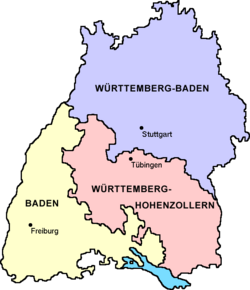
Constitutional Identity and Renaming
In an effort to establish legitimacy, a constitution was enacted on May 19, 1947. The preamble claimed the state was the true successor to the old Republic of Baden, despite the fact that much of its territory had only been part of Baden for 150 years. To solidify this identity, the state adopted the pre-war Baden flag and coat of arms and officially changed its name from "South Baden" to simply Baden.
Political Evolution and Governance
Initially, the region was governed directly by the French military administration. This changed following the December 1946 local elections, where the Badische Christlich-Soziale Volkspartei (BCSV) emerged as the dominant force. Its leader, Leo Wohleb, was appointed president of the state secretariat.
By April 1947, the BCSV aligned with the federal Christian Democratic Union (CDU), becoming CDU Baden. In the state elections of July 24, 1947, the CDU won an absolute majority of 55.9%, while the Social Democratic Party (SPB) followed with 22.4%.
Despite the CDU's majority, the French military administration retained significant executive powers, preventing a single-party government. After failed attempts to form an all-party coalition—largely due to disputes over the inclusion of the Communist party (KPD)—a grand coalition between the CDU and SPB was formed, with Leo Wohleb serving as minister-president. Once the Federal Republic of Germany was formed in 1949 and French administration ended, Wohleb led a CDU-only government until 1952.
The Path to Disestablishment
As military rule ended, the Western powers urged state leaders to finalize borders. A debate emerged: should Baden and Württemberg be restored as separate entities, or merged into a single state? Leo Wohleb strongly opposed any merger.
A straw poll in 1950 and a formal referendum on December 9, 1951, highlighted a regional divide. While the majority in South Baden voted against the merger in favor of restoring the old state of Baden, they were outnumbered by voters in North Baden and the more populous Württemberg. Consequently, on April 25, 1952, the three south-western states merged to form the modern state of Baden-Württemberg.
Legal Challenges and the 1970 Vote
The merger was not without controversy. Legal challenges reached the Federal Constitutional Court of Germany. While a 1951 nullification attempt ended in a draw, the court ruled in 1956 that the referendum in Baden should be repeated because the majority had not accepted it.
The Baden-Württemberg government delayed this repeat vote for 14 years. When the referendum finally took place in 1970, the political climate had shifted; 81% of voters in the former South Baden region voted in favor of maintaining the status quo.
Summary of State Profile (1950)
| Attribute | Detail |
|---|---|
| Capital | Freiburg im Breisgau |
| Area | 6,646 km² |
| Population | 1,399,000 |
| Primary Political Party | CDU Baden (led by Leo Wohleb) |
| Final Status | Merged into Baden-Württemberg |
Frequently Asked Questions
Why was South Baden created separately from North Baden?
The division was a result of the post-WWII occupation zones. The southern part of Baden fell under French administration, while the northern part was placed under American administration to ensure the A8 Autobahn remained within the American zone.
Who was the primary political leader of Baden during this era?
Leo Wohleb was the central figure, serving as the president of the state secretariat and later as the minister-president, leading the CDU Baden.
Did the people of South Baden want to merge into Baden-Württemberg?
Initially, the majority in South Baden opposed the merger in the 1951 referendum. However, by the time a repeat vote was held in 1970, 81% of the population supported the merger.
What happened to the capital city of the original Republic of Baden?
The original capital, Karlsruhe, was located in the American occupation zone, which is why Freiburg im Breisgau was designated as the capital for the French-administered state of South Baden.
When did Baden officially become part of West Germany?
Baden became a founding state of the Federal Republic of Germany (West Germany) on May 23, 1949, after its parliament voted in favor of the Basic Law.