Bad Arolsen: A Historic Gem of Northern Hesse
Nestled in the Waldeck-Frankenberg district of northern Hesse, Bad Arolsen is a town where Baroque elegance meets profound historical significance. Formerly the residence of the Princes of Waldeck-Pyrmont and later the capital of the Waldeck Free State, this town is more than just a scenic destination; it is a site of international remembrance and architectural beauty.
The town's name reflects its status as a climatic spa, with "Bad" being the German term for spa. Today, it serves as a bridge between the aristocratic past of Germany and the global effort to document the tragedies of the 20th century.
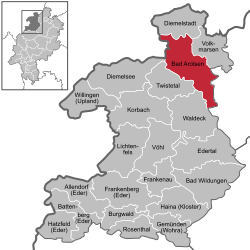
Key Facts
- Location: Northern Hesse, Germany, approximately 45 km west of Kassel.
- Population: 16,050 (as of December 31, 2024).
- Historical Status: Residence town of the Princes of Waldeck-Pyrmont (1655–1918).
- Global Significance: Headquarters of the International Tracing Service (ITS).
- Key Landmark: The Baroque Schloss Arolsen.
Geography and Administration
Bad Arolsen is situated in the state of Hesse within the Kassel administrative region. It covers a total area of 126.47 km² and sits at an elevation of 286 meters. The town is a key stop on the Orange Route, a German-Dutch holiday road that connects regions associated with the House of Orange.
The municipality is composed of a main district with 8,300 inhabitants and several constituent subdivisions, including Mengeringhausen (the largest at 3,746 residents), Helsen, Landau, and Wetterburg, among others.
A Journey Through History
The origins of the town date back to 1131 with the establishment of an Augustinian nunnery called "Aroldessen." By 1655, the site became the residence of the Counts (later Princes) of Waldeck. The current architectural identity of the town was largely shaped between 1713 and 1728 when Prince Friedrich Anton Ulrich replaced the earlier residence with a grand Baroque structure.
The 20th century brought darker chapters. Between 1943 and 1945, the Nazis operated a subcamp of the Buchenwald concentration camp in Arolsen, housing 185 prisoners primarily from German-occupied Poland, Russia, and Germany. Following World War II, the town was part of the American-occupied zone before integrating into West Germany.
Culture and Architectural Highlights
Bad Arolsen is renowned for its Baroque layout. The town center features a chequered street grid, a hallmark of the era's urban planning. While the original plan intended for a mirrored layout on both sides of the palace, only the western side was fully completed due to funding constraints; the eastern side was instead developed into a lush landscape of trees and bushes.
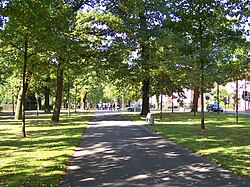
One of the town's most striking features is the Grosse Allee (Grand Avenue). This one-mile broad avenue is lined with approximately 880 German oak trees in a six-line arrangement. Built in 1676, it originally served as a prestigious carriage route between the Residenzschloss and the now-demolished Lustschloss.
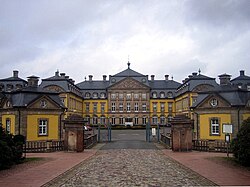
Schloss Arolsen
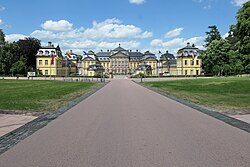
The centerpiece of the town is Schloss Arolsen, a Baroque palace built between 1713 and 1728 by architect Julius Ludwig Rothweil. The palace is celebrated for its stunning stucco work by Andrea Gallasini and ceiling paintings by Italian artist Carlo Ludovici Castelli.
Other Notable Sites
- Landauer Wasserkunst: A historic waterworks in the Landau district dating back to 1555.
- Kirchplatz: The central square and site of the annual Christmas fair.
The International Tracing Service (ITS)
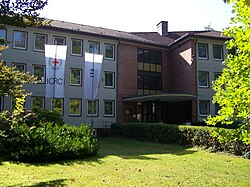
Since 1946, Bad Arolsen has hosted the International Tracing Service, an organization dedicated to locating civilians missing as a result of World War II and political unrest. Originally administered by the International Committee of the Red Cross and now by the Federal Republic of Germany, the ITS is one of the world's most important archives for Holocaust research.
The archive contains 47 million pages of Nazi-related documents. In a major move toward transparency, the archives were fully opened to the public in November 2007, with over 12 million documents digitally scanned and shared with global research institutions.
Town Profile Summary
| Category | Details |
|---|---|
| State / District | Hesse / Waldeck-Frankenberg |
| Population (2024) | 16,050 |
| Total Area | 126.47 km² |
| Key Industry/Role | Tourism, History, and International Archives |
| Notable Citizen | Otto von Bismarck (Honorary Citizen) |
Frequently Asked Questions
What is the International Tracing Service?
The International Tracing Service (ITS) is a global archive based in Bad Arolsen that helps find missing civilians from World War II and preserves millions of documents related to the Nazi regime's persecution of people, particularly the Jewish community.
What is the significance of the Grosse Allee?
The Grosse Allee is a historic one-mile avenue planted with 880 German oak trees. It was built in 1676 as a prestigious connecting route for carriages between the princely residences.
Who was the most famous honorary citizen of Bad Arolsen?
Otto von Bismarck, the former Chancellor of the German Empire from 1871 to 1890, is an honorary citizen of the town.
What are the main annual events in Bad Arolsen?
Key events include the Arolser Barockfestspiele (Baroque festival) in May, the Kram- und Viehmarkt (fair and cattle market) in August, and the traditional Christmas market at Kirchplatz in December.
What is the meaning of the town's coat of arms?
The coat of arms features a nine-leaved oak tree representing the surrounding woods and fresh air of the spa town, an inescutcheon with the letter "A" for Arolsen, and an eight-pointed star representing Waldeck.