Principality of Waldeck and Pyrmont
The Principality of Waldeck and Pyrmont was a sovereign state in Germany that evolved over several centuries, transitioning from a medieval county into a principality and eventually a free state. Its history is a complex tapestry of dynastic unions, territorial acquisitions, and political transformations that mirrored the broader shifts of the Holy Roman Empire and the subsequent German Empire.
The state's origins trace back to the County of Waldeck, established around 1107. Over the centuries, the ruling house expanded its influence through strategic marriages and inheritance, incorporating various territories including the County of Pyrmont, the County of Schwalenberg, and the County of Sternberg.
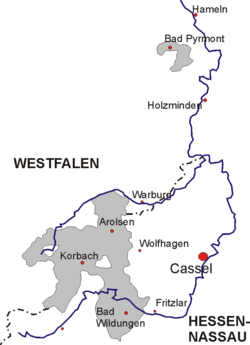
Key Facts
- Timeline: Existed in various forms from 1107 (as a county) until 1918 (as a principality).
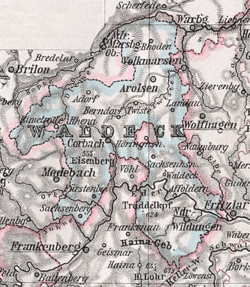
- Capital: Waldeck served as the center until 1655, after which the capital moved to Arolsen.
- Political Evolution: Progressed from the County of Waldeck to the Principality of Waldeck (1712), then the Principality of Waldeck-Pyrmont (1849), and finally the Free State of Waldeck-Pyrmont (1919–1929).
- Key Territories: Included the counties of Pyrmont, Schwalenberg, Sternberg, and Landau.
Territorial Evolution and Dynastic Growth
The early history of the region was defined by the County of Waldeck, founded by Widekind I. By the 13th century, the territory began to fragment and consolidate through various lines, such as the Waldeck-Schwalenberg and Waldeck-Eisenberg branches. The acquisition of the County of Pyrmont in 1494 marked a significant expansion of the house's holdings.
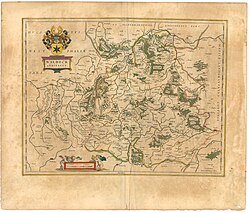
Throughout the 16th and 17th centuries, the state navigated the religious and political upheavals of Germany. The ruling family managed various sub-divisions, including the County of Wildungen and the County of Bergheim. A pivotal moment occurred in 1682 when the County of Eisenberg was raised to a principality, setting the stage for the broader elevation of the state's status.
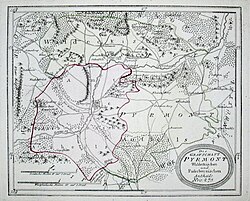
The Transition to a Principality
In January 1712, the state officially became the Principality of Waldeck. This elevation in rank provided the ruling house with greater prestige and political leverage within the imperial structure. The administration became more centralized, and the residence at Bad Arolsen became the focal point of government and court life.

Governance and Legal Framework
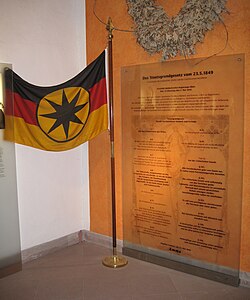
The 19th century brought significant legal reforms. In 1849, the state adopted a Fundamental Law, which served as a constitution to define the rights of citizens and the powers of the prince. This era saw the state officially renamed the Principality of Waldeck-Pyrmont.
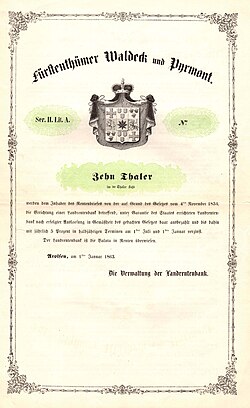
Financial stability was maintained through the issuance of government bonds, such as those issued on January 1, 1863, which helped fund the state's infrastructure and administration during a period of rapid European industrialization.
The End of the Monarchy
The collapse of the German Empire in 1918 led to the abdication of the last reigning prince, George Victor. Following the revolution, the territory transitioned into the Free State of Waldeck-Pyrmont in 1919. This republican phase lasted until 1929, when the state was integrated into the Prussian province of Hesse-Nassau.
Summary of State Evolution
| Period | Political Entity | Primary Status |
|---|---|---|
| 1107–1712 | County of Waldeck | Imperial County |
| 1712–1848 | Principality of Waldeck | Sovereign Principality |
| 1849–1918 | Principality of Waldeck-Pyrmont | Sovereign Principality |
| 1919–1929 | Free State of Waldeck-Pyrmont | Republic |
The cultural legacy of the principality remains visible today through its architecture, heraldry, and the historical records of the ruling house, including the distinct cockades worn on military headgear like the Pickelhaube.

Frequently Asked Questions
When did Waldeck become a principality?
Waldeck was raised to the status of a principality in January 1712.
Where was the capital of the state located?
The capital was originally Waldeck, but it was moved to Arolsen in 1655.
What happened to the state after 1918?
After the monarchy fell in 1918, it became the Free State of Waldeck-Pyrmont in 1919, before being absorbed into Prussia in 1929.
Which other counties were integrated into Waldeck?
The state incorporated several territories over time, including the counties of Pyrmont, Schwalenberg, Sternberg, and Landau.
What was the significance of the 1849 Fundamental Law?
The Fundamental Law of May 23, 1849, acted as a constitution for the Principality of Waldeck-Pyrmont, establishing a legal framework for governance and civil rights.