Art Deco: The Global Legacy of Modernist Luxury and Design
Emerging in the early 20th century, Art Deco represents one of the most influential design movements in history. Spanning roughly from the 1910s to the 1950s, this global style blended traditional craft motifs with Machine Age imagery and materials. It was not merely an architectural trend but a comprehensive aesthetic that permeated everything from the towering skyscrapers of New York City to the delicate facets of high-end jewelry.
At its core, Art Deco celebrated modernity, luxury, and the rapid technological progress of the interwar period. It transitioned from the organic, flowing lines of Art Nouveau toward a more disciplined, geometric approach, reflecting a world increasingly defined by speed, industry, and urban expansion.
Key Facts
- Active Period: Approximately 1910s to 1950s.
- Scope: A global movement affecting architecture, furniture, fashion, and graphic arts.
- Defining Characteristics: Geometric shapes, stepped motifs (ziggurats), streamlining, and the use of luxury materials.
- Major Milestone: The 1925 International Exhibition of Modern Decorative and Industrial Arts in Paris.
- Key Influences: Cubism, Futurism, and ancient civilizations including Mesopotamia and Sub-Saharan Africa.
Origins and Early Influences
Art Deco did not emerge in a vacuum; it was the result of a convergence of several avant-garde movements and historical inspirations. The Vienna Secession and the Wiener Werkstätte (1897–1912) laid the groundwork for a new decorative language, as seen in the Austrian Postal Savings Bank. Simultaneously, the Society of Decorative Artists and the Salon d'Automne in France provided platforms for designers like Émile-Jacques Ruhlmann to showcase early modernist furnishings.
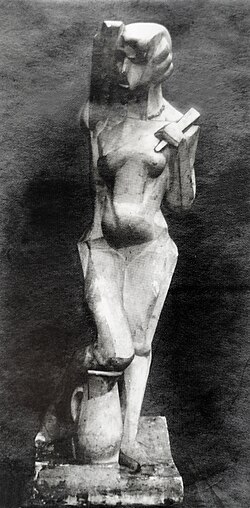
Cubism played a pivotal role, becoming a "lingua franca" for decorative artists. This is evident in the design of La Maison Cubiste (Cubist House) by Raymond Duchamp-Villon. Other influences included the exoticism of the Ballets Russes, the grandeur of Beaux Arts architecture, and the monumental forms of Mesopotamian art, such as the Ziggurat of Ur.
Architectural Grandeur and Urban Landscapes
Architecture is perhaps the most visible legacy of Art Deco. The style is characterized by verticality, symmetry, and bold ornamentation. In the United States, this reached its zenith with the Chrysler Building (1930), featuring its iconic stepped motif and angular entrance. In Europe, the movement manifested in diverse forms, from the streamlined facades of Paris to the modernist buildings of Bucharest.
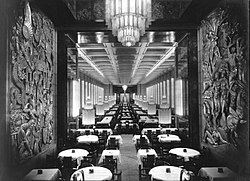
The movement also extended to the interiors of luxury transport. The SS Normandie ocean liner (1935) served as a floating showcase of Art Deco opulence, featuring grand dining rooms and intricate bas-reliefs by Raymond Delamarre.
Common Decorative Motifs
Art Deco designers utilized a specific vocabulary of shapes and symbols to convey modernity:
- Ziggurats: Stepped pyramids used in building tops and entrance halls.
- Streamlining: Smooth, aerodynamic curves inspired by aviation and locomotives.
- Geometric Patterns: Octagon-shaped medallions, vertical and horizontal mouldings, and asymmetric layouts.
- Nature Stylized: Highly abstracted representations of birds and flower baskets.
The Decorative Arts: Furniture, Fashion, and Glass
Beyond buildings, Art Deco redefined the domestic interior. Furniture designers like Ruhlmann and André Groult utilized exotic materials such as shagreen (sharkskin), ivory, and lacquered wood. The "Waterfall" style buffet table became a hallmark of later Art Deco furniture, emphasizing sleek, curving edges.
In fashion, the era saw a shift toward liberation and bold silhouettes. Coco Chanel's sailor blouses and the à la garçonne (boyish) hairstyle popularized by Louise Brooks epitomized the spirit of the 1920s. Jewelry became more architectural, utilizing platinum, onyx, and diamonds in geometric cuts such as the emerald cut (long step-cut facets) and the baguette cut (small rectangular shapes).
Glass art flourished through the work of René Lalique, who created everything from the Victoire hood ornament for automobiles to intricate parrot vases and molded glass pendants.
Industrial Design and the Machine Age
As the movement progressed, it embraced the efficiency of industrial production. This led to the rise of streamlining, where aerodynamic shapes were applied to non-aerodynamic objects to suggest speed and progress. Examples include the Chrysler Airflow sedan, the New York Central 20th Century Limited locomotive, and household appliances like Electrolux vacuum cleaners.

Summary of Art Deco Characteristics
| Category | Key Features | Notable Examples |
|---|---|---|
| Architecture | Verticality, Ziggurats, Symmetry | Chrysler Building, Rockefeller Center |
| Materials | Chrome, Lacquer, Shagreen, Marble | Ruhlmann Cabinets, SS Normandie |
| Jewelry | Geometric cuts, Platinum, Onyx | Boucheron buckles, Lalique glass |
| Industrial | Streamlining, Aerodynamics | Chrysler Airflow, Philco radios |
Frequently Asked Questions
What is the difference between Art Nouveau and Art Deco?
Art Nouveau is characterized by organic, flowing lines and nature-inspired curves. In contrast, Art Deco emphasizes geometric shapes, symmetry, and the sleek lines of industrial machinery.
What was the significance of the 1925 Paris Exposition?
The International Exhibition of Modern Decorative and Industrial Arts formally showcased the style to the world, cementing Art Deco as the premier aesthetic of luxury and modernity in the 1920s.
What are some common Art Deco jewelry cuts?
Common cuts include the emerald cut (long facets), the asscher cut (square with a high crown), the marquise cut (pointed ends for a bolder look), and the baguette cut (small rectangles).
Where can Art Deco be seen today?
Major concentrations of Art Deco architecture exist in New York City, Miami Beach, Mumbai, and Bucharest, as well as in preserved monuments like the U-Drop Inn in Texas.
What is "streamlining" in Art Deco?
Streamlining is a late Art Deco trend that applied aerodynamic curves to industrial design—such as trains, cars, and radios—to symbolize speed, efficiency, and the future.