Plaza Tower: The Rise and Fall of a New Orleans Landmark
Standing as a stark silhouette against the New Orleans skyline, the Plaza Tower is a structure of contradictions. Once a symbol of the city's leap into modern high-rise architecture, this 45-story skyscraper now serves as a cautionary tale of urban decay and failed redevelopment. Located in the heart of the Central Business District (CBD), it remains one of the most prominent and debated buildings in Louisiana.
Designed in the modern style by Leonard R. Spangenberg, Jr. & Associates, the tower was intended to blend futuristic ambition with local geography. Its unique "crown top" and curved walls were designed to echo the winding course of the Mississippi River, giving the building the appearance of a ship poised to sail.
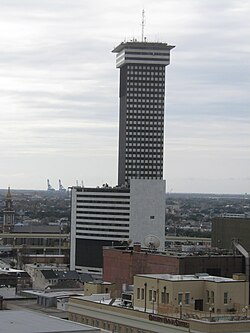
Key Facts
- Height: 531 feet (162 meters).
- Ranking: Third tallest building in both New Orleans and the state of Louisiana.
- Status: Vacant since 2002.
- Historic Status: Listed on the U.S. National Register of Historic Places since January 30, 2013.
- Total Floor Area: 485,000 square feet across 45 floors.
History and Construction
The journey of the Plaza Tower began in 1964 under developer Sam J. Recile. However, the project faced early hurdles, with construction halting in October 1966. Work resumed in 1968 after the property changed hands, and the tower was finally completed in 1969.
For four years, the Plaza Tower held the title of the tallest building in both New Orleans and Louisiana. This reign ended when the Hancock Whitney Center (originally One Shell Square) surpassed it by more than 160 feet. Despite this, the tower remained a pivotal architectural milestone, marking the transition toward modern high-rises alongside the World Trade Center on the riverfront.
From Offices to Vacancy
Originally envisioned as a mixed-use space with offices and upper-floor residences, the building shifted almost entirely to commercial use by 1984. However, the tower's fortunes turned in 2001 when tenants began reporting severe maintenance failures. Allegations of asbestos (a hazardous mineral fiber) and toxic mold led to multiple class-action lawsuits filed by workers against owners and state agencies.
By 2002, the building became a ghost tower. Approximately 700 employees from the Louisiana Department of Social Services, the Department of Health and Hospitals, and the District Attorney's Office vacated the premises en masse. The building has remained sealed and unused ever since.
The Failed "Crescent City Towers" Vision
In the late 2000s, hope for the building's revival emerged through a series of redevelopment proposals. The most ambitious of these sought to transform the skyscraper into luxury residential units under the names "Crescent City Residences" or "Crescent City Towers."
The proposed plan involved gutting the building to its superstructure (the main supporting frame) to remove all contaminants. The vision included a neomodern glass facade with staggered balconies, a gourmet restaurant, a spa, and an indoor pool. Following Hurricane Katrina, the plans were updated to include extreme weather protections, such as glass capable of withstanding 200 mph winds and a self-sufficient water and power supply.
Despite securing initial funding and changing the design to a gold-tinted glass and maroon steel aesthetic, the project collapsed. The owners defaulted on their mortgage in 2007, and the building passed through several owners via auction, including Bryan Burns in 2011 and Alexandra Land and Development LLC in 2014.
Current State: Decay and Danger
In recent years, the Plaza Tower has become a public safety hazard. The building's continued deterioration has led to several dangerous incidents:
- Falling Debris: In May 2021 and January 2023, pieces of the building fell, causing road closures and injuring at least one person.
- Fires: The New Orleans Fire Department responded to fires in January 2022 and April 2023.
- Fatalities: In April 2023, a man fell to his death from the structure.
Due to these hazards, Mayor Latoya Cantrell has explored the possibility of demolishing the building to ensure public safety.
Architectural Legacy
The Plaza Tower remains a polarizing piece of architecture. Critics, including the Society of Architectural Historians, have described it as a "jumble" of various styles—including Constructivism, Futurism, and Expressionism—rather than a cohesive design. Conversely, defenders view it as a bold experiment influenced by the work of Frank Lloyd Wright.
| Feature | Detail |
|---|---|
| Address | 1001 Howard Avenue, New Orleans, LA |
| Architect | Leonard R. Spangenberg, Jr. & Associates |
| Height | 531 ft (162 m) |
| Floors | 45 |
| Elevators | 13 |
| NRHP Designation | January 30, 2013 |
Frequently Asked Questions
Why is the Plaza Tower currently empty?
The building has been vacant since 2002 following reports of toxic mold and asbestos, which led to mass evacuations of state employees and subsequent lawsuits.
Is the Plaza Tower still the tallest building in New Orleans?
No. While it was the tallest for four years after its completion, it is now the third tallest building in both the city and the state of Louisiana.
What happened to the Crescent City Towers project?
The project was a failed attempt to convert the tower into luxury condos. Despite various redesigns and funding attempts, the owners defaulted on their mortgage, and the building returned to auction.
Is the building considered historically significant?
Yes, despite its current state of decay and architectural criticism, the Plaza Tower was added to the U.S. National Register of Historic Places in 2013.
What are the current safety concerns regarding the tower?
The building is suffering from severe decay, resulting in falling debris, multiple fires, and unauthorized access, leading city officials to consider demolition.