Carrollton Historic District
Nestled in the farthest upriver reaches of Uptown New Orleans, the Carrollton Historic District is a neighborhood where history and modern city life blend seamlessly. Once a separate town laid out in 1833 and incorporated in 1845, Carrollton maintained a distinct identity long after its annexation by New Orleans in 1874. Today, it is recognized by the Historic District Landmark Commission and the U.S. National Register of Historic Places, serving as a cultural anchor for the city.
The district is roughly bounded by Lowerline Street, the Mississippi River, Monticello Avenue, and Earhart Boulevard. Its unique history is reflected in its geography; for instance, Lowerline Street is actually located upriver from Upperline Street—a quirk resulting from the annexation of different suburbs at different times.
Key Facts
- Established: Laid out in 1833; incorporated in 1845.
- NRHP Status: Added to the National Register of Historic Places on November 2, 1987.
- Architectural Styles: Colonial Revival, Bungalow/Craftsman, and Italianate.
- Key Landmarks: Carrollton Courthouse, Camellia Grill, and the Maple Leaf Bar.
- Cultural Legacy: Home to the "Black Pearl" section and the birthplace of gospel legend Mahalia Jackson.
The Heart of the Neighborhood: Main Streets and Landmarks
The central artery of the district is Carrollton Avenue, a broad thoroughfare shaded by southern live oaks. The iconic St. Charles Avenue Streetcar runs along the "neutral ground" (the local term for a central median), connecting the neighborhood to the French Quarter. Nearby, the landmark Camellia Grill diner remains a staple for residents and visitors alike.
Beyond the main avenue, Carrollton retains two distinct "neighborhood main streets" that offer a mix of residential charm and commercial vibrancy:
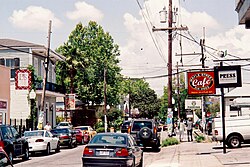
- Maple Street: The center of Lower Carrollton, known for its upscale shops, coffee houses, bars, and restaurants.
- Oak Street: The hub of Upper Carrollton, featuring a variety of shops and the renowned live music venue, the Maple Leaf Bar.
Parks and Cultural Spaces
In the northwest section on Claiborne Avenue lies Marsalis Harmony Park (formerly Palmer Park). This green space hosts annual art and music festivals and features a monument dedicated to Carrolltonians who served in World War I. Following Hurricane Katrina, the park served as a temporary home for the Mid-City art market.
A Rich Social and Ethnic Tapestry
Carrollton has long been an ethnically diverse community. In the 19th century, it welcomed immigrants from Ireland and Germany, and "free people of color" owned homes here prior to the Civil War. One of the most significant areas is the riverfront section known as the Black Pearl, a historically predominantly African-American neighborhood and the home of the "Queen of Gospel music," Mahalia Jackson.
The area is also linked to musical lore. The late 19th-century "Rising Sun Hall," a venue used by Social Aid & Pleasure Clubs for dances and meetings, is cited as a possible inspiration for the legendary song "The House of the Rising Sun."
Education and Civic Architecture
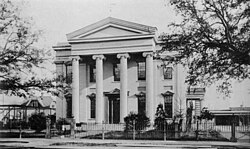
The district's architectural heritage is best exemplified by the Carrollton Courthouse. Completed in 1855 and designed by the prominent architect Henry Howard, this neoclassical building served as the courthouse for both the town of Carrollton and Jefferson Parish. Over the decades, it transitioned into an educational hub, housing several institutions including McDonogh 23, Ben Franklin Senior High, and Audubon Charter School. As of 2023, the building has been repurposed as "The Carrollton," an upscale assisted living facility.
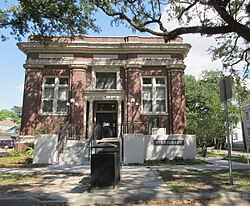
Other educational landmarks include the former James Weldon Johnson Elementary School, which was approved as a campus for the Lycée Français de la Nouvelle-Orléans in 2017. For public literacy, the New Orleans Public Library operates the Nix Branch Library in the Riverbend area, a beloved local spot known for its community-tended gardens.
Community Traditions and Identity
Despite being part of New Orleans for over a century, Carrollton retains a strong sense of independence. The informal post of "mayor of Carrollton" existed into the 1980s to represent the neighborhood's interests to the city council. Even today, the U.S. Postal Service continues to deliver mail addressed to "Carrollton, Louisiana" (ZIP Code 70118).
The neighborhood is also a focal point for Mardi Gras. The Krewe of OAK parades through the streets, and the Phunny Phorty Phellows celebrate the Epiphany (Twelfth Night) on January 6 by throwing beads from the streetcar.
| Category | Details |
|---|---|
| NRHP Reference No. | 87001893 |
| Incorporation Date | March 10, 1845 |
| Annexation Date | 1874 |
| Primary Architect | Henry Howard (Courthouse) |
| Key Neighborhoods | Black Pearl, Leonidas/Pigeontown, Riverbend, East Carrollton |
Frequently Asked Questions
Why is Lowerline Street located upriver from Upperline Street?
This naming anomaly occurred because the two streets served as boundaries for different suburbs that were annexed by New Orleans at different times during the 19th century.
What is the significance of the "Black Pearl" section?
The Black Pearl is the historically predominantly African-American part of Carrollton along the riverfront and is notably the home of gospel legend Mahalia Jackson.
What currently occupies the historic Carrollton Courthouse?
After serving as a courthouse and several schools, the building was converted into an upscale assisted living facility called The Carrollton, which opened in 2023.
Is Carrollton still considered a separate town?
No, it was annexed by New Orleans in 1874. However, it retains a distinct identity, and the USPS still recognizes "Carrollton, Louisiana" for mail delivery.
Which musical landmarks are found in the district?
The neighborhood is home to the famous Maple Leaf Bar on Oak Street and was the site of the late 19th-century Rising Sun Hall.