Richard Meier: The Architect of White Geometry
Richard Meier is a world-renowned American architect and abstract artist celebrated for his commitment to modernism. His work is instantly recognizable for its precise geometric forms and a signature, pervasive use of the color white. From sprawling museum complexes to intimate residential spaces, Meier's designs emphasize light, clarity, and a rigorous structural logic.
Throughout his career, Meier has shaped the skylines of cities across the globe, earning some of the highest honors in the field of architecture. His approach blends the legacy of early 20th-century masters with a contemporary sensibility for space and light.
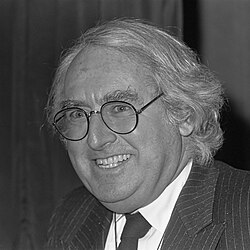
Key Facts
- Born: October 12, 1934, in Newark, New Jersey.
- Education: Bachelor of Architecture from Cornell University (1957).
- Major Awards: Pritzker Architecture Prize (1984) and AIA Gold Medal (1997).
- Signature Style: Geometric designs characterized by the prominent use of white.
- Notable Works: The Getty Center, Barcelona Museum of Contemporary Art, and High Museum of Art.
- Professional Group: Member of "The New York Five."
Early Life and Educational Foundations
Born into a Jewish family in Newark, New Jersey, Meier grew up in Maplewood and attended Columbia High School. He pursued his professional training at Cornell University, where he earned his Bachelor of Architecture degree in 1957.
Following his graduation, Meier embarked on an extensive journey through Europe and the Middle East. He traveled to Denmark, Finland, France, Germany, Greece, Israel, and Italy to network with established architects and immerse himself in the diverse architectural landscapes of the era.
Professional Evolution and "The New York Five"
Meier began his professional career in New York City, working briefly for Skidmore, Owings and Merrill in 1959, followed by a three-year tenure with Marcel Breuer. In 1963, he established his own independent firm.
By 1972, Meier was identified as a member of The New York Five, a group of modernist architects that included Peter Eisenman (his second cousin), Michael Graves, Charles Gwathmey, and John Hejduk. During this period, Meier collaborated with artists like painter Frank Stella, further refining his preference for white, geometric structures.
Rise to International Recognition
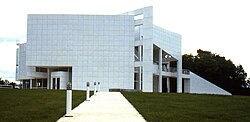
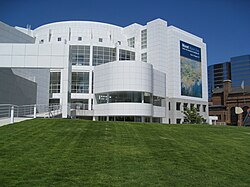
Meier first gained significant acclaim through his residential designs and specific public commissions, such as The Atheneum visitors center in New Harmony, Indiana (1979) and the High Museum of Art in Atlanta (1983).
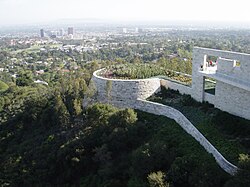
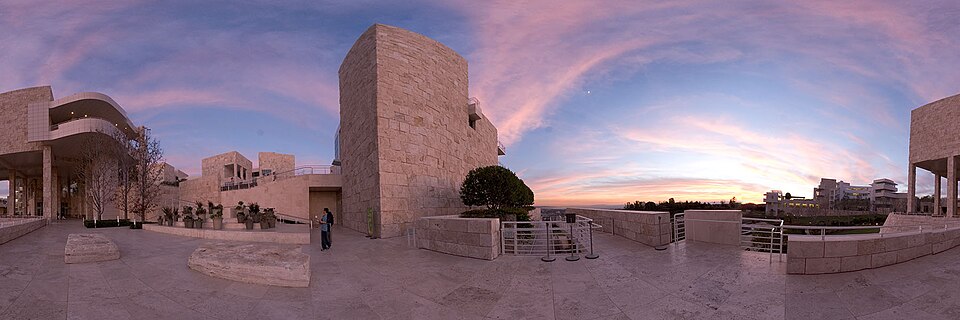
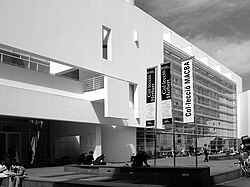
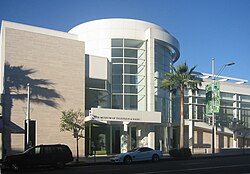
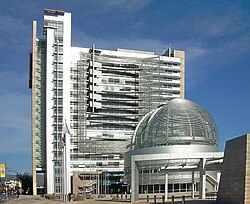
His global profile reached new heights with the completion of the Getty Center in Los Angeles in 1997, a massive museum complex that stands as one of his most iconic achievements. Other major works include the Barcelona Museum of Contemporary Art (1995), the Paley Center for Media in Beverly Hills (1996), and San Jose City Hall (2005).
Architectural Philosophy and Influences
Meier's work is deeply rooted in the principles of early to mid-20th-century modernism. He is particularly influenced by Le Corbusier, specifically the Swiss Pavilion and the Villa Savoye. Critics often note that Meier expanded upon Corbusier's ideas more extensively than any other architect.
Beyond Le Corbusier, Meier's aesthetic reflects the influence of Mies Van der Rohe, and occasionally Frank Lloyd Wright and Luis Barragán. His use of white is not merely a stylistic choice but a nod to historical landmarks, including Mediterranean white-washed villages in Greece, Spain, and southern Italy, as well as traditional cathedrals.
Awards and Legacy
The architectural community has recognized Meier's contributions with numerous prestigious awards. In 1984, he received the Pritzker Prize, with the jury praising his "personal, vigorous, original" structures. He also earned the AIA Gold Medal in 1997 and the A+ Lifetime Achievement Award in 2013.
In 2014, Meier opened a 15,000-square-foot exhibition space at Mana Contemporary in Jersey City, showcasing his sculptures, collages, and architectural drawings to the public.
| Project Name | Location | Completion Year |
|---|---|---|
| The Atheneum | New Harmony, Indiana, USA | 1979 |
| High Museum of Art | Atlanta, Georgia, USA | 1983 |
| Barcelona Museum of Contemporary Art | Barcelona, Spain | 1995 |
| The Hague City Hall | The Hague, Netherlands | 1995 |
| Getty Center | Los Angeles, California, USA | 1997 |
| San Jose City Hall | San Jose, California, USA | 2005 |
Controversies and Resignation
In March 2018, The New York Times reported allegations of sexual harassment and assault against Meier made by several women. In response, Meier initially took a six-month leave of absence. Following these allegations, Cornell University declined a planned endowment for a named chair and reviewed his previous donations.
As more women came forward with allegations dating as far back as 2009, the firm announced that Meier's resignation was permanent on October 9, 2018. The firm subsequently rebranded as MeierPartners.
Frequently Asked Questions
What is Richard Meier's signature architectural style?
Richard Meier is known for his modernist, geometric designs that make prominent and consistent use of the color white to emphasize light and structure.
Which famous architect most influenced Richard Meier?
Meier was most heavily influenced by Le Corbusier, particularly his early works such as the Villa Savoye and the Swiss Pavilion.
What is "The New York Five"?
The New York Five was a group of modernist architects active in the 1970s, consisting of Richard Meier, Peter Eisenman, Michael Graves, Charles Gwathmey, and John Hejduk.
What are some of Richard Meier's most famous buildings?
His most notable works include the Getty Center in Los Angeles, the Barcelona Museum of Contemporary Art, the High Museum of Art in Atlanta, and San Jose City Hall.
Why did Richard Meier resign from his firm?
Meier resigned permanently in 2018 following multiple allegations of sexual harassment and assault brought forward by former employees.