Gottfried Böhm: The Master of Sculptural Concrete Architecture
Gottfried Böhm (1920–2021) was a visionary German architect and sculptor whose work redefined the possibilities of concrete, steel, and glass. Known for his highly sculptural approach, Böhm created structures that felt less like traditional buildings and more like carved monuments. His career spanned over seven decades, during which he bridged the gap between the avant-garde traditions of his family and the technical advancements of the modern era.
Böhm's legacy is defined by his ability to create "connections"—linking the past with the future, the conceptual world of ideas with physical reality, and a building with its specific urban environment. This philosophy ensured that every structure he designed was in harmony with its setting in terms of color, form, and material.
Key Facts
- Pritzker Prize: In 1986, he became the first German architect to receive this prestigious award.
- Signature Style: Specialized in sculptural, expressionist forms, primarily using molded concrete.
- Longevity: His career lasted until his death at the age of 101 in 2021.
- Major Work: The Maria, Königin des Friedens pilgrimage church is widely considered his most influential project.
- Educational Legacy: The Gottfried Böhm Scholarship now supports postgraduate architects in Cologne.
Early Life and Artistic Foundations
Born on January 23, 1920, in Offenbach am Main, Gottfried Böhm was born into a lineage of architectural excellence. His father, Dominikus Böhm, was a renowned architect famous for avant-garde, Expressionist churches across Germany. This familial influence, combined with his grandfather's architectural background, set the stage for Gottfried's future career.
Böhm's path was interrupted by World War II, during which he was conscripted into the Wehrmacht. After being injured in 1942 during Operation Barbarossa, he returned to Germany to complete his studies. He graduated from the Technische Hochschule, Munich, in 1946 and subsequently studied sculpture at a fine-arts academy. This training in clay model making became a cornerstone of his design process, allowing him to treat architecture as a three-dimensional sculpture.
Professional Evolution and Global Influence
Böhm began his professional journey working for his father until 1955, while also collaborating with Rudolf Schwarz and the "Society for the Reconstruction of Cologne." A pivotal moment occurred in 1951 when he spent six months in New York City working for Cajetan Baumann. During this time, he met two titans of modernism, Ludwig Mies van der Rohe and Walter Gropius, who deeply influenced his perspective on space and form.
His first independent project, the "Madonna in the Rubble" chapel in Cologne (completed in 1949), was built on the site of a medieval church destroyed during the war. This project signaled his commitment to integrating new structures with historical contexts.
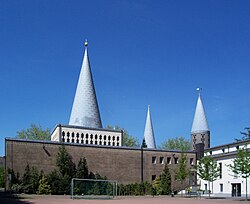
As his career progressed, Böhm expanded his portfolio to include museums, civic centers, and residential buildings. While often categorized as an expressionist or post-Bauhaus architect, he viewed his work as a synthesis of opposites. While his early masterpieces relied heavily on molded concrete, his later works incorporated more steel and glass as material technology evolved.
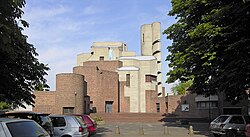
Notable Architectural Achievements
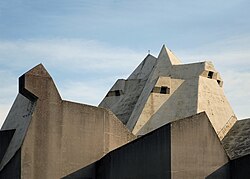
Böhm's work is characterized by bold, organic shapes that challenge the rigidity of urban planning. His most recognized achievement, the Maria, Königin des Friedens pilgrimage church in Neviges, stands as a testament to his ability to create spiritual spaces through raw material.
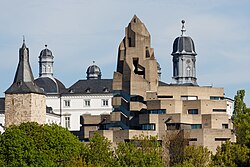
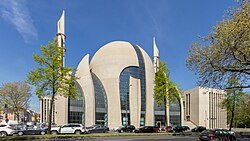
Other significant works include the Bensberg City Hall, which blends modernism with the backdrop of an old castle, and the Cologne Central Mosque, completed in 2018, which showcases his late-career mastery of contemporary materials.
Summary of Career and Legacy
| Category | Details |
|---|---|
| Lifespan | January 23, 1920 – June 9, 2021 |
| Education | Technische Hochschule, Munich (Architecture); Fine-arts academy (Sculpture) |
| Primary Materials | Concrete, Steel, Glass |
| Major Award | Pritzker Architecture Prize (1986) |
| Key Projects | Maria, Königin des Friedens, Bensberg City Hall, Cologne Central Mosque |
The Gottfried Böhm Scholarship
To honor his 100th birthday, Cologne Mayor Henriette Reker established the Gottfried Böhm Scholarship in 2020. First awarded in 2023, this one-year residency supports postgraduate architects interested in the intersection of architecture and urban development.
The scholarship provides a monthly grant of 2,500 euros, free accommodation, and a creative workspace in Cologne. Supervised by the Verein der Freunde und Förderer der Technischen Hochschule Köln e.V., the program encourages visionary tasks for the city and its periphery. The current application window remains open until May 31, 2025, for a start date in October 2025.
Frequently Asked Questions
What is Gottfried Böhm's most famous building?
His most influential and recognized building is the Maria, Königin des Friedens pilgrimage church in Neviges, Germany.
Which prestigious award did Gottfried Böhm win in 1986?
He was awarded the Pritzker Architecture Prize, becoming the first German architect to receive this honor.
How did sculpture influence Böhm's architecture?
Böhm studied sculpture at a fine-arts academy after his architecture degree, and he integrated his clay model making skills into his design process to create highly sculptural buildings.
What materials did Böhm primarily use in his work?
He is best known for his use of molded concrete, though in his later projects, he increasingly utilized steel and glass due to technical advancements.
What is the purpose of the Gottfried Böhm Scholarship?
The scholarship supports postgraduate architects who are specifically interested in the connection between architecture and urban development through a one-year residency in Cologne.