Armistice of 11 November 1918: The End of the Great War
The Armistice of 11 November 1918 marked the cessation of hostilities on land, at sea, and in the air during World War I. This agreement ended the fighting between the Entente (the Allied powers) and Germany, the last remaining opponent after previous armistices had been reached with Bulgaria, the Ottoman Empire, and Austria-Hungary.
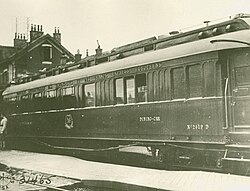
Signed in a railway carriage in the Forest of Compiègne, the agreement was not a formal surrender but a victory for the Entente and a defeat for Germany. It came into effect at 11:00 a.m. Paris Time on November 11, 1918, leading to the famous phrase "the eleventh hour of the eleventh day of the eleventh month."
Key Facts
- Date and Time: Effective November 11, 1918, at 11:00 a.m.
- Location: A railroad car in the Compiègne Forest, France.
- Primary Negotiators: Marshal Ferdinand Foch (Allied Supreme Commander) and German delegates including Matthias Erzberger.
- Basis for Terms: US President Woodrow Wilson's "Fourteen Points."
- Outcome: Immediate cessation of fighting, followed by the Treaty of Versailles in 1919.
- Human Cost: 2,738 men died on the final day of the war.
The Road to Peace: Background and Negotiations
The Deteriorating German Position
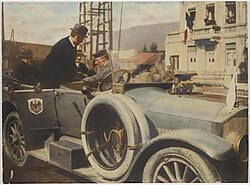
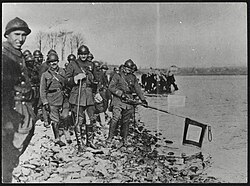
By October 1918, Germany's military and political situation had become untenable. On October 3, Prince Maximilian of Baden was appointed Chancellor to replace Georg von Hertling specifically to negotiate an end to the conflict. By October 5, the German government contacted US President Woodrow Wilson to seek terms based on his Fourteen Points—a set of principles designed to ensure a lasting peace.
Allied Demands and the German Revolution
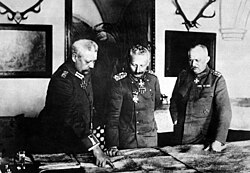
President Wilson maintained strict preconditions for negotiations. He demanded that Germany retreat from all occupied territories, cease submarine warfare, and that Kaiser Wilhelm II abdicate. Wilson warned that if the US had to deal with "monarchical autocrats," the process would be a surrender rather than a peace negotiation. This tension coincided with the German Revolution, which further destabilized the Imperial government.
The Signing at Compiègne
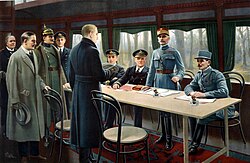
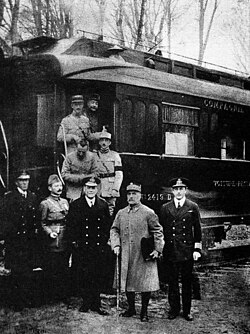
The final agreement was reached at 5:00 a.m. on November 11, 1918. The signing took place in Marshal Ferdinand Foch's personal railway carriage. The Allied delegation was composed entirely of military personnel, while the German delegation included both civilian politicians and military officers.
Key Personnel Involved
- Allied Signatories: Marshal Ferdinand Foch (France) and Admiral Rosslyn Wemyss (United Kingdom).
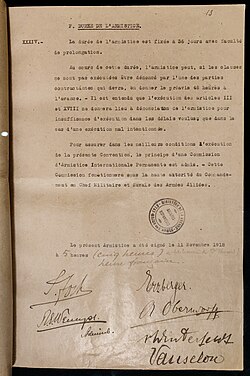
- German Signatories: Matthias Erzberger (civilian), Count Alfred von Oberndorff (Foreign Ministry), Major General Detlof von Winterfeldt (Army), and Captain Ernst Vanselow (Navy).
Terms of the Armistice
The armistice consisted of 34 clauses, largely drafted by Marshal Foch. These terms were designed to ensure Germany could not resume hostilities while a formal peace treaty was negotiated.
| Category | Key Requirements |
|---|---|
| Military Materiel | Surrender of 5,000 artillery pieces, 25,000 machine guns, 1,700 aircraft, and 5,000 locomotives. |
| Territory | Withdrawal of German forces from west of the Rhine; Allied occupation of the Rhineland. |
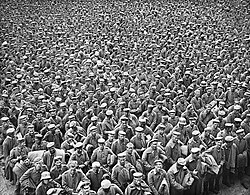
| Prisoners | Release of Allied prisoners of war and interned civilians; no release of German prisoners. |
| Naval/Air | Surrender of warships and aircraft; continuation of the naval blockade of Germany. |
Aftermath and Immediate Impact
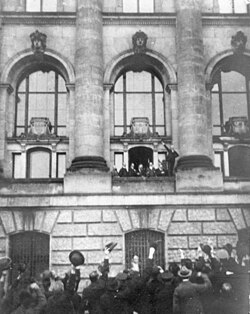
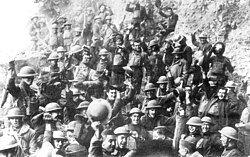
As the clock struck 11:00 a.m., celebrations erupted across the Entente nations. In Paris, flags were displayed at the Élysée Palace and the Ministry of War, and bells rang throughout the city. In the United States and Britain, official communiqués were released to notify the public that the fighting had ceased.

The Final Casualties
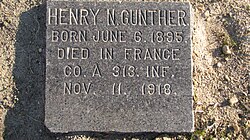
Despite the impending peace, fighting continued until the final second. The Allies maintained pressure to ensure strict adherence to the terms. For example, a US Navy railway gun fired its last shot at 10:57:30 a.m. Tragically, soldiers like American Pte Henry Gunther died just seconds before the ceasefire took effect.
Legacy and Historical Controversy
The "Stab-in-the-Back" Myth
Because the German army had retreated in good order and the Western Front was still 720 kilometers from Berlin, some German leaders, including Hindenburg, promoted the stab-in-the-back myth (Dolchstoßlegende). This false narrative claimed the army remained undefeated on the battlefield but was betrayed at home by Jews, Socialists, and Bolsheviks.
Later Historical Echoes
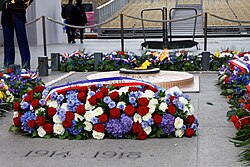
The site of the armistice became a symbol of national humiliation for Nazi Germany. In 1940, Adolf Hitler forced France to sign a new armistice in the same railway carriage at Compiègne as an act of revenge. Additionally, the end of the Second Sino-Japanese War in 1945 was scheduled for the "ninth hour of the ninth day of the ninth month," intentionally echoing the timing of the 1918 Armistice.
Frequently Asked Questions
Was the Armistice of 1918 a formal surrender?
No, it was a ceasefire agreement that ended active fighting. The formal surrender and peace terms were established later in the Treaty of Versailles, signed on June 28, 1919.
Why was the railway carriage in Compiègne chosen?
The carriage served as the personal headquarters of Marshal Ferdinand Foch, the Allied Supreme Commander, providing a secure and mobile location for the negotiations.
What were the "Fourteen Points"?
The Fourteen Points were a statement of principles for peace proposed by US President Woodrow Wilson, which served as the basis for the armistice negotiations and the subsequent peace treaty.
How long did the armistice last before the final treaty?
The armistice was extended three times as negotiations continued. The Treaty of Versailles was signed in June 1919 and officially took effect on January 10, 1920.
Who were the primary signatories for Germany?
The German delegation was led by civilian politician Matthias Erzberger, accompanied by Count Alfred von Oberndorff, Major General Detlof von Winterfeldt, and Captain Ernst Vanselow.