Anton von Werner: The Painter of German Unification
Anton Alexander von Werner (1843–1915) was a preeminent German painter and illustrator who captured the defining moments of the 19th-century German state. Specializing in Realism—an art movement emphasizing the accurate depiction of contemporary life and detail—Werner became the primary visual chronicler of the Franco-Prussian War and the subsequent unification of Germany.
His prestige was unmatched in his era, earning him the favor of three consecutive German Emperors: William I, Frederick III, and Wilhelm II. Through his meticulous compositions, Werner transformed political events into enduring historical monuments.
Key Facts
- Specialization: History painting and illustration in the Realist style.
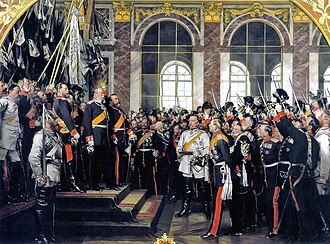
- Major Achievement: Immortalized the proclamation of the German Empire at the Hall of Mirrors in Versailles.
- Academic Leadership: Served as Director of the Berlin Academy (1875) and Director of the Nationalgalerie in Berlin (1909).
- Imperial Patronage: Tutored Emperor Wilhelm II in painting.
- Legacy: His works provide significant historical documentation of the Franco-Prussian War.
Early Life and Artistic Education
Born on May 9, 1843, in Frankfurt (Oder), Brandenburg, Werner was the son of a carpenter. His family, originally from East Prussia, had been ennobled in 1701. Werner's journey into art began in 1857 with an apprenticeship as a decorative painter, followed by formal studies at the Prussian Academy of Arts in Berlin starting in 1860.
He further refined his skills at the Academy of Fine Arts in Karlsruhe under the guidance of masters such as Johann Wilhelm Schirmer and Karl Friedrich Lessing. During this period, he immersed himself in a vibrant intellectual circle that included the composer Johannes Brahms and the pianist Clara Schumann.
Werner's artistic vision was significantly shaped by his travels. In Paris, he studied the works of Jean-Auguste-Dominique Ingres and Eugène Delacroix, while a traveling scholarship later took him to Rome, where he stayed with Anselm Feuerbach until 1869.
The Rise to National Fame
The outbreak of the Franco-Prussian War provided the catalyst for Werner's professional breakthrough. In October 1870, he was attached to the staff of the 3rd Corps d'Armée under Prince Frederick William of Prussia. By January 1871, he was summoned to the Prussian headquarters in Versailles to paint the proclamation of the German Empire.
This commission brought him into direct contact with the most powerful figures of the age, including Chancellor Otto von Bismarck, Field Marshal Helmuth von Moltke, and Emperor Wilhelm I. The resulting work established him as the leading history painter of the new empire.
Imperial Career and Academic Leadership
Upon returning to Berlin, Werner's influence grew rapidly. He designed a massive velarium (a decorative awning) for the Unter den Linden boulevard to celebrate the return of victorious troops, which he later adapted into an innovative stained glass mosaic for the portico of the Victory Column.
His academic ascent was equally swift. He was appointed professor at the Berlin Academy in 1873 and rose to become its director in 1875. His relationship with the monarchy remained strong; he served as a painting tutor to Emperor Wilhelm II and eventually directed the Nationalgalerie in Berlin in 1909.
Major Works and Artistic Legacy
Werner's portfolio is characterized by its immense historical value. While he produced portraits and allegories, his most critical contributions were his large-scale depictions of military and political milestones.
| Work Title | Subject/Theme |
|---|---|
| Proclamation of the German Empire at Versailles | The founding of the German Empire |
| The Capitulation of Sedan | Franco-Prussian War military victory |
| The Congress of Berlin | Diplomatic history |
| Moltke before Paris | Military leadership |
| Opening of the Reichstag (1893) | Imperial political ceremony |
Beyond his official commissions, Werner maintained deep professional bonds, such as his lifelong friendship with the Norwegian painter Hans Gude, who praised Werner's versatility, tireless work ethic, and spirited personality.
Frequently Asked Questions
What art style did Anton von Werner use?
Anton von Werner painted in the Realist style, which focused on the accurate, detailed, and objective representation of subjects, particularly in his historical and military scenes.
Which historical event is Werner most famous for depicting?
He is most renowned for his depictions of the Franco-Prussian War and the proclamation of the German Empire at the Hall of Mirrors in Versailles.
What roles did he hold at the Berlin Academy?
Werner served as a professor starting in 1873 and later became the Director of the Academy in 1875.
Did he have a relationship with the German Emperors?
Yes, he was a favorite of Emperors William I, Frederick III, and Wilhelm II, the latter of whom Werner personally tutored in painting.
Where can his work be seen today?
Many of his works are held in major German institutions, and he served as the director of the Nationalgalerie in Berlin toward the end of his life.