Andorra: The History, Governance, and Culture of the Pyrenean Principality
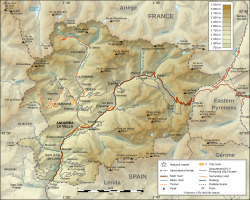
Nestled high in the Pyrenees mountains between France and Spain, the Principality of Andorra is a unique sovereign microstate known for its stunning alpine landscapes and a political system unlike any other in the world. With a total area of 468 km², this landlocked nation blends ancient traditions with modern economic vitality, maintaining a distinct identity centered around its official language, Catalan.
From its prehistoric roots to its current status as a high-income economy, Andorra has navigated centuries of geopolitical shifts to remain a stable and prosperous sanctuary in the heart of Europe.
Key Facts
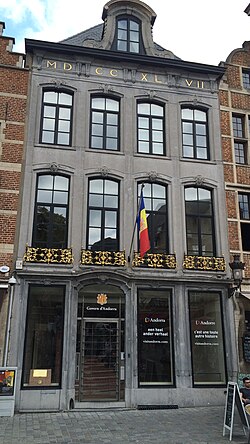
- Official Language: Catalan
- Capital: Andorra la Vella
- Government: Unitary parliamentary co-principality
- Currency: Euro (€)
- Population: Estimated 89,752 (June 2026)
- HDI: 0.913 (Very High)
- National Symbol: Grandalla flower
A Journey Through History
Prehistory and Ancient Roots
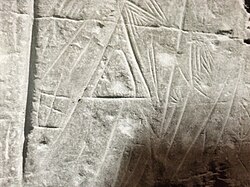
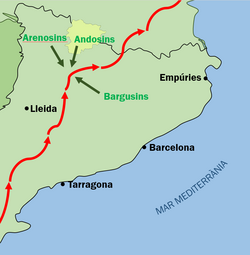
The region's human history stretches back to prehistory, evidenced by sites like the Roc de les Bruixes sanctuary. During the era of the Second Punic War, the Pyrenees served as a strategic barrier where Iberian tribes clashed with the Carthaginian army under Hannibal.
The Middle Ages and the Co-Principality
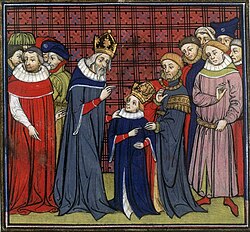
The foundation of modern Andorra began with the influence of the Carolingians. Charlemagne is a central figure in Andorran lore, and the national anthem, "El Gran Carlemany," honors his legacy. The unique political structure of the country was established through the Paréages—feudal charters that began on September 8, 1278. These agreements created a shared sovereignty between the Count of Foix (whose rights eventually passed to the French head of state) and the Bishop of Urgell.
Romanesque Heritage and Early Modernity
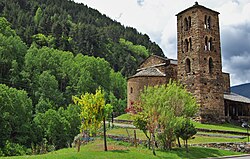
Andorra is rich in Romanesque architecture, particularly its 11th and 12th-century churches. The Sant Joan de Caselles and Sant Miquel d'Engolasters, the latter featuring frescoes by the Mestre de Santa Coloma, stand as testaments to the region's spiritual and artistic history.
![Apse fresco of Sant Miquel d'Engolasters church, painted by Mestre de Santa Coloma during the 12th century[46]](/images/37/d3/37d31bb48e2e1371b5764ca2f6a44adf5b93ac9b7314d251cc8ba10a78439d0d.jpg)
By the 17th century, the country saw the rise of influential families, such as the Rossells, who built manor houses and operated the largest ironwork forges in the country, including Farga Rossell and Farga del Serrat.
![Manor house of the Rossell family in Ordino, Casa Rossell, built in 1611. The family also owned the largest ironwork forges in Andorra as Farga Rossell and Farga del Serrat.[57]](/images/35/2b/352bafaa1147b437b2992725db449f1707f3bc5e72acf54359f28ab5d5232497.jpg)
Modernization and the 1993 Constitution
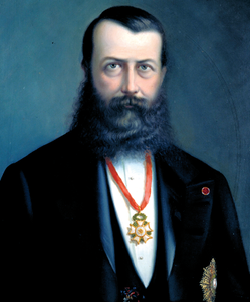
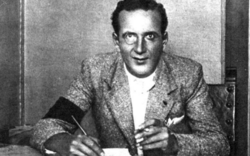
The 19th and 20th centuries brought significant reform. The New Reform of 1866, led by Guillem d'Areny-Plandolit, sought to modernize the state. The country also experienced periods of instability, including the Revolution of 1881 and the brief, self-proclaimed kingship of Boris Skossyreff in 1934.
![Canillo scenery during the Revolution of 1881[75]](/images/31/33/3133bc1db3bc40d883d0c2f1477f296231d7587e272ab9c16b44bc12c5a2af26.jpg)
Andorra transitioned into a fully modern state with the adoption of its Constitution on May 4, 1993. This landmark document formalized its sovereignty, established a parliamentary system, and paved the way for membership in the United Nations and the Council of Europe.
![Enthronement as Co-Prince in 1942 of Bishop Ramón Iglesias (centre). The local comite was led by Francesc Cairat (left), the First General Syndic with the longest regencie, from 1936 to 1960.[101]](/images/f7/d7/f7d743c68734a8d4c448e6e2d9e49f2901441ff32a3c8af155fefc2344433400.jpg)
Governance and Political Structure

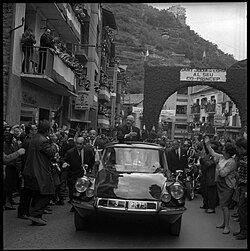
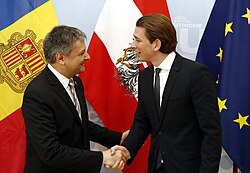
Andorra operates as a unitary parliamentary co-principality. This means it has two heads of state, known as Co-Princes: the Bishop of Urgell and the President of France (currently Emmanuel Macron). While the Co-Princes serve as symbolic heads of state, executive power is held by the Head of Government, and legislative power resides with the General Council.
Administrative Divisions
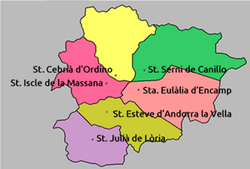
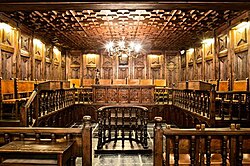
The country is divided into parishes, with Andorra la Vella serving as the capital and largest settlement. The administrative heart of the judiciary is located within the Casa de la Vall.
Geography, Climate, and Economy
The Alpine Environment
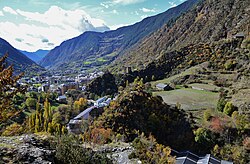
Andorra's geography is dominated by the Pyrenees, resulting in a climate with cold winters and mild summers. The capital, Andorra la Vella, sits at an elevation of 1,113 meters. Precipitation is distributed throughout the year, with peaks in May and October.
Economic Profile
Andorra has evolved from a pastoral and iron-working economy into a high-income hub. Its GDP per capita (PPP) is estimated at $75,988 for 2026. The economy is heavily supported by tourism and trade, though it has recently normalized economic treaties with the European Economic Community (EEC) and adopted the Euro.
![Streets of the city centre of Andorra la Vella in 1986. From 1986 until 1989 Andorra normalised the economic treaties with the EEC.[119][120]](/images/45/ae/45ae74feec9c8e0e48d21877b5d70f8843cd1a97965d1b7abadac7246deae326.jpg)
Infrastructure and Connectivity
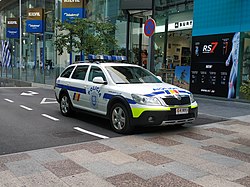
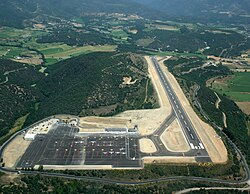
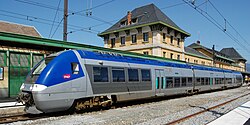
Despite its size, Andorra maintains essential services through entities like Andorra Telecom. While the country has no railways, it is served by the Andorra–La Seu d'Urgell Airport in Spain and rail connections at Latour-de-Carol in France.

Society and Culture
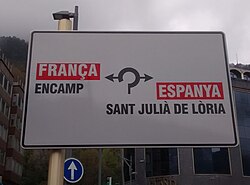
Catalan is the sole official language, appearing on most signage across the country. The population is predominantly Christian, with Catholicism being the most practiced faith.
National Identity and Sports
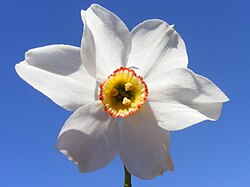
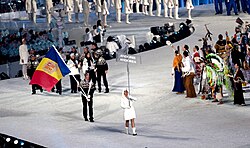
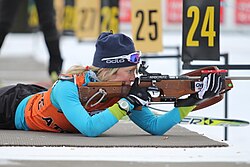
The Grandalla flower serves as the national symbol. In the realm of sports, Andorra is active in the Winter Olympics, represented by athletes such as biathlete Laure Soulié.
Summary of National Statistics
| Category | Detail |
|---|---|
| Total Area | 468 km² |
| Estimated Population | 89,752 |
| Nominal GDP Per Capita | $53,475 |
| Human Development Index | 0.913 (Very High) |
| Official Language | Catalan |
| Currency | Euro (€) |
Frequently Asked Questions
Who are the Co-Princes of Andorra?
The Co-Princes are the Bishop of Urgell and the President of France. This unique arrangement dates back to the medieval Paréages.
What is the official language of Andorra?
Catalan is the only official language of the state, as established by the Constitution.
Does Andorra have its own airport or railway?
Andorra has no railways. Its primary airport, Andorra–La Seu d'Urgell, is located 12 km away in Catalonia, Spain.
When did Andorra become a modern constitutional state?
Andorra adopted its current Constitution on May 4, 1993, which modernized its government and established its international sovereignty.
What is the primary religion in Andorra?
The majority of the population is Christian, with approximately 85.5% identifying as Catholic.