Ammonium Nitrate: Properties, Applications, and Safety
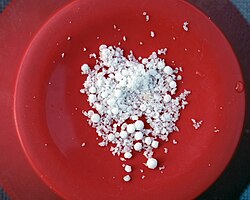
Ammonium nitrate (NH4NO3) is a white crystalline salt composed of ammonium and nitrate ions. Known for its high solubility in water and its role as a powerful oxidizer, this compound serves two primary, yet vastly different, roles in global industry: as a critical high-nitrogen fertilizer for agriculture and as a key component in industrial explosives used for mining and construction.
While it is indispensable for food production and infrastructure development, its chemical nature makes it hazardous if mishandled. Due to its potential for misuse and the risk of accidental detonation, many countries have implemented strict regulatory frameworks to control its distribution and storage.

Key Facts
- Chemical Formula: NH4NO3
- Primary Use: High-nitrogen fertilizer (NPK rating 34-0-0).
- Industrial Use: Major constituent of ANFO (Ammonium Nitrate/Fuel Oil) explosives.
- Physical State: White crystalline solid that is highly hygroscopic (absorbs moisture from the air).
- Hazard Class: Strong oxidizer and explosive under specific conditions.
- Global Production: Estimated at 16.7 million tonnes by 2021.
Chemical and Physical Properties
Ammonium nitrate is characterized by its high solubility in water, a process that is endothermic, meaning it absorbs heat from its surroundings as it dissolves. This property makes it useful for specialized applications like instant cold packs.
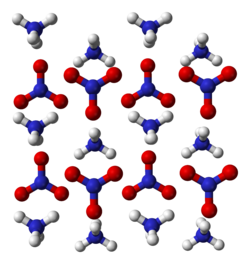
The compound exists in several crystalline phases depending on the temperature. A notable transition occurs at 32.3 °C between the β-rhombic and α-rhombic forms. Because these forms differ in density by 3.6%, the resulting volume change can cause cracking in solid materials. To prevent this, Stabilized Ammonium Nitrate (PSAN) uses metal halide stabilizers to maintain structural integrity, which is essential for applications like rocket propellants.
Technical Specifications
| Property | Value |
|---|---|
| Molar Mass | 80.043 g/mol |
| Density | 1.725 g/cm3 (at 20 °C) |
| Melting Point | 169.6 °C |
| Boiling Point | Approx. 210 °C (decomposes) |
| Detonation Velocity | 2500 m/s |
| LD50 (Oral, rats/mice) | 2085–5300 mg/kg |
Production and Chemical Reactions
The most common industrial production method is the acid-base reaction between anhydrous ammonia (NH3) and concentrated nitric acid (HNO3). This reaction is highly exothermic (releases heat) and is represented by the formula: HNO3 + NH3 → NH4NO3.
Once the solution is formed, water is evaporated to reach a concentration of 95% to 99.9%. The resulting melt is then processed into prills (small beads) in a spray tower or granules in a rotating drum. Other production methods include the nitrophosphate process and various metathesis reactions involving barium or calcium nitrates.
Thermal Decomposition
When heated, ammonium nitrate decomposes. At temperatures below 300 °C, it primarily produces nitrous oxide (N2O) and water. However, at higher temperatures, the reaction shifts to produce nitrogen (N2), oxygen (O2), and water.
Industrial Applications
Agriculture
As a fertilizer, ammonium nitrate provides a concentrated source of nitrogen (34%). While urea has a higher nitrogen concentration, ammonium nitrate is more stable and does not lose nitrogen to the atmosphere as rapidly, making it highly effective for crop growth.
Explosives and Mining
Ammonium nitrate is a versatile component in explosive mixtures. When combined with fuels, it creates powerful blasting agents. The most prominent example is ANFO (Ammonium Nitrate and Fuel Oil), consisting of 94% ammonium nitrate and 6% fuel oil. ANFO is widely used in coal mining, quarrying, and civil construction due to its low cost and relative safety compared to high explosives.
Other specialized mixtures include:
- Amatol: Ammonium nitrate and TNT.
- Ammonal: Ammonium nitrate and aluminum powder.
- Tovex: Ammonium nitrate and methylammonium nitrate.
Niche Uses
Beyond agriculture and mining, the compound is used in instant cold packs due to its endothermic dissolution. Research has also explored its use in off-grid cooling systems and refrigerants. Historically, it was used in Takata airbag inflators, though these were later recalled due to safety failures.
Safety, Handling, and Hazards
Ammonium nitrate is not flammable on its own, but as a strong oxidizer, it significantly accelerates the combustion of organic materials. It must be stored away from combustible substances and high explosives.

The compound is sensitive to heat and confinement. If heated in a closed space, the resulting pressure and temperature increase the risk of detonation. Furthermore, because it is hygroscopic, it must be stored in tightly sealed containers to prevent it from absorbing moisture and coalescing into a solid mass or liquefying.
Health and Environmental Impact
In terms of toxicity, ammonium nitrate is relatively low-risk. Its LD50 (median lethal dose) is approximately 2217 mg/kg, which is roughly two-thirds the toxicity of common table salt.
Major Disasters
History has recorded several devastating explosions caused by the accidental detonation of large ammonium nitrate stockpiles. Notable examples include the Oppau explosion (1921), the Texas City disaster (1947), the Tianjin explosions (2015), and the 2020 Beirut explosion. These events typically occur through shock-induced detonation or intense fires that lead to rapid decomposition and pressure buildup.
Frequently Asked Questions
Is ammonium nitrate toxic to humans?
Ammonium nitrate is generally not considered hazardous to health in standard quantities. Its oral LD50 in rats and mice ranges from 2085 to 5300 mg/kg, making it only slightly more toxic than table salt.
Why is ammonium nitrate used in cold packs?
It is used because its dissolution in water is a highly endothermic reaction, meaning it absorbs heat from the environment, resulting in a rapid drop in temperature.
What is ANFO and why is it used?
ANFO is a mixture of 94% ammonium nitrate and 6% fuel oil. It is used as a bulk industrial explosive in mining and construction because it is inexpensive, relatively safe to handle, and easy to deploy.
What makes ammonium nitrate dangerous in storage?
The primary dangers are its role as an oxidizer, which fuels fires, and its potential to detonate if subjected to a strong shock or heated in a confined space. Its hygroscopic nature also requires sealed storage to prevent caking.
How does ammonium nitrate differ from urea as a fertilizer?
While urea has a higher nitrogen content (46% vs 34%), ammonium nitrate is more stable and does not lose nitrogen to the atmosphere as quickly, providing a more consistent nutrient source for plants.