Alsace-Lorraine Soviet Republic: The Revolutionary Transition of 1918
In the chaotic closing days of World War I, a brief but intense political experiment emerged in the borderlands between France and Germany. The Alsace-Lorraine Soviet Republic (known in German as Räterepublik Elsaß-Lothringen) was a short-lived revolutionary government established in November 1918. Born from the collapse of imperial authority and the wider November Revolution in Germany, this movement sought to assert local control through a network of councils during a pivotal transfer of sovereignty from Germany to France.
Key Facts
- Established: November 10, 1918.
- Dissolved: November 22, 1918 (upon French occupation).
- Capital: Strasbourg.
- Governance: A system of soviets (workers' and soldiers' councils).
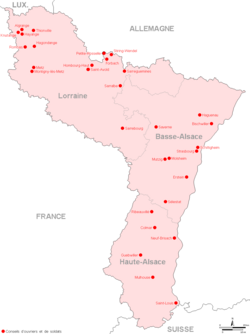
- Scale: 31 revolutionary councils were formed (15 in Alsace, 16 in Lorraine).
- Outcome: Reintegration into the French Third Republic.
The Spark of Revolution
The seeds of the uprising were sown in autumn 1918. Following a failed final attack by the Imperial German Navy against the Royal Navy, mutinies broke out in Kiel on October 30. These mutinies evolved into sailors' demonstrations and the formation of workers' and soldiers' councils—referred to as soviets—which quickly spread across the German Empire.
By November 9, the revolution reached Berlin, leading to the abdication of Emperor Wilhelm II. This collapse of monarchic authority triggered a chain reaction in Alsace-Lorraine. Revolutionary sailors from Kiel and Wilhelmshaven arrived in the region, fueling strikes and the creation of local councils, particularly in the Moselle Lorraine area.
In Metz, rebels released political prisoners and seized the town hall, hoisting a makeshift red flag. Local social-democratic trade unionists, led by socialist locksmith Hans-Heinrich Voortmann, organized a revolutionary council. While some looting occurred, the transition was relatively orderly; the military governor, General Arnold Lequis, accepted the council's authority, and the German civil administration effectively dissolved.
The Proclamation in Strasbourg
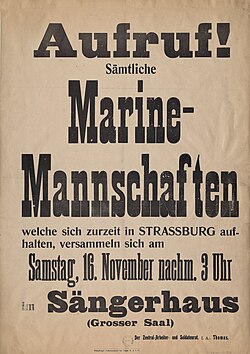
The revolutionary wave hit Strasbourg on November 9, signaled by telegrams announcing the arrival of Baltic mutineers. A soldiers' council was quickly established at the train station, while military government workers, led by Johannes Rebholz, and Social Democratic MP Bernard Böhle formed a revolutionary council with the support of Lieutenant-Colonel von Holleben.
The movement spread rapidly via the railway system. From Haguenau to Colmar and Mulhouse, soldiers and workers established councils, often marching with red flags and cockades. In Sélestat, revolutionaries wore red armbands to identify themselves. By the time the movement reached Guebwiller and Saverne, a dense network of 31 councils had been established across the region to maintain order and prevent anarchy.
The Struggle for Power in Strasbourg
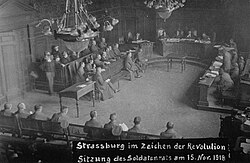
Within Strasbourg, a tension emerged between different political factions. Jacques Peirotes, an MSPD deputy, declared himself mayor to restore bourgeois authority and limit revolutionary influence. Simultaneously, Laurent Meyer of the Woodworkers’ Union formed a workers' council to balance the power of the soldiers.
On November 10, the town hall was occupied. Johannes Rebholz declared that power now belonged to the proletariat (the working class), while Peirotes proclaimed a "social republic," signaling his desire for the region to return to French sovereignty. An executive committee of thirteen members was eventually formed to manage the city, prioritizing free speech and the release of political prisoners.
The National Council of Alsace-Lorraine
Parallel to the grassroots councils, a more formal political body emerged. On November 9, deputies of the Landtag (regional parliament), led by Auguste Labroise, sought to transform the assembly into a sovereign entity. On November 11, they declared the National Council of Alsace-Lorraine under the leadership of Eugène Ricklin.
This National Council operated alongside the municipal and revolutionary councils in Strasbourg. It was recognized by the Council of People's Deputies in Berlin and Friedrich Ebert. While the National Council managed daily administrative affairs—such as demobilizing soldiers and ending railway strikes—it faced internal pressure from radicals like Captain Erik Reinartz, which delayed the formal declaration of annexation to France.
The Return to French Sovereignty
The Soviet Republic's existence was tied to the presence of German troops. Following the Armistice of November 11, 1918, German forces began withdrawing. As they left, the revolutionary councils began to disband spontaneously. By November 20, the red flag was lowered from the Strasbourg cathedral.
French forces, eager to prevent the "revolutionary contagion" from spreading further, advanced quickly. General Émile Fayolle's troops reached the line between Völklingen and Sarreguemines by November 20, and entered Metz and Strasbourg by November 22. The workers' and soldiers' councils voluntarily stood down upon the arrival of the French army.
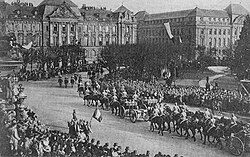
The reintegration was marked by enthusiastic celebrations among the pro-French population. On December 5, the National Council voted unanimously for union with France. When President Raymond Poincaré visited in December, he famously declared from the balcony of Strasbourg’s town hall, "The plebiscite is done!", effectively bypassing a formal referendum to finalize the region's return to France.
| Feature | Details |
|---|---|
| Duration | November 10 – November 22, 1918 |
| Primary Goal | Local control via workers' and soldiers' councils |
| Key Figures | Johannes Rebholz, Hans-Heinrich Voortmann, Eugène Ricklin |
| Total Councils | 31 (15 in Alsace, 16 in Lorraine) |
| Successor State | French Third Republic |
Frequently Asked Questions
What was the Alsace-Lorraine Soviet Republic?
It was a short-lived revolutionary government formed in November 1918 during the collapse of the German Empire at the end of World War I, characterized by the rule of workers' and soldiers' councils.
Why did the republic form so quickly?
The republic emerged due to the influence of the November Revolution in Germany, specifically the mutinies of sailors in Kiel and the subsequent abdication of Emperor Wilhelm II, which left a power vacuum in the region.
What was the role of the National Council of Alsace-Lorraine?
The National Council was a sovereign body formed by Landtag deputies to manage the region's administration and negotiate its political future, operating alongside the more radical revolutionary councils.
How did the Soviet Republic end?
The republic ended with the withdrawal of German troops and the arrival of the French Army between November 17 and 22, 1918, leading to the region's reintegration into France.
Was there a referendum for the region to join France?
No formal referendum was held. President Raymond Poincaré declared that the enthusiastic welcome of the French troops constituted a "plebiscite," thereby avoiding a formal vote.