Alexander Coosemans: Master of Flemish Baroque Still Life
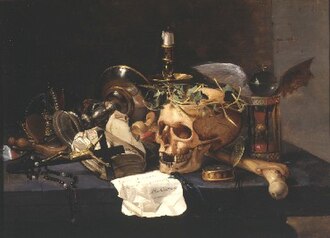
Alexander Coosemans (1627–1689) was a distinguished Flemish Baroque painter who specialized in the intricate art of still life. Based in Antwerp, Coosemans became renowned for his meticulous depictions of flowers, fruit, and inanimate objects. His work spans several specialized genres, including vanitas (paintings reminding the viewer of mortality), pronkstillevens (ostentatious displays of luxury), and game pieces.
Key Facts
- Born/Died: 1627–1689 in Antwerp.
- Specialization: Still lifes, specifically flower pieces, fruit, and symbolic arrangements.
- Mentorship: Pupil of the legendary Jan Davidsz de Heem.
- International Influence: Spent two years (1649–1651) working on commissions in Italy.
- Style: Known for crowded compositions and dramatic lighting compared to his master.
Life and Education
Born in Antwerp and baptized on March 18, 1627, Coosemans was the son of Geertruid Beeck and a successful cloth trader from Brussels who had become a poorter of Antwerp. His father's financial success allowed Alexander to receive a high-quality education in the arts.
In 1641, Coosemans began studying under Jan Davidsz de Heem, the preeminent still life painter of the Netherlands. By 1645, he had achieved professional recognition, becoming a master in the Guild of St. Luke of Antwerp.
Between 1649 and 1651, Coosemans traveled to Italy, where his style evolved. He worked for the Doria-Pamphili-Landi family and contributed fruit and flower elements to decorative paintings by Pasquale Chiesa in the Palazzo del Principe in Genoa and the Palazzo Doria Pamphilj in Rome.
Coosemans returned to Antwerp in 1651 and remained there as a bachelor until his death on October 28, 1689.
Artistic Style and Evolution
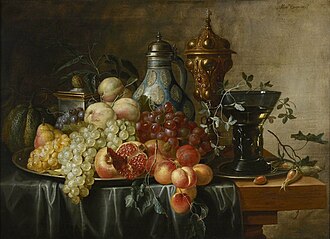
While Coosemans followed the foundations laid by de Heem, he developed a distinct visual language. His compositions tend to be more varied and crowded, favoring dramatic light effects in artificial settings. This contrasts with de Heem's preference for subtle tonalities and harmonious colors designed to mimic naturalism.
The influence of his Italian residency is evident in his later work, and his specific approach to the genre was later followed by the artist Hendrik Schoock.
Vanitas and Pronkstillevens
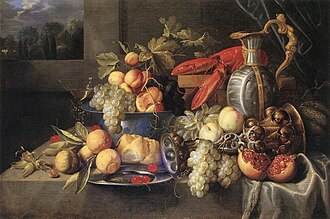
A significant portion of Coosemans' portfolio consists of vanitas and pronkstillevens. These works were not merely decorative but often carried hidden moralistic meanings. For example, in his "Still life on a partly draped table," various objects serve as religious and philosophical symbols:
- Grapes and red wine: Represent Christ and his blood.
- Bread: References the Last Supper and Christian communion.
- Silver vessel: Resembles a ciborium used to hold consecrated hosts.
- Crabs and lobsters: Symbolize the resurrection of Christ, as these creatures must shed their shells to grow.
- Peeled lemon: Represents the vulnerability, suffering, and various stages of human life.
Collaborations and Garland Paintings
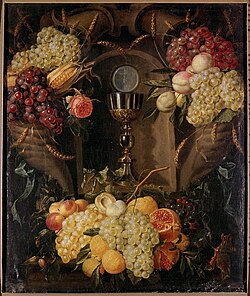
In keeping with the traditions of 17th-century Antwerp, Coosemans frequently collaborated with other artists. He was particularly active in creating garland paintings—a genre pioneered by Jan Brueghel the Elder. These works typically feature a lush wreath of flowers or fruit surrounding a central devotional image or portrait.
In these collaborations, Coosemans would paint the botanical elements while a figure painter handled the central cartouche. Examples include a sculpted bust in a niche and a crucifix surrounded by fruit. In the "Allegory of the Eucharist," Coosemans used a cornucopia to symbolize God's providence, while wheat, grapes, pomegranates, and quinces represented communion, fertility, and immortality.
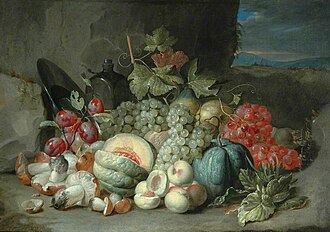
Beyond religious works, Coosemans collaborated with Theodoor van Thulden on a "Double Portrait of a boy and a girl as Cupid and Ceres," where Coosemans provided the still life elements and van Thulden painted the staffage (the human figures).
Summary of Coosemans' Artistic Contributions
| Category | Key Characteristics | Common Symbols |
|---|---|---|
| Vanitas | Moralistic, focused on mortality | Peeled lemons, decaying fruit |
| Pronkstillevens | Ostentatious, luxurious displays | Silver vessels, exotic fruits |
| Garland Paintings | Collaborative, devotional frames | Cornucopias, wheat, pomegranates |
| General Style | Dramatic light, crowded scenes | Artificial settings, varied textures |
Frequently Asked Questions
Who was Alexander Coosemans' teacher?
Alexander Coosemans was a pupil of Jan Davidsz de Heem, who was the leading still life painter in the Netherlands during that era.
What is a 'pronkstilleven'?
A pronkstilleven is an ostentatious still life painting designed to showcase luxury, wealth, and high-status objects.
How did Coosemans' style differ from Jan Davidsz de Heem's?
Coosemans' paintings were generally more crowded and utilized more dramatic lighting in artificial settings, whereas de Heem focused on subtle tonalities and a more natural illusion.
What did the lobsters and crabs symbolize in his paintings?
Because crustaceans must lose their carapace (shell) to grow and start a new life, Coosemans used them to refer to the Christian belief in the resurrection of Christ.
What are garland paintings?
Garland paintings are a type of still life where a floral or fruit wreath surrounds a central image, such as a portrait or a religious symbol. These were typically collaborative efforts between a still life specialist and a figure painter.