Admiral Fallon: A Distinguished Career in Naval and Combat Command
Admiral Fallon's military trajectory is marked by a transition from the cockpit of tactical jet aircraft to the highest echelons of strategic command. With a career spanning decades, he navigated the complexities of naval aviation, international diplomacy, and the management of some of the United States' most critical combatant commands.
Early Aviation and Operational Experience
Fallon began his journey with flight training at Naval Air Station (NAS) Pensacola in Florida and NAS Glynco in Georgia. His early operational years were spent flying the RA-5C Vigilante—a reconnaissance aircraft—at NAS Sanford, Florida, and NAS Albany, Georgia, which included a combat deployment to Vietnam. By 1974, he transitioned to the A-6E Intruder, a twin-engine mid-wing attack aircraft, based at NAS Oceana, Virginia.
Over a 24-year period in flying assignments, Fallon served across Reconnaissance Attack Squadrons (RVAH), Attack Squadrons (VA), and Carrier air wings (CVW). His operational reach extended across the Pacific, Atlantic, and Indian Oceans, as well as the Mediterranean Sea. He embarked on several prestigious vessels, including the USS Saratoga, USS Ranger, USS Nimitz, USS Dwight D. Eisenhower, and USS Theodore Roosevelt. His technical proficiency is evidenced by over 4,800 flight hours in tactical jets and more than 1,300 carrier arrested landings.
Rise Through Command and Leadership
Fallon's leadership capabilities were demonstrated through a series of increasingly responsible commands. He led Attack Squadron 65 aboard the USS Dwight D. Eisenhower and Medium Attack Wing One at NAS Oceana. In 1991, he commanded Carrier Air Wing Eight aboard the USS Theodore Roosevelt during a combat deployment to the Persian Gulf for Operation Desert Storm.
By 1995, as Commander of Carrier Group Eight, he led the Theodore Roosevelt Battle Group in the Mediterranean and commanded Battle Force Sixth Fleet (CTF 60) during NATO's Operation Deliberate Force in Bosnia. His ascent continued as he served as Commander of the U.S. Second Fleet and Commander of Striking Fleet Atlantic from November 1997 to September 2000.
Shore Duties and Strategic Staff Roles
Beyond active sea commands, Fallon held several critical shore assignments. He served as Aide and Flag Lieutenant to the Commander of Fleet Air Jacksonville and held staff positions under the commanders of Reconnaissance Attack Wing One, the Operational Test Force, and the Naval Air Force, U.S. Atlantic Fleet. He also contributed to high-level planning as the Deputy Director for Operations for Joint Task Force Southwest Asia (JTF-SWA) in Riyadh, Saudi Arabia, and as Deputy Director of Aviation Plans and Requirements for the Chief of Naval Operations in Washington, D.C.
His transition to flag officer rank began with NATO, where he served as Assistant Chief of Staff for Plans and Policy for the Supreme Allied Commander, Atlantic. This was followed by roles as Deputy and Chief of Staff of the U.S. Atlantic Fleet and Deputy Commander in Chief and Chief of Staff of the U.S. Atlantic Command. In October 2000, he was appointed as the 31st Vice Chief of Naval Operations.
Diplomacy and High-Level Appointments
In February 2001, while Vice Chief of Naval Operations, Fallon was appointed as a Presidential special envoy to Japan. He was tasked with apologizing for the collision between the USS Greeneville submarine and the Japanese fisheries training vessel Ehime Maru, an accident that resulted in the deaths of nine Japanese crewmembers, including four students. Alongside Ambassador Tom Foley, Fallon met with victims' families in Tokyo and Uwajima, where his public expressions of regret and contrition were credited with preserving U.S.-Japan relations.
Fallon's influence extended to policy and administration. In 2002, he testified before the U.S. Senate Committee on Environment and Public Works, arguing that the military should be exempt from certain environmental laws that hindered base operations. In February 2003, he authorized the Task Force Uniform initiative, which established the Navy Working Uniform and Navy Service Uniform.
Between October 2003 and February 2005, he served as Commander of U.S. Fleet Forces Command and U.S. Atlantic Fleet, during which he was assigned to Operation Iraqi Freedom. He then took on a rare third four-star assignment as Commander of U.S. Pacific Command from February 2005 to March 2007, where he adopted a conciliatory approach toward China.
Command of United States Central Command (CENTCOM)
On January 4, 2007, President Bush nominated Fallon to lead the United States Central Command (CENTCOM). Confirmed by the Senate on February 7, he became the first Navy admiral to hold this position, relieving General John Abizaid on March 16, 2007.
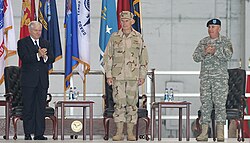
As the combatant commander of CENTCOM, Fallon was the superior officer to General David Petraeus, who then commanded the Multinational Force Iraq. During his tenure, Fallon maintained a complex relationship with Iran, criticizing the nation while simultaneously advocating for negotiations. He emphasized that while the U.S. would maintain a Middle East presence, an arrangement with Iran was necessary. He publicly opposed the "drum beat of conflict" and war, asserting that Iran was not as strong militarily, economically, or politically as it claimed.
Resignation and Retirement
On March 11, 2008, Secretary of Defense Robert Gates announced Fallon's resignation. The official reason centered on a controversy involving an Esquire magazine article that portrayed Fallon as critical of the Bush administration's policies toward Iran. While some viewed his departure as a result of his opposition to military action against Iran, other critics suggested he was pushed to resign due to a failure to prevent the entry of foreign fighters and munitions into Iraq. Following his resignation, Admiral Fallon retired from military service.
Key Facts
- Flight Experience: Over 4,800 flight hours and 1,300 carrier arrested landings.
- Aircraft Flown: RA-5C Vigilante and A-6E Intruder.
- Historic Milestone: First Navy admiral to command U.S. Central Command (CENTCOM).
- Major Operations: Operation Desert Storm, Operation Deliberate Force, and Operation Iraqi Freedom.
- Diplomatic Role: Presidential special envoy to Japan following the Ehime Maru incident.
- Uniform Reform: Authorized the Task Force Uniform initiative for new Navy uniforms.
| Command/Role | Period/Context | Key Focus |
|---|---|---|
| Carrier Air Wing Eight | 1991 | Operation Desert Storm |
| Battle Force Sixth Fleet | 1995 | Operation Deliberate Force (Bosnia) |
| U.S. Second Fleet | 1997–2000 | Striking Fleet Atlantic |
| Vice Chief of Naval Operations | 2000–2003 | Navy Administration |
| U.S. Pacific Command | 2005–2007 | Relations with China |
| U.S. Central Command | 2007–2008 | Middle East Strategy & Iran |
Frequently Asked Questions
Which aircraft did Admiral Fallon fly during his career?
Admiral Fallon flew the RA-5C Vigilante during his early career and combat deployment to Vietnam, and later transitioned to the A-6E Intruder in 1974.
What was Admiral Fallon's role in the Ehime Maru incident?
He served as a Presidential special envoy to Japan, where he met with the families of the nine victims to express regret and apologize on behalf of the United States and President George W. Bush.
Why was Admiral Fallon's appointment to CENTCOM historic?
Admiral Fallon was the first Navy admiral to be appointed as the Commander of the United States Central Command.
What was the Task Force Uniform initiative?
Authorized by Fallon in February 2003, this initiative led to the creation of the Navy Working Uniform and the Navy Service Uniform.
What led to Admiral Fallon's resignation from CENTCOM?
His resignation followed a controversy regarding an article in Esquire magazine that depicted him as critical of the Bush administration's policies toward Iran.