Naval Reserve Officer Training Corps (NROTC): Path to Commissioned Leadership
The Naval Reserve Officer Training Corps (NROTC) is a college-based commissioning program designed to train future officers for the United States Navy and the United States Marine Corps. Unlike traditional military academies, NROTC allows students to earn a degree from a civilian university while preparing for a career of military leadership.
Origins of the NROTC Program
The concept began in September 1924 with a pilot unit at St. John's College in Annapolis, Maryland. Following this trial, the U.S. Department of the Navy officially established the NROTC in 1926. The primary goal was to create a reserve of qualified officers capable of supporting a rapid military expansion during unforeseen emergencies, while also introducing college students and faculty to the national importance of the Navy.
The program launched with six original units: Harvard University, Yale University, Northwestern University, the University of California, Berkeley, the University of Washington, and the Georgia Institute of Technology. Notably, Captain Chester W. Nimitz commanded the unit at UC Berkeley. Early students received a single uniform and a subsistence allowance of $210 during their junior and senior years, with optional paid summer training cruises.
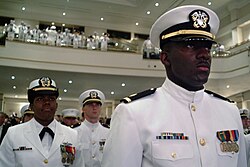
The Modern NROTC System
Today, NROTC graduates enter active duty as commissioned officers rather than reserve officers. Depending on their track, they are commissioned as Ensigns in the U.S. Navy or Second Lieutenants in the U.S. Marine Corps. While attending college, these candidates are known as Midshipmen.
The primary distinction between NROTC and the U.S. Naval Academy is the environment; NROTC Midshipmen attend civilian institutions and remain in the Navy Reserve, only entering active duty for summer training, whereas Naval Academy Midshipmen are on active duty full-time in a highly regimented setting.
Academic Focus and Capacity
Since 2009, the scholarship program has shifted its priority toward STEM (Science, Technology, Engineering, and Mathematics) degrees. The Navy typically maintains around 6,000 midshipmen, though law limits each military service to 5,500 scholarship recipients at any one time.
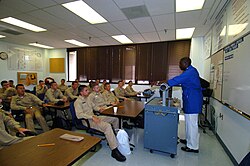
Joining the Program
Most students join NROTC after high school through one of several pathways:
- Scholarship Midshipmen: These students apply during their senior year of high school or early college. The selective process includes a written application, an interview, and a medical exam. The Navy covers tuition, lab fees, and books, and provides a monthly stipend starting at $250 for freshmen, increasing by $50 each subsequent year.
- College Program Midshipmen: These students join without an initial scholarship. They complete the same requirements as scholarship midshipmen and can be commissioned upon graduation. High-performing students, particularly those in technical fields, may be offered scholarships later.
- Enlisted Pathways: Active-duty personnel can pursue commissions via the Seaman to Admiral 21 (STA-21) program for the Navy or the Marine Enlisted Commissioning Education Program (MECEP) for the Marine Corps.
The Degree Tier System
NROTC categorizes majors into three tiers to determine scholarship competitiveness:
- Tier-1: Advanced engineering majors (most competitive).
- Tier-2: Most other academic majors.
- Tier-3: Majors with simpler degree completion requirements.
Due to the rigor of Tier-1 STEM degrees, some units may extend the graduation requirement beyond four years.
Program Requirements and Training
Academic and Physical Demands
During the school year, Midshipmen balance their university studies with military obligations. This includes uniform days for inspections and drill, as well as mandatory Naval Science classes covering history, engineering, weapons, and ethics. Navy Midshipmen must also complete specific coursework in calculus, calculus-based physics, English, and national security or military affairs.
Physical fitness is monitored via two annual Physical Readiness Tests (PRTs). Standards for males include 47 push-ups and a 1.5-mile run in 12 minutes or less; females must complete 21 push-ups and a 1.5-mile run in 14 minutes and 15 seconds. Those who fail are enrolled in the Fitness Enhancement Program (FEP).
Military Colleges
Some students attend Senior Military Colleges (such as The Citadel, Virginia Military Institute, or Texas A&M), where the commitment is full-time. These programs involve living in barracks, wearing uniforms daily, and following a strict military schedule, providing a more immersive experience than standard civilian college programs.
Summer Training and Cruises
Summer breaks are used for hands-on experience. After the freshman year, Midshipmen attend CORTRAMID (Career Orientation and Training of Midshipmen) in San Diego or Norfolk to explore Surface, Submarine, Aviation, and Marine Corps communities.
- Second-Class Cruise: Navy Option students train with a specific warfare community and are paired with an enlisted "running mate."
- First-Class Cruise: A mandatory requirement for commissioning that focuses on integrating the Midshipman into the officer community.
- Marine Option: These students attend the Mountain Warfare Training Center and eventually complete a six-week course at Marine Officer Candidate School (known as "Bulldog").
Service Commitment and Uniforms
Graduates face a service commitment based on their program and specialty. Scholarship graduates typically owe eight years of service, with at least five on active duty. Specialized roles, such as Naval Aviators, may have commitments up to 10 years. College Program graduates typically owe three years of active duty. Remaining service time is completed in the Navy Reserve.
Midshipmen are issued various uniforms, including poly/wool khakis, Summer Whites, Service Dress Blues (SDBs), and the NWU Type III working uniform. They also receive coveralls and steel-toed boots for summer cruises.
| Feature | Navy Option | Marine Option |
|---|---|---|
| Commission Rank | Ensign | Second Lieutenant |
| Active Duty Term | Typically 5 Years | Typically 4 Years |
| Summer Training | Fleet Cruises (CORTRAMID, etc.) | Mountain Warfare & OCS |
| Key Academic Focus | STEM / Naval Science | National Security / Military Affairs |
Key Facts
- Established: 1926 (following a 1924 pilot program).
- Commissioning: Graduates become Ensigns (Navy) or Second Lieutenants (Marine Corps).
- STEM Priority: Since 2009, scholarships have favored STEM degrees over humanities.
- Training: Includes Naval Science classes, PRTs, and summer cruises.
- Commitment: Scholarship graduates generally serve 8 years total (min. 5 active); College Program graduates typically serve 3 years active.
Frequently Asked Questions
What is the difference between NROTC and the Naval Academy?
NROTC Midshipmen attend civilian colleges and universities and are in the Navy Reserve, whereas Naval Academy Midshipmen attend a dedicated military institution in Annapolis, MD, and are on active duty full-time.
How does the NROTC scholarship work?
The scholarship covers tuition, educational fees, and books, and provides a monthly stipend that increases annually. It is highly selective and favors students in Tier-1 and Tier-2 majors (STEM fields).
Can I join NROTC if I am already enlisted?
Yes. Navy personnel can use the Seaman to Admiral 21 (STA-21) program, and Marines can use the Marine Enlisted Commissioning Education Program (MECEP) to earn a commission through ROTC.
What happens if a Midshipman fails the Physical Readiness Test (PRT)?
Midshipmen who do not meet the minimum requirements for push-ups, planks, or the 1.5-mile run are automatically enrolled in the Fitness Enhancement Program (FEP) for additional training.
What is CORTRAMID?
CORTRAMID (Career Orientation and Training of Midshipmen) is a summer training program after the freshman year where students spend time with the Surface, Submarine, Aviation, and Marine Corps communities to help them choose their future career path.