Aconcagua: Scaling the Highest Peak in the Americas
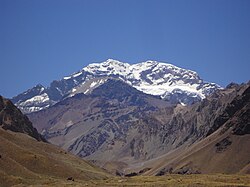
Standing as a titan in the Principal Cordillera of the Andes, Aconcagua is more than just a mountain; it is the highest point in both the Western and Southern Hemispheres. Located in the Mendoza Province of Argentina, this massive peak reaches an elevation of 6,967.16 meters (22,858.1 feet), making it the highest mountain in the Americas and the highest peak outside of Asia. As one of the prestigious Seven Summits—the highest mountains on each of the seven continents—it attracts adventurers from across the globe.
The mountain is situated approximately 15 kilometers from the border between Argentina and Chile and is protected within the Aconcagua Provincial Park. Its geography is defined by the Vacas Valley to the north and east, and the Horcones Inferior Valley to the west and south. The landscape is further shaped by several glaciers, the most significant being the Horcones Inferior glacier, which stretches roughly 10 kilometers in length.
Key Facts
- Elevation: 6,967.16 meters (22,858.1 feet).
- Global Rank: 2nd most topographically prominent peak in the world.
- Location: Mendoza Province, Argentina.
- Climbing Status: Highest non-technical mountain in the world.
- Summit Success Rate: Estimated between 30% and 40%.
- First Recorded Ascent: Matthias Zurbriggen in 1897.
Climbing Aconcagua
Aconcagua is often described as technically straightforward, particularly via the Normal Route from the north. This path is a scramble that requires no specialized equipment or ropes, earning it the reputation of being the world's highest non-technical mountain. However, the lack of technical difficulty is offset by the extreme altitude. At the summit, atmospheric pressure is roughly 40% of that at sea level, making altitude sickness (acute mountain sickness) a common and dangerous challenge for most climbers.
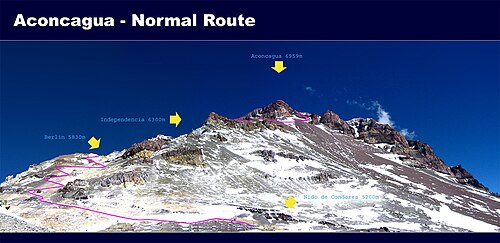
Because of these conditions, the mountain has earned the grim nickname "Mountain of Death," with an average of three deaths recorded per year. To manage the ascent, climbers utilize a series of established camps to acclimatize.
Established Camps on the Normal Route
- Puente del Inca (2,740m): A village with lodge facilities.
- Confluencia (3,380m): An early camp within the national park.
- Plaza de Mulas (4,370m): The primary base camp and one of the largest in the world, featuring medical screenings, internet, and showers.
- Camp Canadá (5,050m): A ledge overlooking the base camp.
- Camp Alaska (5,200m): A less common site known as the "change of slope."
- Nido de Cóndores (5,570m): A large plateau often monitored by park rangers.
- Camp Berlín (5,940m): A classic high camp providing wind protection.
- Camp Colera (6,000m): A popular high camp featuring the "Elena" emergency shelter.
History and Records
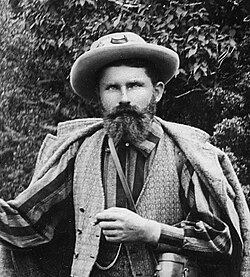
The quest to conquer Aconcagua began in earnest in 1883 when German explorer Paul Güssfeldt reached 6,500 meters. The first recorded successful ascent occurred on January 14, 1897, when Swiss guide Matthias Zurbriggen reached the summit as part of an expedition led by Edward FitzGerald.
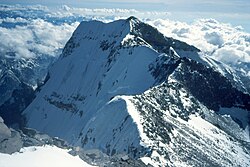
Over the decades, various routes were pioneered, including the Polish Glacier route in 1934 and the challenging South Face in 1954. The mountain has also seen remarkable human achievements: Tyler Armstrong became the youngest person to summit at age nine in 2013, while Scott Lewis reached the peak at age 87 in 2007. In the realm of speed, American Tyler Andrews holds the current record for climbing and descending from Horcones in 11 hours and 24 minutes.
Technological milestones have also reached the peak. In September 2019, an Airbus H145 became the first twin-engine helicopter to land on the summit, enduring temperatures as low as −22 °C.
Cultural and Environmental Significance
Long before modern mountaineering, the Incas regarded Aconcagua as a sacred site. Archaeological discoveries in 1985 revealed a high-altitude worship site at 5,167 meters, where the remains of a high-social-class child (the Aconcagua mummy) were found alongside coca leaves and figures.
Today, the mountain faces significant environmental challenges. The improper disposal of human waste poses health risks to humans and wildlife. To combat this, the park employs a system of eco-friendly toilets and helicopter waste removal, flying out over 22,500 kg of waste each season from the main base camps.
Aconcagua Summary Table
| Feature | Detail |
|---|---|
| Elevation | 6,967.16 m (22,858.1 ft) |
| Prominence Rank | 2nd Globally |
| Parent Range | Principal Cordillera, Andes |
| Primary Route | Normal Route (Northwest) |
| First Ascent | 1897 (Matthias Zurbriggen) |
| Country | Argentina |
Frequently Asked Questions
Is Aconcagua a technical climb?
No, the Normal Route is considered a non-technical scramble that does not require ropes or specialized climbing equipment, though it is physically demanding due to the altitude.
Why is it called the "Mountain of Death"?
The nickname stems from the high risk of altitude sickness and the fact that the mountain records approximately three deaths per year.
Who is the youngest person to summit Aconcagua?
Tyler Armstrong of California is the youngest person to reach the summit, achieving the feat at nine years old in 2013.
How do climbers handle waste on the mountain?
Climbers are encouraged to use eco-friendly toilets provided by organized expeditions. Waste is collected in barrels and flown out by helicopter from base camps like Plaza de Mulas.
What is the success rate for reaching the summit?
It is estimated that only 30% to 40% of climbers who attempt the summit are successful.