Abba Eban: The Eloquent Voice of Israeli Diplomacy
Abba Eban was a towering figure in the early decades of the State of Israel, serving as a diplomat, politician, and scholar. Born in South Africa and educated at Cambridge, Eban became the primary international voice for Israel, utilizing his mastery of languages and oratorical brilliance to navigate the complex geopolitical landscape of the mid-20th century.
Key Facts
- Roles: Served as Israel's first Permanent Representative to the UN and second Ambassador to the United States.
- Government: Held positions as Minister of Foreign Affairs, Minister of Education and Culture, and Deputy Prime Minister.
- Education: Achieved a rare triple first in Hebrew, Arabic, and Persian at Queens' College, Cambridge.
- Linguistic Skill: Mastered ten languages, including Ancient Greek, French, German, and Spanish.
- Legacy: Awarded the Israel Prize in 2001 for his lifetime contribution to society and the state.
Early Life and Academic Brilliance
Born Aubrey Solomon Meir Eban on February 2, 1915, in Cape Town, South Africa, Eban was the son of Lithuanian Jewish parents. His early years were marked by tragedy when his father died in London shortly before Eban's first birthday. As a child, he immersed himself in the study of the Talmud, Biblical literature, and the Hebrew language.
Eban's academic trajectory was extraordinary. At Queens' College, Cambridge, he studied Classics and Oriental languages, earning a triple first in Hebrew, Arabic, and Persian. By age 23, he became a Fellow of Pembroke College. Beyond academia, he was deeply involved in the Federation of Zionist Youth and served as the editor of The Young Zionist.
Military Service and Intelligence
With the onset of World War II, Eban worked for Chaim Weizmann at the Zionist Organization in London. He later served in the British Army in Egypt and Mandate Palestine. In Jerusalem, he operated as an intelligence officer, coordinating volunteers for resistance in the event of a German invasion and acting as a liaison between the Allies and the Jewish Yishuv (the Jewish community in pre-state Palestine).
Following the war, he helped establish the British Foreign Office's Middle East Centre for Arab Studies, initially in Jerusalem and later in Shemlan, Lebanon. During this period, he was known as "Aubrey Evans." He also demonstrated his scholarly depth by translating Tawfiq al-Hakim's 1937 novel, Maze of Justice, from Arabic.
The Architect of International Recognition
Eban's transition to high-level diplomacy began in New York, where he served as a liaison officer to the United Nations Special Committee on Palestine. He played a pivotal role in securing approval for Resolution 181, which recommended the partition of Palestine into Jewish and Arab segments. It was during this time that he adopted the Hebrew name Abba, meaning "Father."
From 1949 to 1959, Eban served as Israel's Permanent Representative to the UN and as the Ambassador to the United States. He became world-renowned for his command of the English language and his ability to captivate audiences, even those hostile to his cause. In 1952, he was elected vice president of the UN General Assembly.
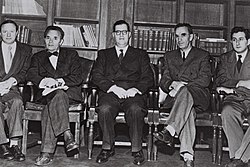
Despite his successes, his tenure was not without controversy. In 1948, Eban vehemently denied accusations from the Arab Higher Committee regarding the use of bacteriological warfare by the Haganah. While he dismissed these claims as antisemitic incitement at the time, records revealed in 2022 regarding "Operation Cast Thy Bread" later substantiated some of these accusations.
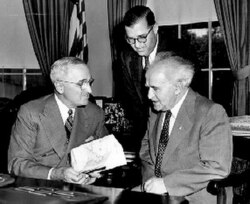
Political Career and Ministerial Roles
Returning to Israel in 1959, Eban entered the Knesset as a member of the Mapai party. He held several high-ranking positions, including Minister of Education and Culture (1960–1963) and Deputy Prime Minister (1963–1966). Simultaneously, he served as the president of the Weizmann Institute of Science.
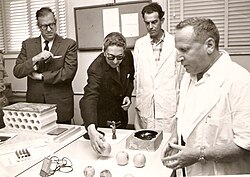
As Minister of Foreign Affairs from 1966 to 1974, Eban was the face of Israel during the Six-Day War. He defended Israel's actions at the UN, arguing the country responded to an imminent threat. He was instrumental in shaping UN Security Council Resolution 242 (1967) and Resolution 338 (1973). Though often viewed as a "dove"—a term for those favoring diplomacy and territorial compromise for peace—he remained a staunch defender of the state's security.
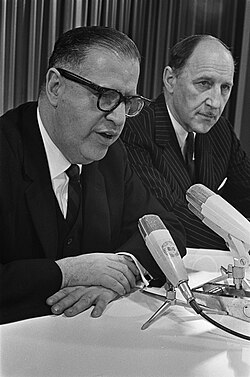
Later Years and Intellectual Contributions
After leaving the cabinet, Eban remained active in politics, chairing the Knesset's Foreign Affairs and Defense Committee from 1984 to 1988. After losing his seat in 1988, he transitioned to a career in academia and writing. He served as a visiting academic at prestigious institutions, including Princeton, Columbia, and George Washington University.
Eban authored numerous books on diplomacy and Jewish history, including My People: The Story of the Jews and Diplomacy for the Next Century. He also hosted and narrated several PBS documentaries. He passed away on November 17, 2002, in Tel Aviv at the age of 87.
| Period | Role | Organization/Entity |
|---|---|---|
| 1949–1959 | Permanent Representative | United Nations |
| 1950–1959 | Ambassador | United States |
| 1960–1963 | Minister of Education & Culture | Government of Israel |
| 1963–1966 | Deputy Prime Minister | Government of Israel |
| 1966–1974 | Minister of Foreign Affairs | Government of Israel |
| 1984–1988 | Chair, Foreign Affairs & Defense Committee | Knesset |
Frequently Asked Questions
What was Abba Eban's most famous quote?
He is widely remembered for his remark regarding the Palestinians: "The Arabs never miss an opportunity to miss an opportunity," referring to missed chances for peace.
How many languages did Abba Eban speak?
Eban reportedly mastered ten languages, including Hebrew, Arabic, Persian, Ancient Greek, French, German, Spanish, English, Latin, and Modern Hebrew.
What was Eban's role in the creation of the State of Israel?
He served as a liaison officer to the United Nations Special Committee on Palestine in 1947, where he was successful in gaining approval for Resolution 181, the partition plan for Palestine.
What academic achievements did he have at Cambridge?
Eban achieved a very rare triple first in Hebrew, Arabic, and Persian at Queens' College, Cambridge, and later became a Fellow of Pembroke College.
Which Israeli prize did he receive?
In 2001, Abba Eban was awarded the Israel Prize for his lifetime achievement and special contributions to the State and society.