President of the State of Israel
The President of the State of Israel serves as the nation's head of state, acting as a symbol of national unity and the personification of the Israeli state. While the role is primarily ceremonial, the presidency provides a non-partisan influence that ensures stability and continuity within the government. Unlike the Prime Minister, who wields executive power, the President focuses on representing Israel internationally and fostering cohesion domestically.
The current incumbent is Isaac Herzog, who assumed office on July 7, 2021. He is the 11th person to hold this position since the office was established on February 16, 1949.
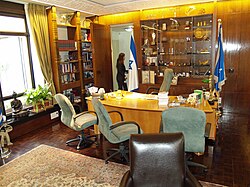
Key Facts
- Incumbent: Isaac Herzog (since July 7, 2021).
- Term Length: A single, non-renewable seven-year term.
- Appointer: Elected by the Knesset (the Israeli parliament).
- Residence: Beit HaNassi.
- Annual Salary: US$ 173,255.
- First Holder: Chaim Weizmann.
Election and Tenure
The President is elected by an absolute majority of the Knesset via a secret ballot. If no candidate achieves a majority in the first two rounds, the candidate with the fewest votes is eliminated in each subsequent round until only two remain.
Eligibility is broad: any Israeli resident citizen may run for the office. Notably, there is no minimum age requirement, meaning a minor could hypothetically be elected. To maintain the non-partisan nature of the role, the presidential tenure is not linked to the term of the Knesset. If the President is unable to serve or the office becomes vacant, the Speaker of the Knesset serves as the acting president, as there is no vice president in the Israeli system.
Evolution of the Term
From 1949 until 2000, presidents served five-year terms and could be elected up to twice. Since 2000, the law has shifted to a single, seven-year term to further insulate the office from political cycles.
Powers and Responsibilities
The presidency is governed by Basic Law: The Presidency (1964) and Basic Law: The Government. While the President is the head of state, executive power is vested in the Cabinet, led by the Prime Minister. Most presidential acts require a countersignature from the Prime Minister or another designated minister to be legally effective.
Routine Functions
The President performs several essential administrative and symbolic duties:
- Signing bills passed by the Knesset into law (excluding those regarding presidential powers).
- Ratifying international and bilateral treaties.
- Endorsing credentials for Israeli ambassadors and receiving foreign diplomats.
- Appointing public officials, including judges (based on Judicial Selection Committee nominations), the governor of the Bank of Israel, and various academic and medical leaders.
Reserve Powers
The President possesses specific reserve powers—discretionary functions that do not require government advice:
- Government Formation: After elections, the President consults party leaders and assigns a Knesset member the task of forming a government. If the nominee fails, the President may assign the task to another member or dissolve the Knesset for new elections.
- Dissolution of the Knesset: The President may refuse a Prime Minister's request to dissolve the Knesset if the government has lost its majority, preventing the abuse of snap elections.
- Presidential Clemency: The President has the absolute discretion to pardon, reduce, or commute sentences for civilians and soldiers.
Ceremonial Roles and Honors
Beyond constitutional duties, the President is involved in high-level national honors. This includes conferring the title of Righteous Among the Nations (via Yad Vashem), presenting the Wolf Prize, and awarding the Presidential Medal of Honor. The President also delivers keynote addresses at the opening of the Knesset conference and official ceremonies for Yom Hazikaron (Remembrance Day) and Yom HaShoah (Holocaust Remembrance Day).
Presidential Backgrounds and Affiliations
Historically, most presidents were deeply involved in Zionist activities or national politics. Early presidents were often born in the former Russian Empire. Diversity in the office has grown over time: Yitzhak Navon was the first native-born and Sephardi president, Chaim Herzog was the first with a Western European background, and Moshe Katsav was the first of Mizrahi background. Isaac Herzog is the first president born in the modern state of Israel and the first son of a former president to hold the office.
Politically, most presidents from Yitzhak Ben-Zvi to Ezer Weizman were associated with the Labor Party. Moshe Katsav was the first president from the Likud party. Interestingly, the office has occasionally attracted non-political figures; Albert Einstein was offered the presidency in 1952 but declined, citing a lack of aptitude for dealing with people and official functions.
| Feature | Detail |
|---|---|
| Role Type | Head of State (Primarily Ceremonial) |
| Election Method | Absolute majority of the Knesset via secret ballot |
| Term | 7 years (Non-renewable) |
| Key Reserve Powers | Government formation, Knesset dissolution, Pardons |
| Legal Immunity | Immune from civil suit and criminal prosecution for official functions |
Frequently Asked Questions
Does the President of Israel have executive power?
No. Executive power is vested in the Government (the Cabinet) and led by the Prime Minister. The President's role is largely ceremonial, though they hold specific reserve powers regarding government formation and pardons.
How is the President of Israel elected?
The President is elected by the Knesset through a secret ballot. A candidate must receive an absolute majority of votes to win.
Can a President be re-elected?
No. Since 2000, the President serves a single seven-year term and is not eligible for re-election.
What happens if the President is unable to perform their duties?
In the event of temporary incapacity or a vacancy in the office, the Speaker of the Knesset serves as the acting president.
What is the most significant power the President holds?
In practice, the most important power is leading the process of government formation by consulting party leaders and appointing a member of the Knesset to form a government.