Zeid Ra'ad al-Hussein: A Legacy of Global Diplomacy and Human Rights
Prince Zeid Ra'ad bin Zeid al-Hussein is a distinguished Jordanian diplomat and legal scholar whose career has spanned the highest levels of international governance. From his early days in the Jordanian desert police to leading the United Nations' human rights apparatus, Zeid has dedicated his professional life to the intersection of law, peace, and human dignity. Today, he continues to influence global policy as the president and CEO of the International Peace Institute and the Perry World House Professor of the Practice of Law and Human Rights at the University of Pennsylvania.
Key Facts
- UN Human Rights Chief: Served as the United Nations High Commissioner for Human Rights from 2014 to 2018, becoming the first Muslim to hold the position.
- ICC Pioneer: Played a central role in establishing the International Criminal Court (ICC) and served as the first president of its Assembly of State Parties (2002–2004).
- Jordanian Diplomacy: Represented Jordan as the Permanent Representative to the UN (two terms) and as the Ambassador to the United States.
- Global Leadership: Member of The Elders, an independent group of global leaders founded by Nelson Mandela.
- Academic Excellence: Holds a PhD from Christ's College, Cambridge, and a B.A. from Johns Hopkins University.
Early Life and Academic Foundation
Born on January 26, 1964, in Amman, Jordan, Zeid was raised within the Hashemite house. His education was international in scope, beginning at Reed's School in Surrey, United Kingdom, and continuing at Johns Hopkins University in the United States, where he graduated in 1987. He furthered his academic pursuits at Christ's College, Cambridge, earning a PhD in 1993. His lifelong connection to Cambridge was later formalized in 2016 when he was named an Honorary Fellow of the college.
Zeid's entry into public service began in 1989 with a commission as an officer in the Jordanian desert police. This foundational experience in security and order transitioned into international peacekeeping between 1994 and 1996, when he served as a political affairs officer for UNPROFOR (the United Nations Protection Force) in the former Yugoslavia.
A Distinguished Diplomatic Career
Zeid's ascent in the diplomatic world was marked by strategic roles in New York and Washington. He served as Jordan's Permanent Representative to the United Nations from 2000 to 2007, and again from 2010 to 2014. During the interim, from 2007 to 2010, he served as Jordan's Ambassador to the United States and non-resident Ambassador to Mexico.
Beyond bilateral relations, Zeid became a cornerstone of international criminal law. He was instrumental in the creation of the International Criminal Court and chaired critical negotiations regarding the definitions of genocide, war crimes, and crimes against humanity. His leadership extended to the UN Security Council, where he served as president in January 2014, overseeing sanctions committees related to Liberia and the Democratic Republic of the Congo.
One of his most enduring contributions to UN internal policy was the "Zeid Report." While serving as the Advisor to the Secretary-General on Sexual Exploitation and Abuse in UN Peacekeeping, he produced a comprehensive report aimed at eliminating such abuses from all peacekeeping operations.
Tenure as UN High Commissioner for Human Rights
In September 2014, Zeid assumed the role of United Nations High Commissioner for Human Rights. His tenure was characterized by a fearless approach to calling out atrocities and systemic failures regardless of the perpetrator's political standing.
He was particularly vocal against the Islamic State (ISIS), describing the group's vision as a "house of blood" and advocating for human rights education for all children starting before the age of nine to prevent such ideologies from taking root. He also drew parallels between the lessons of the Holocaust and the need to combat modern extremism.
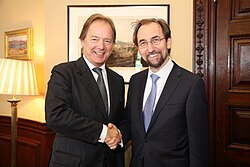
Throughout his term, Zeid challenged various global powers. He criticized the Saudi-led intervention in Yemen, suggesting potential war crimes, and condemned the execution of juveniles in Iran. He also expressed alarm over the post-coup purges in Turkey and the lack of UN access to Kashmir.
Domestic Policy and International Friction
Zeid's commitment to human rights occasionally led to friction with sovereign states. He urged the UK to prevent xenophobia following the Brexit referendum and expressed concern that the rhetoric of Donald Trump's presidential campaign could be "dangerous from an international point of view." These comments drew formal complaints from the Russian government, illustrating the delicate balance between a human rights mandate and diplomatic neutrality.
Summary of Professional Milestones
| Period | Role/Organization | Key Focus/Achievement |
|---|---|---|
| 1994–1996 | UNPROFOR | Political Affairs Officer in former Yugoslavia |
| 2000–2007; 2010–2014 | Permanent Representative of Jordan to the UN | Diplomatic leadership and Security Council Presidency |
| 2002–2004 | President, Assembly of State Parties (ICC) | Establishment of the International Criminal Court |
| 2007–2010 | Ambassador of Jordan to the USA | Bilateral relations and non-resident Ambassador to Mexico |
| 2014–2018 | UN High Commissioner for Human Rights | Global human rights advocacy and the "Zeid Report" |
| 2019–Present | The Elders / IPI / UPenn | Peacebuilding, academia, and global leadership |
Frequently Asked Questions
What is the "Zeid Report"?
The Zeid Report is a landmark document produced by Zeid Ra'ad al-Hussein during his time as Advisor to the Secretary-General. It focused on eliminating sexual exploitation and abuse within United Nations peacekeeping operations.
Was Zeid Ra'ad al-Hussein the first Muslim to lead the UN Human Rights Office?
Yes, upon his appointment in 2014, he became the first Muslim to serve as the United Nations High Commissioner for Human Rights.
What role did he play in the International Criminal Court?
Zeid played a central role in the ICC's establishment and was elected as the first president of the Assembly of State Parties to the Rome Statute from 2002 to 2004.
Which academic institutions is he associated with?
He is an alumnus of Johns Hopkins University and Christ's College, Cambridge (where he is an Honorary Fellow). He currently serves as the Perry World House Professor of the Practice of Law and Human Rights at the University of Pennsylvania.
What is "The Elders"?
The Elders is an independent group of global leaders, founded by Nelson Mandela, who work together for peace, justice, and human rights. Zeid was invited to join this group in 2019.