Yellow Supergiants: Evolutionary Paths and Stellar Dynamics
In the vast landscape of the Hertzsprung-Russell (HR) diagram—the graph used by astronomers to classify stars by temperature and luminosity—yellow supergiants occupy a unique and complex position. Unlike stars that remain stable for billions of years, yellow supergiants are a heterogeneous group. They are not a single type of star, but rather a collection of stars crossing through a specific temperature range at various stages of their evolution.
These celestial giants appear when stars evolve away from the main sequence, the primary stage of a star's life where it fuses hydrogen into helium in its core. Once this hydrogen is exhausted, the star undergoes dramatic structural changes, expanding in size and shifting in color.
Key Facts
- Yellow supergiants make up less than 1% of all stars due to their brief evolutionary phases.
- They often represent a transitional phase between blue and red supergiant stages.
- Many yellow supergiants pulsate as Classical Cepheid variables when crossing the instability strip.
- Stars between 5 M☉ and 12 M☉ can spend up to 10 million years in this phase during a "blue loop."
- Post-AGB stars can reach luminosities of 10,000 L☉ or higher while appearing as yellow supergiants.
The Path of High-Mass Stars
Stars with masses greater than 8–12 M☉ (solar masses) begin their lives as hot, luminous class O and early B stars. After spending a few million years on the main sequence, their core hydrogen is depleted, triggering an expansion and cooling process.
These stars typically spend a few thousand years as yellow supergiants while cooling before transitioning into red supergiants, a phase that lasts between one and four million years. Because these transitions happen so quickly relative to the star's total lifespan, these stars are exceptionally rare in the modern universe.
Some red supergiants experience a blue loop, a process where the star temporarily re-heats and shifts back toward the yellow or blue spectrum before cooling once more. These loops are most common in red supergiants with lower masses and depend heavily on the star's specific chemical composition.
The Instability Strip and Pulsation
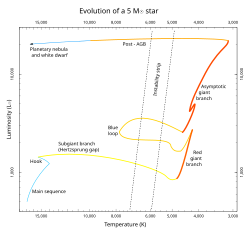
When a star cools for the first time or undergoes an extended blue loop, it may cross the instability strip—a region of the HR diagram where stars become unstable to pulsations. In this region, yellow supergiants act as Classical Cepheid variables, characterized by pulsation periods of ten days or longer.
Intermediate and Low-Mass Evolution
Stars with intermediate masses (roughly 2 M☉ to 12 M☉) follow a different trajectory. After leaving the main sequence, they cool along the subgiant branch toward the red-giant branch. Because their helium cores are sufficiently large, fusion begins before the core becomes degenerate (a state of extremely high density where quantum pressure supports the star).
For stars between 5 M☉ and 12 M☉, the resulting blue loop can extend to F and G spectral types with luminosities reaching 1,000 L☉. These stars often develop supergiant luminosity classes and pulsate as short-period Cepheids. Because these loops can last approximately 10 million years, this category of yellow supergiant is more common than the high-mass variety.
The Asymptotic Giant Branch (AGB) and Post-AGB Phase
Low-mass stars, similar to the Sun, develop degenerate helium cores and ignite helium in a "flash" at the tip of the red-giant branch. While their horizontal branch phase is too dim for supergiant classification, they later enter the asymptotic giant branch (AGB).
As these stars move from the blue half of the horizontal branch toward the AGB, they pass through yellow classifications and pulsate as BL Herculis variables. Thermal pulses from the helium-fusing shell can trigger further blue loops, causing them to pulsate as W Virginis variables.
Eventually, as the hydrogen-fusing shell nears the surface, the star sheds its outer layers. This exposes the hot interior, causing the star to heat up and transition toward becoming a white dwarf. During this brief post-AGB phase, stars can reach luminosities of 10,000 L☉ or more, appearing as yellow supergiants and pulsating as RV Tauri variables.
Supernovae and Anomalies
While most first-time yellow supergiants transition to the red supergiant stage without exploding, the end of the cycle is more volatile for others. Some post-red supergiant yellow supergiants may experience core collapse, triggering a supernova.
Interestingly, some supernovae have been linked to yellow supergiant progenitors that lack the luminosity of post-red supergiants. If confirmed, this suggests that moderate-mass stars with helium cores can undergo core-collapse supernovae, likely due to binary star interactions.
Historical observations also provide clues to this volatility. Reports from Chinese astronomers in the 2nd or 1st century BC described the red supergiant Betelgeuse as yellow, suggesting it may have been in a yellow supergiant phase at that time.
| Star Mass | Primary Path | Pulsation Type | Typical Duration/Luminosity |
|---|---|---|---|
| > 8–12 M☉ | Main Sequence → Yellow → Red | Classical Cepheids | Few thousand years (Yellow phase) |
| 5–12 M☉ | Blue Loop (Intermediate) | Short-period Cepheids | Up to 10 million years |
| Low Mass (< Sun) | Post-AGB → White Dwarf | RV Tauri / W Virginis | ≥ 10,000 L☉ |
Frequently Asked Questions
What exactly is a yellow supergiant?
A yellow supergiant is not a single type of star but a classification for various stars that pass through the yellow region of the HR diagram. This includes high-mass stars cooling toward the red supergiant stage, intermediate-mass stars in a blue loop, and low-mass stars in the post-AGB phase.
Why are yellow supergiants so rare?
They are rare because the yellow supergiant phase is an evolutionary transition. Stars spend millions of years on the main sequence, but only a few thousand to a few million years as yellow supergiants before moving to another stage or ending their lives.
What is a blue loop?
A blue loop is an evolutionary event where a red supergiant temporarily re-heats, moving from the red part of the HR diagram back toward the blue/yellow region before eventually cooling again.
Can a yellow supergiant become a supernova?
Yes. While many transition to red supergiants, some post-red supergiant yellow supergiants can undergo core collapse. Additionally, some moderate-mass yellow supergiants may trigger supernovae through binary star interactions.
What are Cepheid variables?
Cepheid variables are stars that pulsate in luminosity. Yellow supergiants become Cepheids when they cross the instability strip, a specific temperature range that triggers these regular pulsations.