Neutron Stars: The Universe's Densest Stellar Remnants
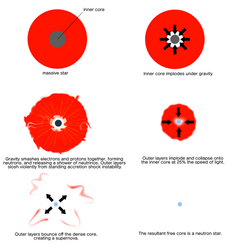
In the vast lifecycle of stars, few objects are as extreme as the neutron star. Born from the violent collapse of massive stars, these stellar remnants compress a mass greater than that of our Sun into a sphere no larger than a small city. They represent one of the most exotic states of matter in the known universe, pushing the laws of physics to their absolute limits.
Key Facts
- Mass: Typically ranges from 1.44 to approximately 2.9 solar masses (M ☉).
- Size: Extremely compact, often with a radius of around 10 to 12 kilometers.
- Temperature: Surface temperatures can reach at least 42,000 K.
- Density: So dense that a sphere just 25 kilometers in diameter can contain 500,000 Earth-masses.
- Discovery: First identified as pulsars in 1967 by Jocelyn Bell Burnell and Antony Hewish.
Physical Properties and Structure
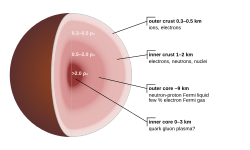
A neutron star is a class of stellar remnant characterized by its incredible density and pressure. To understand its scale, consider that a white dwarf—another type of stellar remnant—is roughly the size of Earth (6,000 km radius), whereas a neutron star is only about 10 km in radius.

The internal structure of these stars is governed by the equation of state, which describes the relationship between pressure and density. This is often modeled using the Tolman–Oppenheimer–Volkoff equation to determine the maximum mass a neutron star can support before collapsing into a black hole. Because of their immense mass, neutron stars exhibit extreme gravity, which causes relativistic light deflection—a phenomenon where gravity bends light so severely that more than half of the star's surface is visible to a distant observer.
![Gravitational light deflection at a neutron star. Due to relativistic light deflection, over half the surface is visible (each grid patch represents 30° by 30°).[52] This star's radius is twice its Schwarzschild radius.[52]](/images/9d/7f/9d7fc48f784340dfaa50cb1ddf26b1c55aaf20370d40d3b3014b553ff1c0646b.webp)
Mass and Radius Relationships
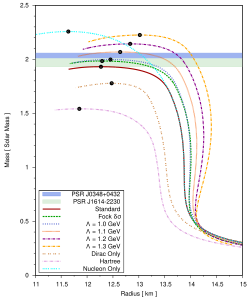
The relationship between a neutron star's mass and its radius is a primary focus for astrophysicists. For example, a neutron star with a mass of 2 M ☉ would have a radius of no less than 10,970 meters according to certain models. Observations of specific stars, such as PSR J0348+0432 (2.01 ± 0.04 M ☉) and PSR J0952−0607 (2.35 M ☉), help scientists constrain the possible compositions of their interiors.
Pulsars and Radiation
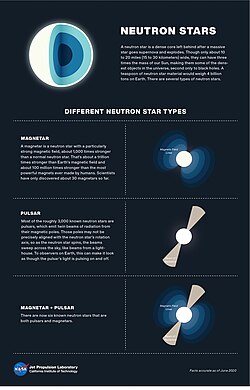
Many neutron stars are observed as pulsars—highly magnetized, rapidly rotating neutron stars that emit beams of electromagnetic radiation. As the star spins, these beams sweep across Earth like a lighthouse beacon, creating regular radio pulses. The energy driving this emission is the star's own rotational energy.
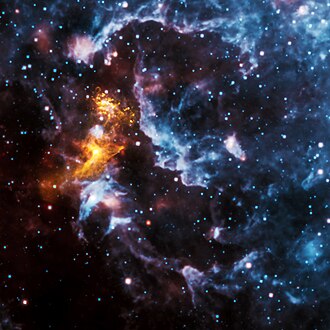
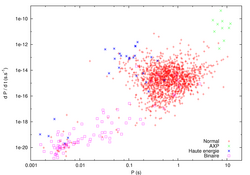
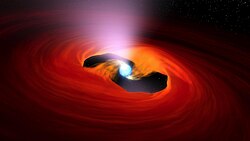
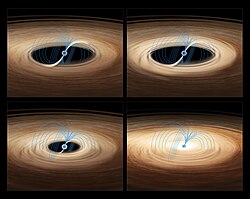
While most pulsars emit radio waves, others are detected via X-rays. X-ray pulsars often exist in binary systems where they pull matter from a companion star, creating an accretion disk that emits powerful X-rays along the magnetic axis.
Rotation and "Starquakes"
Neutron stars can experience sudden changes in their rotation speed. A glitch is a sudden increase in spin rate, while an anti-glitch is a sudden decrease. These events are often attributed to starquakes (stellar quakes), where the star's rigid crust cracks and readjusts under immense stress.
Types of Neutron Stars
Depending on their magnetic field strength and environment, neutron stars are categorized into several subtypes:
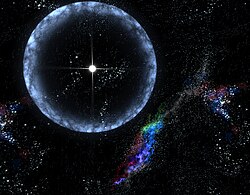
- Magnetars: Neutron stars with extremely powerful magnetic fields, including Soft Gamma Repeaters (SGR) and Anomalous X-ray Pulsars (AXP).
- Millisecond Pulsars (MSP): "Recycled" pulsars that spin hundreds of times per second.
- Spider Pulsars: Binary systems where the pulsar consumes its companion; these include "Black Widows" and "Redbacks."
- Isolated Neutron Stars: Stars like the "Magnificent Seven" that are X-ray dim and do not pulse in radio frequencies.
Binary Systems and Mergers
When two neutron stars orbit each other in a binary system, they eventually spiral inward and collide. These binary neutron star mergers are cataclysmic events that generate gravitational waves and trigger nucleosynthesis, the process that creates heavy elements like gold.
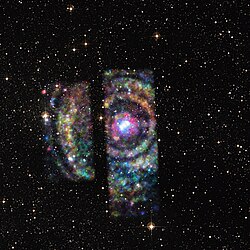
The result of such a merger is typically the formation of a black hole surrounded by a debris disk of remaining matter.
Summary of Neutron Star Characteristics
| Property/Example | Details/Value |
|---|---|
| Typical Mass Range | 1.44 – 2.9 M ☉ |
| Typical Radius | ~10 – 12 km |
| Heaviest Known | PSR J0952−0607 (2.35 M ☉) |
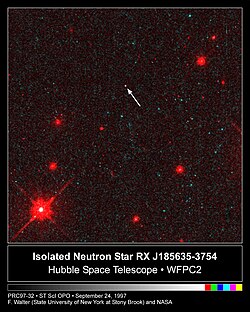
| Closest Known | RX J1856.5−3754 |
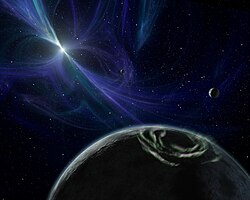
| First Planet Discovery | PSR B1257+12 |
Frequently Asked Questions
How are neutron stars different from black holes?
While both are incredibly dense, a neutron star has a physical surface and is supported by neutron degeneracy pressure. A black hole is so massive that it collapses completely into a singularity, from which not even light can escape.
What is a pulsar?
A pulsar is a rotating neutron star that emits beams of radiation from its magnetic poles. Because the star rotates, these beams appear as regular pulses to an observer on Earth.
Can planets exist around a neutron star?
Yes. The first exoplanets ever discovered were found orbiting the millisecond pulsar PSR B1257+12, proving that planetary systems can exist or reform around these remnants.
What happens when two neutron stars collide?
A collision produces a massive explosion, releases gravitational waves, and creates heavy elements through nucleosynthesis. The merger usually results in the formation of a black hole.
What is a starquake?
A starquake is a rupture in the crust of a neutron star. These events can cause "glitches," which are sudden changes in the star's rotation speed.