Royal Astronomical Society Gold Medal: History and Legacy
The Gold Medal of the Royal Astronomical Society (RAS) stands as the most prestigious honor bestowed by the society. Primarily designed to recognize lifetime achievement in the fields of astronomy and geophysics, the medal has also been awarded on occasion to honor a singular, groundbreaking discovery. Since its inception, it has served as a benchmark for excellence in our understanding of the universe and the physical properties of the Earth.
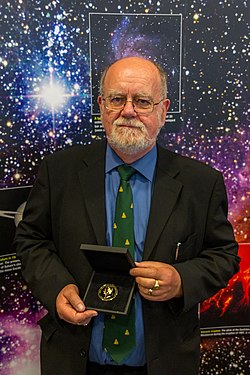
The medal itself features an image of the 40-foot telescope constructed by Sir William Herschel, who served as the first President of the RAS. Today, the award is split to ensure balance across scientific disciplines: one medal is awarded for astronomy (which encompasses astrophysics and cosmology) and one for geophysics (including planetary science and tectonics).
Key Facts
- Established: First awarded in 1824.
- Scope: Recognizes achievements in astronomy and geophysics.
- Frequency: Two medals are awarded annually (one per field).
- First Female Recipient: Caroline Herschel in 1828.
- Current Holders: Shrinivas Kulkarni and Andrew Jackson (2026).
Evolution of the Award
Founded in 1820, the RAS began awarding gold medals in 1824. While silver medals were briefly introduced in 1824 and 1827, they were quickly phased out in favor of other specialized awards. In the early years, the number of medals awarded varied; often multiple medals were given in a single year, but by 1833, a bye-law restricted the award to just one recipient per year.
This restrictive practice lasted for over a century, with only a few exceptions in 1867 and 1886. It was not until 1964 that the RAS expanded the award to two medals per year to properly reflect the distinct research areas of astronomy and geophysics.
The history of the medal also reflects the slow progress of gender representation in the field. While Caroline Herschel became the first woman to receive the honor in 1828, it took nearly 170 years before another woman, Vera Rubin, was recognized in 1996. In 2005, Margaret and Geoffrey Burbidge became the first pair to receive a joint award since 1886.
The Neptune Controversy
One of the most famous episodes in the medal's history occurred following the discovery of Neptune in 1846. Three astronomers were central to the event: Urbain Le Verrier and John Couch Adams, who independently predicted the planet's existence, and Johann Gottfried Galle, who performed the actual observation based on Le Verrier's calculations.
Because of the strict one-medal-per-year bye-law, the RAS Council faced a dilemma. While Le Verrier was initially the strongest candidate due to his formal publication, many members believed Adams deserved equal credit. Unable to reach the required 3:1 super-majority to confirm Le Verrier and forbidden from awarding the medal jointly, the RAS awarded no gold medal in 1847.
The society attempted to resolve the tension in 1848 by issuing 12 "testimonial" awards to various nominees, including Adams and Le Verrier, though Galle was excluded. This decision was later criticized as a "fudged" solution. Eventually, Adams and Le Verrier received gold medals in 1866 and 1868, respectively, though officially for work unrelated to Neptune.
Political Tensions and General Relativity
The medal has occasionally been influenced by geopolitical climates, most notably in the case of Albert Einstein. In 1919, Arthur Eddington's solar eclipse expedition confirmed Einstein's general theory of relativity (the geometric theory of gravitation), making Einstein an immediate favorite for the 1920 medal.
Despite being voted the strongest candidate in December, the RAS Council failed to confirm the award in January 1920. This was largely due to political sensitivities, as Britain was still technically at war with Germany, and Einstein held joint German and Swiss citizenship. This led to the embarrassing situation where Eddington had already informed Einstein he would win, only to later withdraw the news.
Einstein was nominated again in 1921, but the award went to Henry Norris Russell due to ongoing controversy. Einstein finally received his gold medal in 1926 after the political environment stabilized. Interestingly, Eddington received his own medal in 1924, partly for his role in confirming Einstein's theories.
Award Summary
| Detail | Information |
|---|---|
| Country of Origin | United Kingdom |
| First Award Year | 1824 |
| Award Categories | Astronomy & Geophysics |
| Current Awardees | Shrinivas Kulkarni & Andrew Jackson |
| Official Website | ras.ac.uk/awards-and-grants/awards |
Throughout its history, the medal has honored some of the greatest minds in science, from Charles Babbage and Henri Poincaré to Stephen Hawking and Vera Rubin.
Frequently Asked Questions
How many RAS Gold Medals are awarded each year?
Currently, two medals are awarded annually: one for achievements in astronomy (including astrophysics and cosmology) and one for geophysics (including planetary science and tectonics).
Who was the first woman to win the RAS Gold Medal?
Caroline Herschel was the first woman to receive the award in 1828. The second woman to receive the honor was Vera Rubin in 1996.
Why was no medal awarded in 1920?
No medal was awarded in 1920 because of political tensions following World War I. The Council felt it was inappropriate to award the medal to Albert Einstein, a German citizen, while Britain was still technically at war with Germany.
What is the significance of the image on the medal?
The medal features an image of the 40-foot telescope built by Sir William Herschel, who was the first President of the Royal Astronomical Society.
Why did the discovery of Neptune cause a controversy?
A bye-law restricting the award to one person per year prevented the RAS from jointly honoring Urbain Le Verrier and John Couch Adams, who both predicted the planet's existence. This resulted in no gold medal being awarded in 1847.