Yellow Foxtail Anatomy and Biological Structure
The term Yellow Foxtail refers to several plant species, including Pennisetum glaucum (formerly Setaria glauca) and Setaria pumila, the latter of which is native to Europe. By examining the internal structures of Setaria pumila, we can observe the classic characteristics of a monocotyledon (monocot)—a group of flowering plants whose seeds contain only one embryonic leaf.
Analyzing the anatomy of this plant reveals how its roots, stems, and leaves are specialized for efficient nutrient transport and gas exchange, allowing it to thrive in diverse environments.
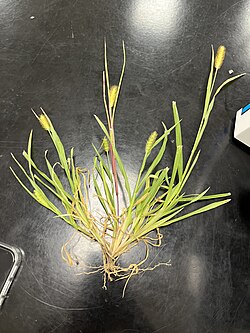
Key Facts
- Scientific Name: Setaria pumila (for the European native variety).
- Plant Type: Monocotyledon (monocot).
- Root Structure: Features a distinct central pith and a ring of vascular bundles.
- Stem Structure: Characterized by scattered vascular bundles throughout the ground tissue.
- Leaf Features: Parallel venation with stomata arranged in neat, parallel rows.
Root Anatomy of Setaria pumila
The root system of the Yellow Foxtail exhibits typical monocot anatomy. The outermost layer is the epidermis, which protects the inner tissues. Beneath this lies a broad cortex composed of parenchyma cells—versatile plant cells used for storage and structural support.
A critical boundary exists between the cortex and the stele (the central part of the root), known as the endodermis. This layer contains the Casparian strip, a waterproof band that regulates the flow of water and minerals into the vascular cylinder. Inside this cylinder, the xylem (which transports water) and phloem (which transports nutrients) are arranged in a ring of alternating vascular bundles. Unlike dicot roots, the Yellow Foxtail root possesses a distinct central core of parenchyma called the pith.
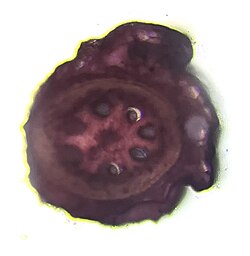
Stem Composition and Transport
The stem of the Yellow Foxtail further distinguishes it as a monocot. While dicots typically arrange their vascular tissues in a ring, the vascular bundles in Setaria pumila are scattered throughout the ground tissue. Each bundle is encased in a protective bundle sheath and contains both xylem and phloem to move water, minerals, and sugars throughout the plant.
The surrounding ground tissue consists primarily of parenchyma cells, which provide the necessary structural support and serve as nutrient storage sites.
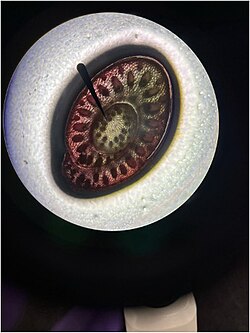
Leaf Structure and Gas Exchange
The leaves of the Yellow Foxtail are adapted for maximum photosynthetic efficiency. A cross section reveals an upper and lower epidermis enclosing the mesophyll, a layer of cells packed with chloroplasts where photosynthesis occurs. Parallel vascular bundles run through the blade, transporting water to the mesophyll and carrying sugars away to the rest of the plant.
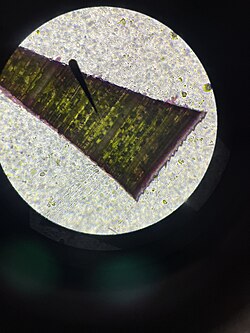
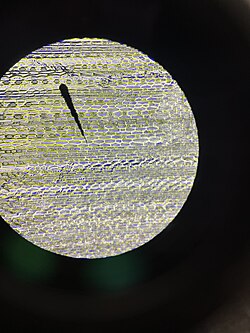
On the surface of the leaf, the epidermis contains stomata—small openings flanked by pairs of guard cells. These stomata regulate gas exchange by allowing carbon dioxide to enter for photosynthesis while releasing oxygen and water vapor. In Setaria pumila, these stomata are organized in parallel rows that align with the leaf's veins, optimizing the delivery of water and nutrients to the photosynthetic cells.
Summary of Monocot Characteristics in Yellow Foxtail
| Plant Part | Key Structural Feature | Biological Function |
|---|---|---|
| Root | Central Pith & Ringed Vascular Bundles | Water/mineral transport and structural support |
| Stem | Scattered Vascular Bundles | Nutrient transport and storage |
| Leaf | Parallel Venation & Mesophyll | Photosynthesis and sugar transport |
| Epidermis | Parallel Rows of Stomata | Regulated gas exchange (CO2/O2) |
Frequently Asked Questions
What is the scientific name for Yellow Foxtail?
Yellow Foxtail can refer to several plants, most notably Setaria pumila (native to Europe) and Pennisetum glaucum (formerly known as Setaria glauca).
How do the roots of Yellow Foxtail differ from dicot roots?
Unlike dicot roots, which usually lack a central core of parenchyma, the monocot roots of the Yellow Foxtail have a distinct central pith.
What is the purpose of the Casparian strip in the root?
The Casparian strip is located within the endodermis and acts as a boundary that regulates the movement of water and minerals from the cortex into the stele.
How are the vascular bundles arranged in the stem?
In the Yellow Foxtail stem, the vascular bundles are scattered throughout the ground tissue rather than being arranged in a ring, which is a defining trait of monocots.
What role do stomata play in the Yellow Foxtail leaf?
Stomata are openings controlled by guard cells that facilitate gas exchange, allowing the plant to take in carbon dioxide for photosynthesis and release oxygen and water vapor.