Understanding the Plant Cortex: The Essential Outer Layer
When we examine the anatomy of a plant, we often focus on the visible leaves or the sturdy bark. However, beneath the surface lies a critical structural and functional layer known as the cortex. In vascular plants, the cortex serves as a vital intermediary zone, situated between the epidermis—the plant's outermost "skin"—and the vascular bundles that transport water and nutrients.
At its most basic level, the cortex is composed primarily of parenchyma cells, which are large, thin-walled cells belonging to the ground tissue system. These cells typically show very little structural differentiation. However, the cells located toward the outer edge of the cortex often develop irregularly thickened walls; these specialized cells are known as collenchyma cells, providing essential mechanical support to the plant.
The Role of the Cortex in Stems and Branches
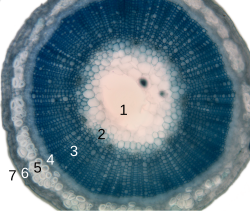
The organization of the cortex varies depending on the type of plant. In herbaceous stems—those that are soft and green—the plant is organized into concentric cylinders. The epidermis, cortex, and vascular cambium (the layer of tissue that produces new vascular cells) wrap around a central core called the pith.
Interestingly, some cells within the herbaceous cortex contain chloroplasts. This gives these areas a green pigment and allows the stem to perform photosynthesis, the process of converting light into simple carbohydrates.
In woody plants, the cortex is positioned between the periderm (the protective outer bark) and the vascular tissue, specifically the phloem. In these plants, the cortex facilitates the movement of materials into the root's central cylinder through diffusion and serves as a storage site for food in the form of starch.
The Cortex in Root Systems
In the roots of vascular plants, the cortex is far more prominent, occupying a significantly larger portion of the organ's total volume than it does in stems. The cells here are loosely packed, creating intercellular spaces that allow for the efficient movement of oxygen and water.
Beyond facilitating transport, the root cortex acts as a primary storage area for reserve foods. The innermost boundary of this region is the endodermis. This specialized layer is critical for the plant's survival, as it stores starch and regulates the transport of plant hormones, ions, and water moving into the center of the root.
The Cortex in Lichens
While we typically associate the cortex with vascular plants, the term is also used in the study of lichens. In this context, the cortex is the surface layer or "skin" of the nonfruiting part of the lichen's body. This outer layer of thallus tissue (the vegetative body of the lichen) protects the undifferentiated cells of the medulla located beneath it.
The structure of the lichen cortex varies by species:
- Fruticose lichens: Feature a single cortex that encircles their branches, even in flattened, leaf-like varieties.
- Foliose lichens: Possess distinct upper and lower cortices.
- Crustose, placodioid, and squamulose lichens: Have an upper cortex but lack a lower one.
- Leprose lichens: Completely lack a cortex.
Key Facts
- The cortex is located between the epidermis and the vascular bundles in vascular plants.
- It consists mainly of parenchyma cells, with outer collenchyma cells providing support.
- In herbaceous stems, some cortical cells can perform photosynthesis.
- The endodermis is the innermost layer of the root cortex, regulating water and hormone transport.
- In lichens, the cortex acts as a protective skin over the medulla.
Cortex Comparison Summary
| Plant Part/Type | Location | Primary Functions |
|---|---|---|
| Herbaceous Stem | Between epidermis and vascular cambium | Structural support and photosynthesis |
| Woody Stem | Between periderm (bark) and phloem | Material transport via diffusion and starch storage |
| Root | Between epidermis and endodermis | Food storage and movement of water/oxygen |
| Lichen | Outer layer of the thallus | Protection of the medulla |
Frequently Asked Questions
What is the main difference between parenchyma and collenchyma cells in the cortex?
Parenchyma cells are large, thin-walled cells that make up the bulk of the ground tissue. Collenchyma cells are found in the outer cortical regions and have irregularly thickened cell walls to provide structural support.
How does the root cortex differ from the stem cortex?
The root cortex occupies a much larger volume of the organ than the stem cortex does. Additionally, the root cortex is characterized by loosely packed cells that facilitate the movement of oxygen and water.
What is the function of the endodermis in roots?
The endodermis is the innermost layer of the root cortex. It is responsible for storing starch and regulating the flow of water, ions, and plant hormones into the vascular system.
Do all lichens have a cortex?
No, not all lichens possess a cortex. While fruticose and foliose lichens have them, and crustose, placodioid, and squamulose lichens have only an upper cortex, leprose lichens lack a cortex entirely.
Can the cortex of a stem produce food?
Yes, in herbaceous stems, some of the outer cortical cells contain chloroplasts, which allow them to produce simple carbohydrates through photosynthesis.