Year Definitions: From Astronomical Cycles to Calendar Systems
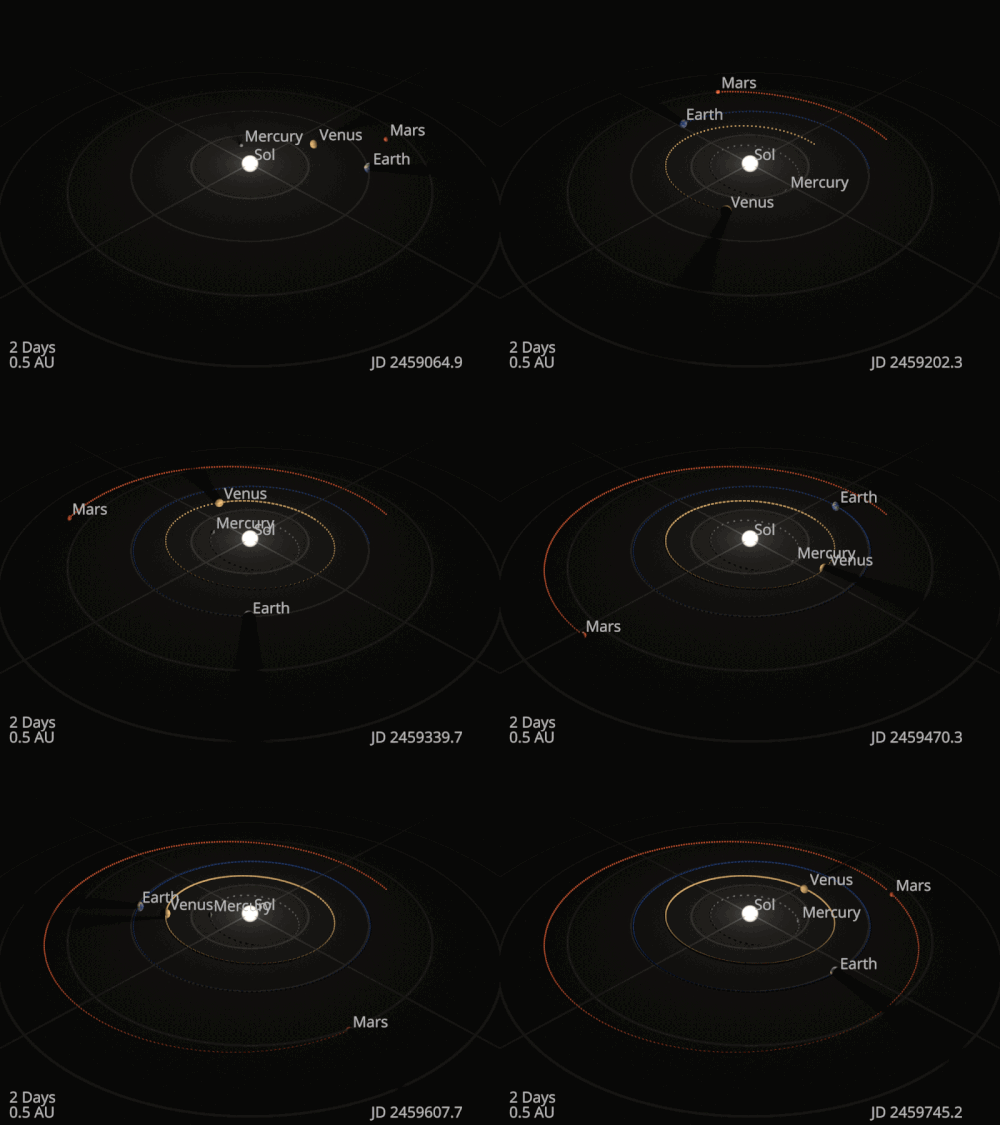
At its most basic level, a year is a unit of time defined by the duration it takes for the Earth to complete one orbit around the Sun. While we often think of a year as a simple 365-day block, science and history reveal a complex variety of definitions depending on whether one is measuring the stars, the seasons, or the administrative needs of a society.
Key Facts
- The tropical year (approx. 365 days, 5 hours, 48 minutes, 45 seconds) is the basis for most solar calendars.
- The sidereal year is about 20 minutes longer than the tropical year because it is measured against fixed stars.
- The Gregorian calendar uses a leap year system to maintain an average year length of 365.2425 days.
- A Julian year is a precise scientific unit defined as exactly 365.25 days of 86,400 SI seconds each.
- Axial precession (the slow wobble of Earth's axis) causes the difference between tropical and sidereal years.
Astronomical Definitions of a Year
In astronomy, a "year" can be defined in several ways depending on the reference point used for the Earth's position.
Tropical Year
The tropical year is the period required for the Sun's mean ecliptic longitude to increase by 360 degrees. Because it is measured relative to the equinox, it represents a complete cycle of the seasons. It lasts approximately 365 days, 5 hours, 48 minutes, and 45 seconds. This is the primary foundation for solar calendars.
Sidereal Year
The sidereal year is the time Earth takes to complete one revolution relative to a fixed frame of reference, such as the distant stars. Due to axial precession, the sidereal year is roughly 20 minutes longer than the tropical year, averaging 365.256363 days.
Anomalistic and Draconic Years
Other specialized measurements include the anomalistic year, which is the time between perihelion passages (when Earth is closest to the Sun), averaging 365.259636 days. The draconic year (or eclipse year) is shorter, lasting approximately 346.62 days.
Calendar Systems and Approximations
Because astronomical years are not whole numbers of days, human calendars use various methods of intercalation—the insertion of extra days or months—to keep the calendar aligned with the solar year.
The Gregorian Calendar
The world's most widely used civil calendar, the Gregorian calendar, aims to keep the northward equinox on or before March 21. It employs a leap year system where 97 out of every 400 years are leap years, resulting in a mean year length of 365.2425 days.
The Julian Calendar
The older Julian calendar is simpler, adding a leap day every four years without exception. This results in a mean year of 365.25 days. While less accurate than the Gregorian system, the Julian year remains a vital unit in astronomy, totaling exactly 31,557,600 seconds.
Lunar and Lunisolar Calendars
Not all years are based on the Sun. A lunar year consists of twelve lunar phases, totaling roughly 354 days. Lunisolar calendars, common in Asia, combine these by adding a thirteenth leap month approximately every three years to stay aligned with the solar cycle. The lunar Hijri calendar, however, ignores the solar year entirely.
Scientific and Pragmatic Time Units
Beyond calendars, the term "year" is used as a standardized unit in various professional fields.
Standardized Scientific Years
To avoid the variability of Earth's orbit, organizations like IUPAC and IUPAP have proposed definitions based on the SI base unit of the second. The IUPAC Green Book defines a year as 31,556,925.9747 seconds. In geology and astronomy, SI prefixes are used to denote vast spans of time:
- ka (kiloannus): Thousand years
- Ma (megaannus): Million years
- Ga (gigaannus): Billion years
Pragmatic Divisions
In daily life, "year" often refers to non-astronomical cycles, such as the fiscal year for financial reporting or the academic year for educational institutions.
| Year Type | Average Duration (Days) | Primary Use/Basis |
|---|---|---|
| Draconic (Eclipse) | 346.62 | Nodal period of orbit |
| Lunar | 354.37 | Twelve lunar phases |
| Tropical (Solar) | 365.24219 | Seasonal cycle/Equinoxes |
| Gregorian | 365.2425 | Modern civil calendar |
| Julian | 365.25 | Astronomical time unit |
| Sidereal | 365.25636 | Fixed star reference |
| Anomalistic | 365.259636 | Perihelion to perihelion |
Frequently Asked Questions
Why is a sidereal year longer than a tropical year?
This difference is caused by axial precession, the slow change in the orientation of Earth's rotational axis. Because the axis wobbles, the Earth reaches the equinox point slightly before it completes a full 360-degree orbit relative to the stars.
What is the difference between AD and CE?
Both refer to the same era in the Gregorian calendar. AD (Anno Domini) means "in the year of the Lord," while CE (Common Era) is a secular alternative preferred by many faiths and non-religious individuals.
How does a leap year work in the Gregorian calendar?
To approximate the tropical year, the Gregorian calendar adds a leap day every four years. However, to maintain precision, years divisible by 100 are not leap years unless they are also divisible by 400.
What is a Julian year in science?
In scientific contexts, a Julian year is not a calendar year but a precise unit of time defined as exactly 365.25 days, with each day consisting of 86,400 SI seconds. This is used to calculate distances like the light-year.
Is there a year zero in the Gregorian calendar?
No, the Gregorian calendar uses inclusive counting, meaning it jumps from 1 BC (or BCE) directly to 1 AD (or CE). However, astronomical year numbering does use a year 0 to simplify calculations.