Year Definitions: From Astronomical Orbits to Calendar Cycles
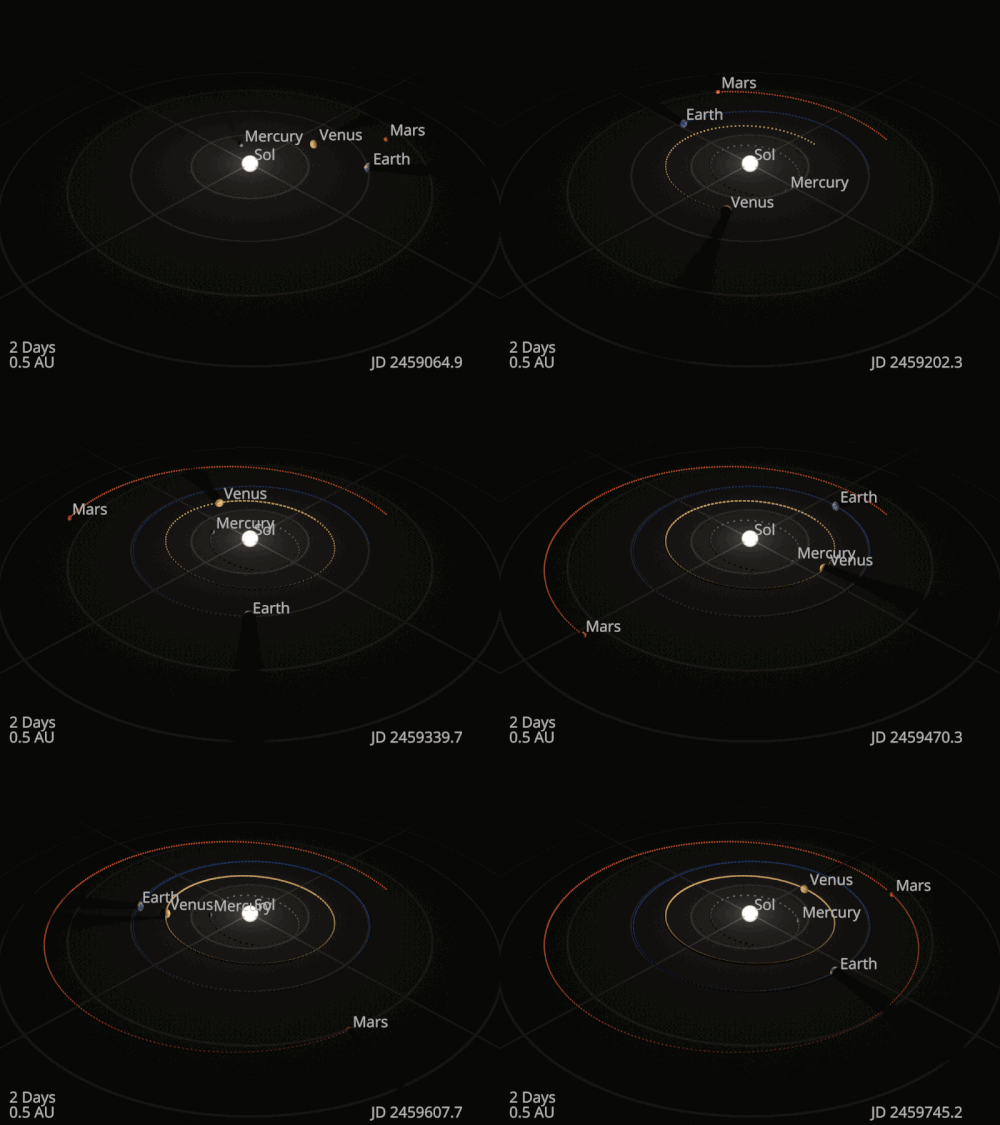
At its most fundamental level, a year is a unit of time based on the duration it takes the Earth to orbit the Sun. However, depending on whether you are a scientist, a historian, or a student, the definition of a "year" can change significantly. While we often think of a year as a simple 365-day period, the complexities of planetary motion and human record-keeping have created several distinct ways to measure this span of time.
Key Facts
- The tropical year is the basis for solar calendars and follows the cycle of the seasons.
- The Gregorian calendar is the modern world standard, using leap years to approximate the tropical year.
- In astronomy, a Julian year is defined as exactly 365.25 days.
- The sidereal year measures Earth's orbit against fixed stars and is about 20 minutes longer than the tropical year.
- A lunar year consists of approximately 354 days, based on twelve lunar phases.
Astronomical Variations of the Year
In the realm of astronomy, a single definition of a year is insufficient to describe the various ways Earth moves through space. Scientists use specific terms to describe different orbital cycles.
Tropical and Sidereal Years
The tropical year (approximately 365 days, 5 hours, 48 minutes, and 45 seconds) is the time it takes for the Sun's ecliptic longitude to increase by 360 degrees. Because it is tied to the equinoxes, it is the foundation for seasonal calendars. Due to axial precession—the slow wobble of Earth's axis—the tropical year is about 20 minutes shorter than the sidereal year.
The sidereal year is the time required for Earth to complete one revolution relative to a fixed frame of reference, such as the stars. Its average duration is approximately 365.256 days.
Anomalistic and Draconic Years
The anomalistic year measures the time between successive passages of the perihelion (the point where Earth is closest to the Sun) and the aphelion (the point where Earth is farthest from the Sun). This cycle averages about 365.2596 days. Meanwhile, the draconic year (or eclipse year) lasts approximately 346.62 days.
Calendar Systems and Human Timekeeping
Because Earth's actual orbital period does not align perfectly with whole days, humans have developed various calendar systems to manage time. These systems use intercalation—the insertion of extra days or months—to stay in sync with celestial events.
The Gregorian and Julian Calendars
The Julian calendar establishes an average year length of 365.25 days, achieved by adding a leap day every four years. While useful, it is less precise than the modern Gregorian calendar. The Gregorian system, which is the current global standard, uses a more complex leap year rule (97 leap years every 400 years) to achieve a mean year length of 365.2425 days. This brings it much closer to the tropical year, minimizing seasonal drift.
Lunisolar and Lunar Calendars
Not all calendars follow the sun. Lunisolar calendars, common in many Asian traditions, use twelve lunar months but add a thirteenth "leap month" roughly every three years to stay aligned with the solar seasons. In contrast, the lunar Hijri calendar consists of twelve lunar months and does not attempt to follow the solar year.
| Year Type | Approximate Days | Primary Use/Context |
|---|---|---|
| Draconic (Eclipse) | 346.62 | Lunar nodal period |
| Lunar | 354.37 | Based on Moon phases |
| Tropical | 365.24219 | Solar/Seasonal cycles |
| Gregorian | 365.2425 | Modern civil calendar |
| Julian | 365.25 | Astronomical/Historical use |
| Sidereal | 365.25636 | Fixed star reference |
| Anomalistic | 365.25964 | Perihelion to perihelion |
Scientific Notation and Year Numbering
In scientific and historical contexts, years are often numbered using specific eras. The Gregorian era uses Anno Domini (AD) or Common Era (CE). For time before this epoch, Before Christ (BC) or Before the Common Era (BCE) is used. Notably, there is no "year zero" in this system; counting moves directly from 1 BC to 1 AD.
In astronomical year numbering, a zero is used to designate 1 BC/BCE, and negative numbers are used for years prior to that. For extremely large spans of time, scientists use SI prefixes: ka (kiloannus) for thousands of years, Ma (megaannus) for millions, and Ga (gigaannus) for billions.
Frequently Asked Questions
What is the difference between a tropical year and a sidereal year?
The tropical year is the time between equinoxes and governs the seasons, while the sidereal year is the time it takes Earth to orbit the Sun relative to the fixed stars. The tropical year is shorter due to Earth's axial precession.
Why do we have leap years?
Leap years are used to compensate for the fact that a solar year is not an integer number of days. Without adding an extra day (intercalation) periodically, our calendar would eventually drift out of sync with the seasons.
What is a Julian year in astronomy?
In astronomy, a Julian year is a standardized unit of time defined as exactly 365.25 days, with each day consisting of exactly 86,400 SI seconds.
How is a lunar year different from a solar year?
A solar year is based on Earth's orbit around the Sun (approx. 365 days), whereas a lunar year is based on the cycle of the Moon's phases (approx. 354 days).
What does BCE and CE mean?
BCE stands for "Before the Common Era" and CE stands for "Common Era." These are secular alternatives to BC (Before Christ) and AD (Anno Domini).