Gregorian Calendar: History, Mechanics, and Global Adoption
The Gregorian calendar is the most widely used civil calendar in the world today. Introduced as a refinement of the earlier Julian calendar, it was designed to align the human measurement of time more closely with the Earth's revolution around the Sun. By correcting a slight but persistent mathematical error in the Julian system, the Gregorian reform ensured that seasonal events, such as the spring equinox, remained consistent over centuries.
The transition began in October 1582 following the issuance of the papal bull Inter gravissimas by Pope Gregory XIII. This decree didn't just change how we count leap years; it fundamentally reset the date to correct centuries of accumulated drift.
![Lunario Novo, Secondo la Nuova Riforma della Correttione del l'Anno Riformato da N.S. Gregorio XIII,[k] printed in Rome by Vincenzo Accolti in 1582, one of the first printed editions of the new calendar](/images/46/71/46715f4f1c37231c67f8b08ef7ed61f5ff4cf269a0f289ec765dfc7061119f5f.jpg)
Key Facts
- Origin: Introduced by Pope Gregory XIII in 1582 to replace the Julian calendar.
- Purpose: To more accurately approximate the tropical year (the time it takes Earth to orbit the Sun), which is approximately 365.2422 days.
- Average Year Length: 365.2425 days.
- Leap Year Rule: Years divisible by 4 are leap years, unless they are divisible by 100 but not by 400.
- Initial Correction: 10 days were deleted from the calendar in October 1582 to fix the drift since the Council of Nicaea.
How the Gregorian Calendar Works
Like its predecessor, the Gregorian calendar is a solar calendar consisting of 12 months with lengths ranging from 28 to 31 days. The primary distinction lies in the calculation of leap years to prevent the calendar from drifting away from the solar seasons.
The Leap Year Logic
In the Julian calendar, every fourth year was a leap year, resulting in an average year of 365.25 days. However, the actual solar year is slightly shorter. To correct this, the Gregorian system omits three leap days every 400 years. Specifically, centurial years (those ending in 00) are only leap years if they are divisible by 400. For instance, the years 1600 and 2000 were leap years, while 1700, 1800, and 1900 were not.
Calendar Cycles and Accuracy
The Gregorian calendar operates on a 400-year cycle totaling 146,097 days. This cycle includes 303 common years and 97 leap years. Because 146,097 is exactly divisible by 7, the calendar repeats its sequence of dates and weekdays perfectly every 400 years.
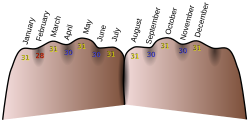
| Month | Days | Month | Days |
|---|---|---|---|
| January | 31 | July | 31 |
| February | 28 (29 in leap years) | August | 31 |
| March | 31 | September | 30 |
| April | 30 | October | 31 |
| May | 31 | November | 30 |
| June | 30 | December | 31 |
The Process of Global Adoption
The adoption of the Gregorian calendar was not instantaneous. While Catholic countries like Spain, Poland, and Portugal adopted it in 1582, Protestant and Orthodox regions resisted the change for decades or even centuries.
The British Transition and Dual Dating
Great Britain and its colonies adopted the calendar in 1752 via the Calendar (New Style) Act 1750. This transition involved two major changes: moving the start of the new year from March 25 (Lady Day) to January 1, and removing 11 days from September 1752 to align with the Gregorian date. During this period, some writers used dual dating, listing both the "Old Style" (Julian) and "New Style" (Gregorian) dates to avoid confusion.
Timeline of Adoption by Region
- 1582: Italy, Spain, France, Poland, Portugal.
- 1700: Denmark-Norway, Protestant Low Countries.
- 1752: Great Britain, Ireland, and the British Empire.
- 1873: Japan.
- 1918: Russia, Ukraine, Estonia.
- 1923: Greece.
- 1926: Turkey.
- 2016: Saudi Arabia.
Comparing the Gregorian and Julian Systems
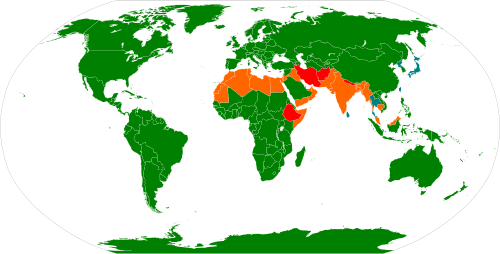
Because the Julian calendar adds more leap days than the Gregorian, the gap between the two dates increases over time. In 1582, the difference was 10 days. By the 20th century, the gap had grown to 13 days. This difference continues to grow by approximately three days every four centuries.
Frequently Asked Questions
Why was the Gregorian calendar created?
It was created to correct the Julian calendar's overestimation of the solar year. The Julian system was slightly too long, causing the calendar to drift away from the actual astronomical seasons, which affected the calculation of the date of Easter.
What happened to the "missing days" in 1582?
To correct the accumulated drift since the Council of Nicaea, 10 days were deleted. In the countries that adopted the reform immediately, Thursday, October 4, 1582, was followed immediately by Friday, October 15, 1582.
How do you determine if a year is a leap year?
A year is a leap year if it is divisible by 4. However, if the year is divisible by 100, it is NOT a leap year unless it is also divisible by 400.
Is the Gregorian calendar perfectly accurate?
It is highly accurate, but not perfect. It has a mean year of 365.2425 days, while the tropical year is about 365.2422 days. Some astronomers, such as Sir John Herschel, have proposed further modifications to remove leap days every 4,000 years to increase precision.