XIII (Royal Württemberg) Army Corps
The XIII (Royal Württemberg) Army Corps (XIII AK) served as a primary military formation of the Imperial German Army. Effectively acting as the national army of the Kingdom of Württemberg, the corps was integrated into the Prussian Army command structure in 1871, mirroring the integration of most other German state armies during the unification of the empire.
Established originally as the Württemberg Corps Command in 1817, the unit was officially designated as the XIII Army Corps on December 18, 1871, following the conclusion of the Franco-Prussian War. Headquartered at the Villa Bohnenberger in Stuttgart, the corps remained active until 1919, serving under the patronage of the King of Württemberg.
Key Facts
- Active Period: 1817–1919.
- Peak Strength: Approximately 44,000 personnel upon mobilization in 1914.
- Headquarters: Stuttgart, Germany.
- Distinguishing Mark: Red shoulder strap piping.
- Major Conflicts: Austro-Prussian War, Franco-Prussian War, and World War I.
Early Engagements and Integration
The Austro-Prussian War
During the Austro-Prussian War of 1866, the corps fought on the Austrian side as the Royal Württemberg Division of the VIII German Federation Army Corps. While they engaged Prussian forces at Tauberbischofsheim, they were unable to halt the Prussian advance into northern Württemberg, though the engagement was considered of minor strategic importance to the overall war.
The Franco-Prussian War
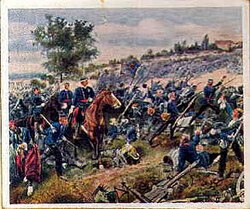
By the Franco-Prussian War (1870–71), the unit served as the Württemberg Field Division within the Combined Württemberg-Baden Army Corps. The division played a role in several pivotal operations, including the Battle of Wörth, the Battle of Sedan, and the Siege of Paris.
Peacetime Organization
In peacetime, the XIII Army Corps followed a standardized German Army structure, consisting of two primary divisions: the 26th and 27th. While most German corps commanded eight infantry, four field artillery, and four cavalry regiments, the XIII Corps was an exception, maintaining a 9th infantry regiment.
The corps also directly managed specialized support units, including a pioneer battalion, a train battalion, and the Stuttgart Defence Command (Landwehr-Inspektion).
| Division | Brigade | Key Units | Garrison |
|---|---|---|---|
| 26th Division | 51st Infantry Brigade | 119th Grenadiers, 125th Infantry | Stuttgart |
| 52nd Infantry Brigade | 121st Infantry, 122nd Fusiliers | Ludwigsburg, Heilbronn | |
| 27th Division | 53rd Infantry Brigade | 123rd Grenadiers, 124th Infantry | Ulm, Weingarten |
| 54th Infantry Brigade | 120th Infantry, 127th Infantry, 180th Infantry | Ulm, Tübingen |
World War I Operations
Mobilization and Structure
Upon mobilization on August 2, 1914, the corps was restructured for modern warfare. The 180th Infantry Regiment was moved to the 26th Reserve Division, and the cavalry brigades were reorganized into reconnaissance units or assigned to the 7th Cavalry Division. At full mobilization, the XIII Corps consisted of 24 infantry battalions, 8 machine gun companies (48 guns), 24 field artillery batteries (144 guns), and 4 heavy artillery batteries (16 guns).
Combat Chronicle
The corps began the war on the Western Front under the 5th Army, later transferring to the 6th Army during the Race to the Sea (the Allied and German attempt to outflank each other to the English Channel). In October 1914, the headquarters formed "Corps Fabeck," a provisional army group.
The unit's deployment was varied; it moved to the Eastern Front in November 1914 to serve with the 9th Army before returning to the Western Front in 1916 under the 4th Army. In the final stages of the war, it commanded Group Ebene under Army Group Duke Albrecht of Württemberg until the armistice.
The Württemberg Mountain Battalion
In 1915, a specialized mountain battalion was formed from Württemberg line regiments. By 1917, this unit became part of the Alpenkorps (a specialized mountain warfare division). It was within this unit that a young Erwin Rommel distinguished himself on the Romanian and Italian fronts, earning the Pour le Mérite—the highest Prussian military honor—at the Battle of the Isonzo in 1917.
Frequently Asked Questions
When was the XIII Army Corps established?
The corps was originally established as the Württemberg Corps Command in 1817 and was officially renamed the XIII Army Corps on December 18, 1871.
How did the XIII Corps differ from other German Army Corps?
While most corps had eight infantry regiments, the XIII Corps (along with the II, XVIII, and XXI Corps) was larger, possessing a 9th infantry regiment.
What was the role of the Württemberg Mountain Battalion?
Formed in 1915, this specialized unit was integrated into the Alpenkorps in 1917 and fought on the Romanian and Italian fronts, most notably at the Battle of the Isonzo.
Who was the most famous soldier associated with the Württemberg units in WWI?
Erwin Rommel is the most notable figure, having served in the Württemberg mountain battalion and winning the Pour le Mérite for his actions in 1917.
Which major battles did the corps participate in during the Franco-Prussian War?
The corps, serving as the Württemberg Field Division, fought in the Battle of Wörth, the Battle of Sedan, and the Siege of Paris.