Württemberg Monarchy: A History of Counts, Dukes, and Kings
The history of the Württemberg monarchy is a sweeping saga of political evolution, spanning nearly a millennium. From its humble beginnings as a county in the 11th century to its eventual status as a sovereign kingdom, the region was governed by a succession of counts, dukes, electors, and kings. This progression reflects the broader shifts in European power and the complex genealogical laws that governed royal succession.
Key Facts
- Formation: The state was formed in 1081.
- First Monarch: Conrad I, who ruled as a Count.
- Last Monarch: William II, who reigned as King from October 6, 1891, to November 30, 1918.
- Abolition: The monarchy officially ended on November 30, 1918.
- Succession: The monarchy was hereditary.
- Current Pretender: Wilhelm, Duke of Württemberg.
The Evolution of the State
The political structure of Württemberg underwent several significant elevations in status over the centuries. It began as the County of Württemberg (1089–1442), later evolving into the Duchy of Württemberg in 1495. By 1803, it was raised to an Electorate, and finally, in 1806, it became the Kingdom of Württemberg, a status it maintained until the end of World War I.
Throughout its history, the territory was often divided into various partitions. These included the County of Stuttgart, the County of Urach, and the County of Montbéliard. Later ducal partitions emerged, such as the Duchy of Weitlingen, the Duchy of Oels, and the Duchy of Winnental, reflecting the internal dynastic splits of the House of Württemberg.
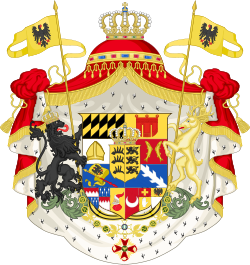
Dynastic Succession and Legal Challenges
The House of Württemberg adhered to Salic law, a legal code that restricted inheritance to male heirs. This strict adherence created significant challenges when male lines failed. Following the death of William II in 1921, the royal house had to trace its lineage back to the descendants of Friedrich II Eugen (who ruled from 1795 to 1797) to find a legitimate successor.
Succession was further complicated by morganatic marriages—unions between people of unequal social rank, where the spouse and children do not inherit the titles or privileges of the royal partner. For instance, the line of the Duke of Urach was excluded from succession due to a morganatic marriage contracted by Duke William in 1800. Consequently, the succession devolved to the younger branch of Altshausen.
The reach of the House of Württemberg extended beyond its own borders through these familial ties. Mary of Teck, a morganatic descendant of Friedrich II Eugen, became a key figure in British royalty when she married George V, the Duke of York and future King of the United Kingdom.
Summary of the Württemberg Monarchy
| Attribute | Details |
|---|---|
| First Ruler | Conrad I (Count) |
| Last Ruler | William II (King) |
| Established | 1081 |
| Abolished | November 30, 1918 |
| Royal Style | His Majesty |
| Succession Type | Hereditary |
Frequently Asked Questions
Who was the first and last monarch of Württemberg?
The first monarch was Conrad I, who ruled as a Count. The last monarch was William II, who served as King until the monarchy was abolished in 1918.
How did the status of Württemberg change over time?
Württemberg progressed through four main stages: it started as a County (1089), became a Duchy (1495), was raised to an Electorate (1803), and finally became a Kingdom (1806).
What is Salic law and how did it affect the monarchy?
Salic law is a system of inheritance that excludes females from inheriting the throne. In Württemberg, this meant that when male heirs were unavailable, the house had to look back to distant male branches, such as the Altshausen line, to determine the successor.
What is a morganatic marriage in the context of Württemberg?
A morganatic marriage is a union between a royal and a person of lower social rank. Children from such marriages were denied succession rights, which is why the line of the Duke of Urach was excluded from the throne after Duke William's marriage in 1800.
Who is the current pretender to the throne?
The current pretender to the defunct throne of Württemberg is Wilhelm, Duke of Württemberg.