Wormholes: The Physics of Spacetime Shortcuts
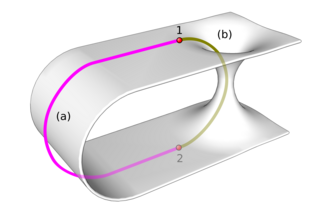
Imagine a universe where the vast distances between galaxies are not barriers, but mere folds in a fabric that can be bypassed. This is the conceptual basis of a wormhole, a hypothetical structure that connects disparate points in spacetime. Rather than traveling across the surface of the universe, a wormhole acts as a tunnel, linking two separate locations, different points in time, or both.
These theoretical shortcuts are not mere science fiction; they are based on specific solutions to the Einstein field equations and remain consistent with the general theory of relativity, which describes how gravity warps the geometry of space and time.
Key Facts
- Theoretical Basis: Wormholes are consistent with the general theory of relativity and the Einstein field equations.
- Types: They are generally categorized as non-traversable (like the Einstein-Rosen bridge) or traversable.
- Stability: Standard Schwarzschild wormholes are unstable and would pinch off too quickly for light to pass through.
- Requirements: Traversable wormholes may require exotic matter or negative mass to remain open.
- Potential: Theoretically, they could allow for faster-than-light travel, time travel, or interuniversal travel.
The Evolution of Wormhole Theory
Schwarzschild Wormholes and Einstein-Rosen Bridges
The first mathematical foundations for wormholes appeared shortly after Karl Schwarzschild published his solution to the field equations. In 1916, Ludwig Flamm discovered a bridge-like structure, which was later rediscovered and popularized by Albert Einstein and Nathan Rosen in 1935. This structure became known as the Einstein-Rosen bridge.
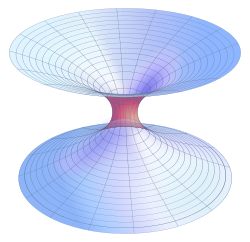
While mathematically sound, these bridges pose a practical problem. In 1962, Robert W. Fuller and John Archibald Wheeler demonstrated that such wormholes are unstable if they connect two parts of the same universe. They concluded that the bridge would "pinch off" so rapidly that not even light—the fastest entity in the universe—could cross from one side to the other.
Traversable Wormholes
To move beyond the unstable Einstein-Rosen bridge, physicists began exploring traversable wormholes—tunnels that could actually be entered and exited. Kip Thorne and other researchers have suggested methods for creating these artificially or finding them naturally.
One theory proposed by Matt Visser in 1995 suggests that if cosmic strings with negative mass were generated during the early stages of the universe, many natural wormholes could exist today. However, keeping a wormhole open requires overcoming the natural tendency of spacetime to collapse the tunnel. This typically involves the use of exotic matter, a theoretical substance with negative energy density that provides the necessary outward pressure to stabilize the throat of the wormhole.
![Image of a simulated traversable wormhole that connects the square in front of the physical institutes of University of Tübingen with the sand dunes near Boulogne-sur-Mer in the north of France. The image is calculated with 4D raytracing in a Morris–Thorne wormhole metric, but the gravitational effects on the wavelength of light have not been simulated.[note 1]](/images/37/13/3713d937a5cdce1e6f69399dbd3d31e79e94346b3ec5650b065235cfbff762b4.jpg)
Implications for Travel and Time
If a stable, traversable wormhole could be maintained, the implications for physics and exploration would be profound. Because the distance through the wormhole is significantly shorter than the distance through normal space, it would effectively allow for faster-than-light (FTL) travel without violating the local laws of relativity.
Beyond spatial shortcuts, the geometry of a wormhole could theoretically be manipulated to connect different points in time, potentially enabling time travel. Furthermore, some models suggest the possibility of interuniversal travel, connecting our universe to an entirely different one.
Summary of Wormhole Types
| Feature | Einstein-Rosen Bridge | Traversable Wormhole |
|---|---|---|
| Stability | Unstable (pinches off) | Potentially stable |
| Passability | Non-traversable | Traversable by matter/light |
| Requirement | Standard General Relativity | Exotic matter / Negative mass |
| Primary Use | Mathematical model | Theoretical FTL/Time travel |
Frequently Asked Questions
Are wormholes real?
Wormholes are currently hypothetical. While they are mathematically possible under the general theory of relativity, no physical evidence of a wormhole has ever been observed in the universe.
What is the difference between a black hole and a wormhole?
A black hole is a region of spacetime where gravity is so strong that nothing can escape. A wormhole is a theoretical tunnel that connects two different points in spacetime, effectively acting as a bridge rather than a dead end.
Could a human actually travel through a wormhole?
According to current physics, a standard Einstein-Rosen bridge would collapse instantly. For a human to survive the trip, a "traversable" wormhole would be needed, which requires the existence of exotic matter to keep the tunnel open and stable.
How would a wormhole allow for time travel?
By manipulating the two ends (mouths) of a traversable wormhole—for example, by moving one end at relativistic speeds—a time difference could be created between the two points, potentially allowing a traveler to emerge in the past or future.