Work-Life Balance: The Evolution of Labor and Leisure from Antiquity to the Digital Age
The concept of work-life balance—the equilibrium between professional obligations and personal time—is often viewed as a modern struggle. However, the tension between labor and leisure has been a central theme of human society for millennia. From the philosophical debates of Ancient Greece to the legislative battles of the Industrial Revolution and the digital boundaries of the 21st century, the way we define "time off" has shifted from a moral and spiritual pursuit to a codified legal right.
Key Facts
- Classical Roots: Ancient Greeks viewed scholē (leisure) as essential for ethical cultivation and civic life.
- The 8-Hour Standard: Popularized by Robert Owen in 1817, the "eight hours labor, eight hours recreation, eight hours rest" slogan became a global demand.
- Legal Milestones: The ILO's 1919 Hours of Work Convention and the US Fair Labor Standards Act of 1938 established early federal limits on working hours.
- Modern Rights: France (2017) and Spain (2018) have pioneered the right to disconnect, limiting work communication outside office hours.
- Recent Trends: A 2022 UK pilot study on shorter workweeks showed reduced burnout and lower turnover without sacrificing revenue.
Foundations of Balance: Antiquity and the Middle Ages
In classical Greek thought, leisure was not merely the absence of work but a condition for education and contemplation. Aristotle argued that a healthy society protects time for these pursuits, linking toil to leisure as a necessary duality. Similarly, the poet Hesiod described an agrarian life where labor was dictated by seasonal rhythms and ritual festivals, ensuring that nature itself set the boundaries of work.
The Romans further refined this distinction through the concepts of otium (reflective private time) and negotium (public business). Cicero's writings on duties emphasized the need to negotiate these two spheres, creating an ideal of a balanced life that influenced later humanist traditions.
During the Middle Ages, balance became institutionalized through faith. The Rule of St Benedict in the sixth century created a structured daily schedule for monks, dividing their time between the Divine Office (prayer and reading) and manual labor. In broader society, "church time"—marked by feasts and fasts—coexisted with the emerging "merchant's time," meaning that the definition of rest varied depending on one's social estate and the season.
The Industrial Revolution and the Fight for the Eight-Hour Day
The late eighteenth century brought a seismic shift in how time was perceived. Factory production replaced natural and spiritual rhythms with standardized clock time. As documented by E. P. Thompson, employers used bells and clocks to discipline workers, redefining "idleness" and eroding the boundaries between family life and labor.
This rigid discipline sparked a global reform movement. By 1817, Robert Owen had popularized the demand for an eight-hour day, divided equally between work, recreation, and rest. This movement eventually transitioned from grassroots activism to government legislation in the early twentieth century.
The 20th Century: Codification and Social Conflict
The early 1900s saw major corporate and international shifts. In 1914, Henry Ford introduced the eight-hour shift and the five-dollar day to reduce employee turnover. Internationally, the International Labour Organization (ILO) adopted the Hours of Work Convention in 1919, setting a standard of eight hours per day and forty-eight per week for industrial work.
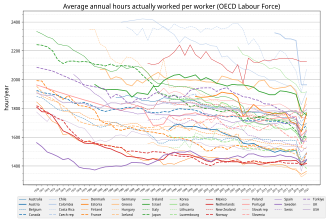
In the United States, the Fair Labor Standards Act of 1938 phased down the workweek from forty-four to forty hours by 1940, introducing premium overtime pay to discourage excessive hours. By the late twentieth century, the conversation shifted toward gender and social pressures. Scholars like Juliet Schor highlighted that despite productivity gains, working hours in the US continued to rise. Arlie Russell Hochschild explored the "second shift," referring to the unequal division of unpaid care work at home.
Legislative protections also expanded to cover family needs. The Family and Medical Leave Act of 1993 provided 12 weeks of unpaid leave for medical and family reasons, while states like Massachusetts introduced specific statutes for maternity leave and small necessities, such as school activities.
The 21st Century: Digital Boundaries and Flexible Work
The modern era is defined by the struggle to separate work from home in an age of constant connectivity. The European Union's Work-life Balance Directive (2019) mandated minimum standards for paternity and carers leave, as well as the right to request flexible working.
To combat the "always-on" culture, France introduced the droit a la deconnexion (right to disconnect) in 2017, requiring companies to negotiate limits on after-hours communication. Spain followed with Organic Law 3/2018, making digital disconnection a statutory right.
The COVID-19 pandemic accelerated the adoption of remote and hybrid models. While the ILO and OECD noted gains in inclusion and productivity, they also warned of "hidden overtime" and blurred boundaries. This has led to a resurgence of interest in shorter workweeks. A significant 2022 UK pilot, evaluated by the University of Cambridge, found that shorter weeks led to lower burnout and stable revenues, prompting many firms to make the change permanent.
Summary of Work-Life Evolution
| Era | Primary Driver of Balance | Key Concept/Legislation |
|---|---|---|
| Antiquity | Philosophy & Nature | Scholē / Otium |
| Middle Ages | Religion & Ritual | Rule of St Benedict |
| Industrial Rev. | Labor Reform | 8-8-8 (Work/Rec/Rest) |
| 20th Century | State Legislation | Fair Labor Standards Act (1938) |
| 21st Century | Digital Wellness | Right to Disconnect / Hybrid Work |
Frequently Asked Questions
What is the "right to disconnect"?
The right to disconnect is a legal principle, adopted in countries like France and Spain, that allows employees to refrain from engaging in work-related electronic communications (such as emails) outside of their official working hours.
Who first proposed the eight-hour workday?
Robert Owen popularized the slogan "Eight hours labor, eight hours recreation, eight hours rest" by 1817, which served as a foundation for later labor laws and international standards.
What did the 2022 UK shorter workweek pilot find?
Researchers from the University of Cambridge and their partners found that the pilot resulted in reduced employee burnout and lower turnover, while company revenues remained stable or improved.
How did the Industrial Revolution change the perception of time?
It replaced seasonal and task-based rhythms with standardized clock time, using tools like bells and clocks to discipline labor and create a sharper, more rigid divide between work and home life.
What is the "second shift"?
Coined by Arlie Russell Hochschild, the "second shift" refers to the unpaid domestic labor and caregiving that employees (disproportionately women) perform at home after completing their paid professional workday.