Wolfgang Amadeus Mozart: The Life and Legacy of a Classical Master
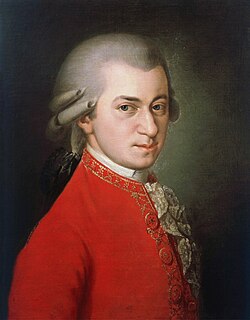
Wolfgang Amadeus Mozart (1756–1791) stands as one of the most influential figures in the history of Western music. A prolific Classical composer and musician, Mozart completed more than 800 works during his short life. His portfolio spans nearly every musical genre of his era, including symphonies, concertos, chamber music, choral works, and operas, each characterized by a timeless blend of clarity and emotional depth.
Born in Salzburg and later establishing himself in Vienna, Mozart's journey from a child prodigy to a mature master redefined the standards of musical composition. His ability to balance transparency and power continues to make his works staples of the modern repertoire.
Key Facts
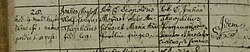
- Born: January 27, 1756, in Salzburg.
- Died: December 5, 1791, in Vienna (aged 35).
- Total Works: Over 800 compositions.
- Major Honors: Recipient of the Order of the Golden Spur from Pope Clement XIV.
- Key Style: Hallmark of the Classical style, emphasizing balance, clarity, and transparency.
Early Life and Prodigious Beginnings
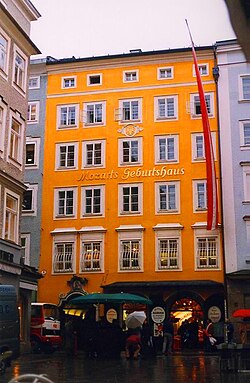
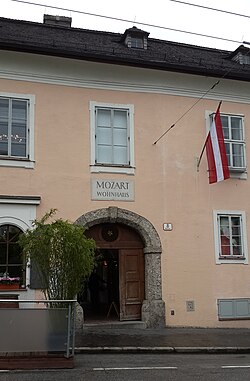
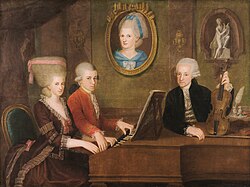
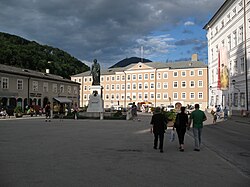
Mozart was born at Getreidegasse 9 in Salzburg to Leopold and Anna Maria Mozart. From a very young age, his extraordinary talent was evident, leading to a childhood defined by travel and performance. Under the guidance of his father, Leopold, Mozart toured extensively between 1762 and 1773, showcasing his skills to the royal courts of Europe.
![Mozart family on tour: Leopold, Wolfgang, Nannerl; watercolour by Carmontelle, c. 1763[11]](/images/7b/5b/7b5bee457a366ffdacfc44671cffe872fdd7655510b607cd59e6bed009810e8a.jpg)
The Formative Years
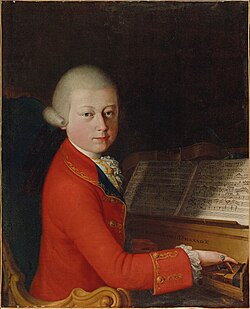
By the age of 14, Mozart was already a sophisticated musician, blending technical mastery with an intuitive grasp of composition.
Professional Career and Evolution
The Salzburg Court (1773–1777)
During his employment at the Salzburg court, Mozart focused heavily on violin concertos. He wrote one in 1773 and four more in 1775, with the latter three (K. 216, K. 218, and K. 219) remaining essential pieces today. By 1776, he shifted his focus toward piano concertos, leading to the breakthrough E♭ concerto K. 271 in early 1777.
Despite his talent, finding stable employment was often difficult. Journeys to Vienna and Munich in the mid-1770s yielded mixed results, though the Munich trip saw the successful premiere of his opera La finta giardiniera.
The Paris Journey and Papal Honors
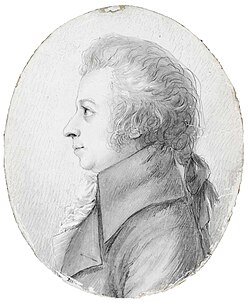
Between 1777 and 1778, Mozart traveled to Paris. This period produced notable works such as Symphony No. 31 (the "Paris" symphony), Piano Sonata No. 8 (K. 310/300d), and the Concerto for Flute and Harp in C major (K. 299/297c). During his travels, his prestige grew, highlighted by receiving the Order of the Golden Spur from Pope Clement XIV in Rome in 1770.
![Mozart wearing the badge of the Order of the Golden Spur which he received in 1770 from Pope Clement XIV in Rome[31]](/images/89/10/8910b374bdb5af156c1585c9edebd154828a6a346f102ff3a96e7682d2c62b3c.jpg)
The Vienna Years
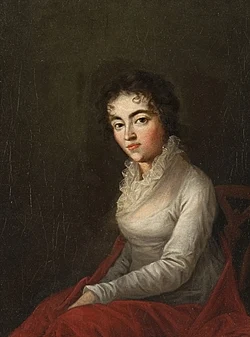
Mozart eventually settled in Vienna, where he experienced both his greatest artistic triumphs and significant personal struggles. He married Constanze Weber, and together they had six children, though only two—Karl Thomas and Franz Xaver Wolfgang—survived into adulthood.
![Maria Anna Thekla Mozart. Self-portrait in pencil from 1777 or 1778. Now in the Mozart-Museum in Salzburg.[34]](/images/28/46/28466fc1a943f043b387dab8abf1d20212aa12106d2978866d630188a9f19781.png)
Financial Hardship and Artistic Peak
The late 1780s were a period of economic decline in Vienna, exacerbated by the Austro-Turkish War. As patrons could no longer afford commissions or tickets, Mozart's income plummeted; by 1788, he saw a 66% decline in earnings compared to his peak in 1781.
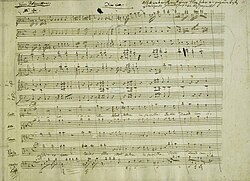
Despite these hardships, his final year (1791) was one of immense productivity. He composed some of his most revered works, including the opera Die Zauberflöte (The Magic Flute), the Clarinet Concerto (K. 622), and his final piano concerto (No. 27 K. 595). He also began his final, unfinished work, the Requiem Mass in D minor (K. 626).
![Fortepiano played by Mozart in 1787, Czech Museum of Music, Prague[85]](/images/19/76/19763df65c0733e914498014813dea3fb3da05644162eb1a9e537b9e8c142388.jpg)
Death and Musical Legacy
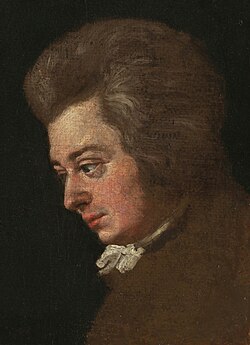
Mozart passed away in his home on December 5, 1791, at the age of 35. While his death has been the subject of various theories, including streptococcus, his legacy remains undisputed.
Musical Style and Innovation
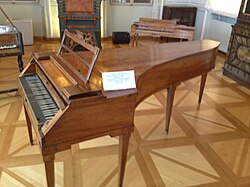
Mozart's music is the embodiment of the Classical style. While often described as delicate, his work possesses an exceptional power, evident in masterpieces like the Symphony No. 40 in G minor (K. 550) and the opera Don Giovanni. He utilized instruments of his time, such as the fortepiano (an early version of the modern piano), to push the boundaries of expression.
| Category | Details |
|---|---|
| Birth/Death | 1756 (Salzburg) – 1791 (Vienna) |
| Key Genres | Symphonies, Operas, Concertos, Chamber Music, Choral |
| Notable Works | Die Zauberflöte, Don Giovanni, Requiem K. 626, Symphony No. 40 |
| Family | Parents: Leopold & Anna Maria; Spouse: Constanze Weber |
| Musical Style | Classical (Clarity, Balance, Transparency) |
Frequently Asked Questions
How many works did Mozart compose?
Mozart completed more than 800 works throughout his life, covering almost every musical genre of the Classical era.
What was the "Order of the Golden Spur"?
The Order of the Golden Spur was a prestigious award received by Mozart in 1770 from Pope Clement XIV during his time in Rome.
Why did Mozart face financial difficulties in Vienna?
His income declined due to a general economic downturn in Vienna caused by the Austro-Turkish War, which left patrons unable to afford commissions and concert tickets.
What is the significance of the Requiem K. 626?
The Requiem is one of Mozart's most famous and admired works, though it remained unfinished at the time of his death in 1791.
What instruments did Mozart primarily use?
Mozart played and composed for various instruments, most notably the fortepiano, which was the precursor to the modern piano.