Cisleithania: The Austrian Half of the Dual Monarchy
From 1867 to 1918, the geopolitical landscape of Central Europe was dominated by the Dual Monarchy of Austria-Hungary. While often viewed as a single entity, the empire was split into two primary administrative halves. The northern and western portion was known officially as The Kingdoms and Lands Represented in the Imperial Council, though it is more commonly referred to by the term Cisleithania.
Cisleithania served as a self-governing part of the broader union, distinguished from Transleithania (the Hungarian lands) by the Leitha River—a tributary of the Danube. With its capital in Vienna, the residence of the Emperor, Cisleithania was a complex mosaic of ethnicities, languages, and historical territories that stretched from the Alps in the west to the borders of modern-day Ukraine and Romania in the east.
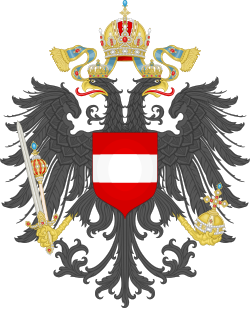
Key Facts
- Official Name: The Kingdoms and Lands Represented in the Imperial Council.
- Time Period: 1867–1918.
- Capital: Vienna.
- Total Area: 300,005 km².
- Population (1910): Approximately 28.6 million.
- Government: Constitutional monarchy under the Emperor of Austria.
- Motto: Indivisibiliter ac inseparabiliter ("Indivisibly and inseparably").
Administrative Structure and the Crown Lands
Cisleithania was organized into 15 crown lands (Kronländer). These were not mere administrative districts but historical-political entities with unique legal characteristics. Each crown land possessed a regional assembly known as the Landtag, which handled local legislation. While some members were appointed ex officio (such as bishops), others were elected through a limited franchise.
The executive power within these lands was managed by a stadtholder (Statthalter), who represented the Emperor and the Imperial-Royal government. Some regions were administered jointly; for example, Vorarlberg was managed with Tyrol, and the Austro-Illyrian Littoral combined Trieste, Istria, and Gorizia-Gradisca.
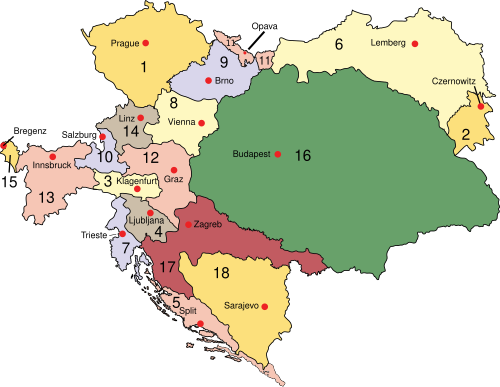
The Hierarchy of Territories
The crown lands varied in status, ranging from kingdoms and archduchies to duchies and free cities. Notable examples included the Archduchy of Austria, the Kingdom of Bohemia, and the Free City of Trieste. Additionally, the Condominium of Bosnia and Herzegovina, occupied in 1878, was governed jointly by both Cisleithania and Transleithania.
Politics and the Imperial Council
The legislative heart of Cisleithania was the Reichsrat (Imperial Council), a bicameral parliament located in Vienna. It consisted of the House of Lords (Upper House) and the House of Deputies (Lower House). Initially, the House of Deputies was elected via a four-class franchise based on wealth, but a major reform in 1907 introduced equal, direct, and secret universal suffrage for men.
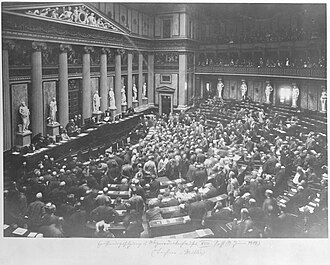
Politics in the Reichsrat were often paralyzed by ethnic nationalism. As suffrage expanded, Slavic deputies gained a majority, leading to clashes with German-speaking nationalists. This tension was most evident during the Czech National Revival, where leaders like František Palacký sought Slavic emancipation, while others used filibustering to obstruct legislation. When parliamentary deadlock occurred, the Emperor frequently ruled via imperial decrees.
Common Affairs of the Dual Monarchy
While Cisleithania managed its own internal affairs, certain "k.u.k." (Imperial and Royal) matters were shared with Hungary. These included the common army, the navy, and foreign diplomacy. These were managed by delegations of 60 members from each parliament, though all final decisions required ratification by both the Reichsrat in Vienna and the Hungarian parliament in Budapest.
Demographics and Society
Cisleithania was one of the most diverse regions in the world at the time. In 1910, nearly 60% of the population was ethnically Slavic. German speakers, including Yiddish-speaking Jews, constituted about one-third of the population.
| Ethnicity | Percentage of Population |
|---|---|
| Germans | 33% |
| Czechs | 22% |
| Poles | 15% |
| Ruthenians (Ukrainians) | 12% |
| Slovenes | 5% |
| Italians | 3% |
| Croats | 3% |
| Other | 7% |
Religious diversity was equally prominent. While Roman Catholicism was the dominant faith (79%), the region also housed significant populations of Greek Catholics (12%), Orthodox Christians (2.3%), Evangelicals (2%), and Muslims (1.2%). Jews represented approximately 4.6% of the total Austro-Hungarian population.
Economic Growth and Development
Following the Compromise of 1867, Cisleithania experienced accelerated economic growth. Between 1870 and 1913, GDP per capita grew by an average of 1.01% per annum. While this was slightly lower than the growth seen in Transleithania (1.31%) or the German Empire (1.52%), the overall output increased significantly. Total GDP for Cisleithania rose from approximately 25,003 million in 1870 to 62,638 million by 1913.
Frequently Asked Questions
What does the name "Cisleithania" actually mean?
The term is derived from the Leitha River. In Latin, "cis-" means "on this side of," so Cisleithania refers to the lands on the Austrian side of the Leitha River, distinguishing them from Transleithania ("across the Leitha").
How did the government of Cisleithania differ from the rest of Austria-Hungary?
Cisleithania had its own parliament (the Reichsrat) and its own Minister-President. It managed its own internal laws and administration, while sharing only foreign policy, defense, and military financing with the Hungarian half of the empire.
Who were the primary leaders of Cisleithania?
The region was headed by the Emperor of Austria, most notably Franz Joseph I (1867–1916) and Karl I (1916–1918). The executive government was led by a Minister-President, starting with Prince Karl of Auersperg and ending with Heinrich Lammasch.
What caused the political instability in the Imperial Council?
Instability was primarily driven by ethnic nationalism. Conflicts between German-speaking deputies and various Slavic groups (particularly Czechs and Poles) often led to legislative deadlock, forcing the Emperor to rule by decree.
What happened to Cisleithania after 1918?
Following the dissolution of Austria-Hungary in October 1918, Cisleithania was split into several successor states, including the Republic of German-Austria, the First Czechoslovak Republic, the Kingdom of Serbs, Croats and Slovenes, the Second Polish Republic, and parts of Italy and Romania.