Wind Shear: Atmospheric Dynamics and Their Impact on Aviation and Weather
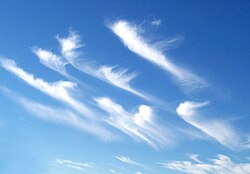
Wind shear, also known as a wind gradient, occurs when there is a significant difference in wind speed and/or direction over a relatively short distance in the atmosphere. While it is a microscale meteorological phenomenon—meaning it happens over very small distances—its effects can be felt on a massive scale, influencing everything from the trajectory of a commercial airliner to the intensity of a hurricane.
Atmospheric wind shear is categorized into two primary types: vertical wind shear, which is the change in wind speed or direction as altitude increases, and horizontal wind shear, which is the change in wind speed across a lateral position at a constant altitude.
Key Facts

- Definition: A variation in wind velocity over horizontal or vertical distances.
- Aviation Risk: Significant horizontal shear for airliners is typically defined as a change of 45 knots (23 m/s).
- Weather Influence: High vertical shear can inhibit tropical cyclones but helps organize severe thunderstorms.
- Detection: Doppler radar and Terminal Doppler Weather Radar (TDWR) are used to alert pilots of dangerous shear.
- Natural Occurrence: Common near mountains, weather fronts, and during microbursts.
The Mechanics of Wind Shear
Horizontal and Vertical Components
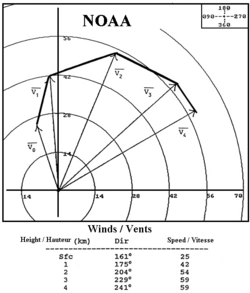
Horizontal wind shear is frequently observed near coastlines. Because landmasses create more friction than open water, wind speeds offshore are often nearly double those observed onshore. Vertical wind shear, conversely, is a critical driver of large-scale weather patterns. The thermal wind concept explains that differences in wind speed at various heights are dependent on horizontal temperature differences, a process that fundamentally creates the jet stream—the high-altitude westerly currents of air.
Common Causes and Occurrences
Wind shear is not a random occurrence but is often tied to specific meteorological features:
- Weather Fronts: Significant shear occurs when fronts move at 30 knots (15 m/s) or faster with a temperature difference of 5°C (9°F) or more.
- Jet Streams: Vertical and horizontal shear at the edges of upper-level jet streams cause clear air turbulence (CAT).
- Inversions: On calm nights, a radiation inversion can create a layer where wind direction shifts by 90 degrees and speed changes by 40 knots (21 m/s).
- Downbursts and Microbursts: These are powerful columns of sinking air that spread outward upon hitting the ground, creating violent wind shifts.
![Microburst schematic from NASA. The direction of travel is downward until the air current hits ground level, at which point it spreads outward in all directions. The wind regime in a microburst is completely opposite to a tornado.[citation needed]](/images/c4/99/c499e77fbb337c18d24d3a60051447f518ac122acf749d0099f8f3c90e4f1e92.jpg)
Impact on Weather Systems
Tropical Cyclones and Thunderstorms
Wind shear plays a contradictory role in storm development. For tropical cyclones, low vertical wind shear is essential; high shear can blow the warm core away from the surface center, weakening the storm.
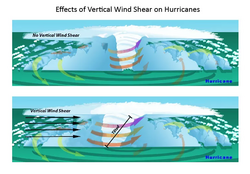
In contrast, severe thunderstorms require wind shear to survive. Shear separates the storm's inflow of warm, moist air from its rain-cooled outflow. Without this organization, a thunderstorm would quickly cut off its own fuel source and dissipate. Strong shear in the high troposphere often creates the characteristic anvil-shaped top of mature cumulonimbus clouds.
![Strong wind shear in the high troposphere forms the anvil-shaped top of this mature cumulonimbus cloud, or thunderstorm.[13]](/images/a5/26/a52673a786f2372ec345e5de90f4e4e82a808617b94e491ba635984bbde36191.jpg)
Aviation and Flight Safety
Commercial Aircraft and Microbursts
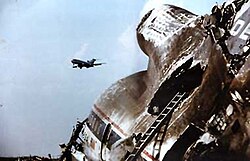
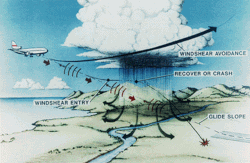
For passenger aircraft, wind shear is most dangerous during takeoff and landing. A sudden loss of headwind can cause a rapid decrease in airspeed, making it impossible for the aircraft to maintain altitude. Historical accidents, such as Delta Air Lines Flight 191, highlight the lethality of microbursts, where wind intensity can double in under a minute.
Gliding and Soaring
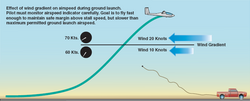
Glider pilots must constantly adjust for wind gradients. During ground launches, sudden shear can cause indicated airspeed to exceed safety limits. During landing, descending through a gradient can increase the sink rate while decreasing airspeed. Some birds, like albatrosses, use dynamic soaring to maintain flight without flapping, trading ground speed for height by diving through wind gradients.
Other Environmental Effects
Sound Propagation and Architecture
Wind shear can refract (bend) sound waves, allowing sounds like thunder or gunshots to be heard in areas where they would normally be blocked. This phenomenon creates "acoustic shadows," as seen during the American Civil War at the Battle of Iuka, where Union soldiers failed to hear a battle only six miles away.
In architecture, wind turbines are heavily impacted by vertical wind-speed profiles. The difference in wind speed between the bottom and top of a blade's travel creates a bending moment on the turbine shaft. Because wind shear is reduced over water, offshore turbine towers can be shorter and less expensive.
Summary of Wind Shear Effects
| Domain | Primary Effect | Outcome |
|---|---|---|
| Aviation | Rapid airspeed change | Loss of altitude/control |
| Hurricanes | High vertical shear | Storm weakening |
| Thunderstorms | Inflow/Outflow separation | Increased storm longevity |
| Acoustics | Wave front refraction | Acoustic shadows or distant audibility |
| Energy | Vertical speed profile | Bending stress on turbine shafts |
Frequently Asked Questions
What is the difference between vertical and horizontal wind shear?
Vertical wind shear is a change in wind speed or direction as you move upward in altitude. Horizontal wind shear is a change in wind speed or direction as you move laterally across a distance at the same altitude.
Why is wind shear dangerous for airplanes during landing?
It can cause a sudden, drastic loss of airspeed. If an aircraft loses its headwind rapidly, it may lose the lift required to stay airborne, potentially slamming the aircraft into the ground before the pilot can compensate.
How does wind shear help create severe thunderstorms?
It organizes the storm by separating the updraft (warm inflow) from the downdraft (rain-cooled outflow). This prevents the storm from "choking" on its own cold air, allowing it to persist longer and become more severe.
What is a microburst?
A microburst is a localized, powerful column of sinking air (downburst) that hits the ground and spreads outward in all directions, creating intense and dangerous wind shear.
How do meteorologists detect wind shear?
They use Doppler radar and specialized systems like Terminal Doppler Weather Radar (TDWR) at airports to monitor wind velocity changes in real-time.
How does wind shear affect the sound we hear?
Wind shear bends sound waves through refraction. Depending on the wind profile, this can either carry sound much further than usual or create an "acoustic shadow" where sound is completely blocked.