William Girling Reservoir: A History of Engineering and Innovation
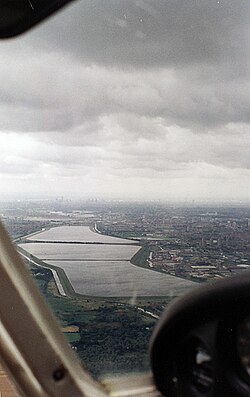
The William Girling Reservoir stands as a testament to the evolution of British civil engineering and water management. Conceived as a critical component of the broader Lea Valley water supply strategy, its journey from a 19th-century proposal to a completed infrastructure project is marked by pioneering technology and a pivotal moment in the science of soil mechanics.
Origins and Administration
The vision for the reservoir was first presented to the Royal Commission on Water Supply, also known as the Balfour Committee, in 1893. Initially, the project fell under the jurisdiction of the East London Waterworks Company. However, the administrative landscape shifted with the Metropolis Water Act 1902, which transferred the responsibilities of eight different water companies to the newly formed Metropolitan Water Board (MWB).
Construction and Technical Innovation
Actual construction commenced in 1936 after the MWB accepted a tender from John Mowlem for £682,156. Led by civil engineer Robert Wynne-Edwards, the project was notable for its adoption of cutting-edge machinery. For the first time in British dam construction, mechanical scrapers and bulldozers were utilized, which significantly accelerated the pace of work.
The 1937 Embankment Failures
Despite the rapid progress, the project faced a significant technical crisis in 1937. The design, created by Sir Jonathan Roberts Davidson, came under scrutiny when a major slip occurred in the north-west corner of the partly formed embankment. When the fill reached a height of 23 feet (7.0 m), a section 66 feet (20 m) wide dropped 2 feet 4 inches (71 cm) and shifted forward 13 feet (4.0 m).
Because the failure happened before any water had been stored, no flooding occurred. However, a second slip in December 1937 prompted the MWB to seek expert guidance. They consulted two renowned soil mechanics experts, Herbert Chatley and Karl Terzaghi. Their recommendations led to critical design modifications in July 1938, and the reservoir was ultimately redesigned to increase its total capacity by 11.3%.
The Birth of Modern Soil Mechanics
The investigations into these landslips are historically significant, as they are widely regarded as the birth of modern soil mechanics—the branch of engineering that studies the physical properties of soil and how it behaves under pressure—within Great Britain.
Completion and Later Use
The timeline for completion was extended due to the onset of the Second World War. The reservoir was finally finished in 1951 and officially opened on September 4 by William Girling, the Chairman of the MWB, after whom the reservoir is named.
In more recent history, the site played a role in national security. During the security exercises for the 2012 Summer Olympics, the reservoir was identified as a strategic location for the deployment of Rapier surface-to-air missiles.
Key Facts
- Initial Proposal: Presented to the Balfour Committee in 1893.
- Construction Cost: £682,156 (tendered by John Mowlem).
- Engineering Firsts: First British dam project to use bulldozers and mechanical scrapers.
- Capacity Increase: Redesigned after 1937 slips to increase capacity by 11.3%.
- Official Opening: September 4, 1951.
- Scientific Legacy: Site of the foundational development of modern soil mechanics in Britain.
| Detail | Information |
|---|---|
| Lead Civil Engineer | Robert Wynne-Edwards |
| Designer | Sir Jonathan Roberts Davidson |
| Governing Body | Metropolitan Water Board (MWB) |
| Key Experts Consulted | Herbert Chatley and Karl Terzaghi |
| Completion Date | 1951 |
Frequently Asked Questions
Who was the reservoir named after?
The reservoir was named after William Girling, who served as the Chairman of the Metropolitan Water Board (MWB) and officially opened the facility in 1951.
Why is the reservoir significant to the field of science?
The investigations into the embankment slips that occurred during construction in 1937 are considered the starting point for modern soil mechanics in Britain.
What caused the delays in construction?
Construction was delayed by two primary factors: the need to redesign the embankment following structural slips in 1937 and the outbreak of the Second World War.
What role did the reservoir play during the 2012 Olympics?
As part of the security exercise for the 2012 Summer Olympics, the reservoir was used as a deployment site for Rapier surface-to-air missiles.
Which companies were involved in the project?
The project was originally under the East London Waterworks Company before being transferred to the Metropolitan Water Board, with the construction contract awarded to John Mowlem.