William Bainbridge: The Resilient Commodore of the Early U.S. Navy
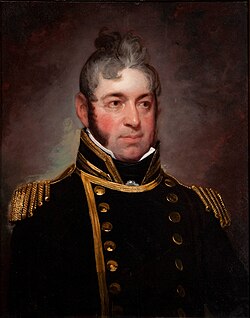
Commodore William Bainbridge (1774–1833) was a pivotal figure in the formative years of the United States Navy. Serving under six different U.S. presidents, beginning with John Adams, Bainbridge's career was marked by a dramatic arc of high-seas victories, a harrowing period of captivity, and a steadfast commitment to American naval strength. From the early skirmishes of the Quasi-War to the decisive battles of the War of 1812, his life mirrored the growth of the young nation's maritime power.
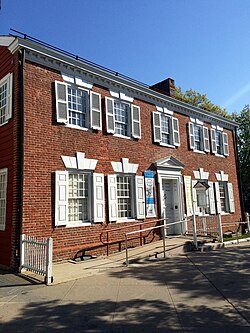
Born in Princeton, New Jersey, Bainbridge was the eldest son of Dr. Absalom Bainbridge and Mary Taylor. His early life was shaped by political turmoil; his father, a loyalist during the American Revolution, was convicted of high treason by the State of New Jersey and eventually relocated to England. Consequently, William was raised by his maternal grandfather, John Taylor, Esq.
Early Maritime Experience
Before joining the official naval officer corps, Bainbridge honed his skills in the merchant service. In 1792, he served aboard the Cantor, and by 1796, he was aboard the Hope, a 140-ton vessel. While docked in Bordeaux, France, Bainbridge demonstrated exceptional courage by helping to suppress a mutiny on a nearby ship. Despite being outnumbered and wounded by exploding gunpowder, he successfully restored order. This act of bravery, combined with his navigational skill, led to his appointment as commander of that vessel at the age of nineteen.
Naval Career and the Quasi-War
When the United States Navy was formally organized in 1798, Bainbridge was appointed as a commanding lieutenant of the schooner USS Retaliation. During the Quasi-War—an undeclared naval conflict between the U.S. and France—Bainbridge experienced an early setback. On November 20, 1798, he surrendered the Retaliation to two French frigates after mistaking them for British warships. While this was the first ship of the nascent U.S. Navy to be surrendered, Bainbridge was not disciplined for the error. He was later promoted to Master Commandant of the brig USS Norfolk in 1799.
The Barbary Wars and Captivity
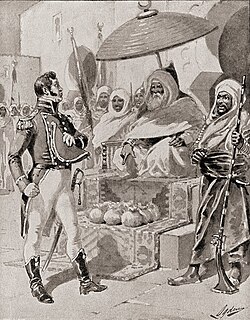
Bainbridge's service in the Mediterranean was characterized by both diplomatic tension and military hardship. In 1800, while commanding the USS George Washington, he was tasked with delivering tribute to the dey of Algiers to prevent the capture of American merchant ships. Under the threat of the dey's shore batteries, Bainbridge was forced to fly the Algerian flag and ferry gifts to Constantinople.
The First Barbary War brought a more severe trial. In 1803, while commanding the USS Philadelphia to enforce a blockade of Tripoli, Bainbridge ran the frigate aground on an uncharted reef. After failing to refloat the vessel and facing fire from Tripolitan gunboats, he surrendered the ship to prevent its capture intact, ordering the powder magazine flooded and signal books destroyed.
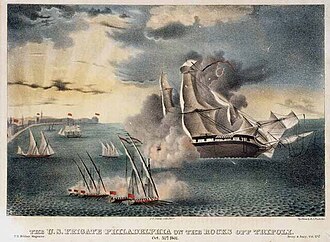
Bainbridge and his crew remained prisoners in Tripoli for nineteen months. They were eventually released on June 3, 1805, following a series of bombardments by the U.S. squadron. A subsequent Naval Court of Inquiry cleared him of misconduct, allowing him to return to active service.
Triumph in the War of 1812
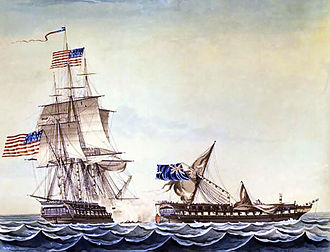
Bainbridge reached the pinnacle of his military fame during the War of 1812. In September 1812, he took command of the 44-gun frigate USS Constitution. On December 29, 1812, off the coast of Brazil, he engaged the 38-gun HMS Java. Despite being wounded twice, Bainbridge led the Constitution to a decisive victory, utilizing the ship's superior construction and well-drilled crew to dismantle the British vessel. For this victory, President James Madison awarded him the Congressional Gold Medal in 1813.
Later Service and Legacy
Bainbridge continued to serve in the Second Barbary War of 1815, commanding a squadron sent to Algiers to enforce peace and neutrality. In a notable diplomatic mission, he used his flagship, USS Columbus, to transport Antonio Canova's statue of George Washington from Italy to Boston.
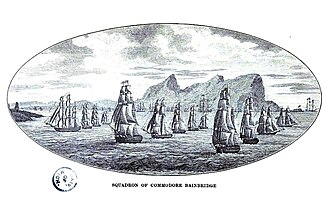
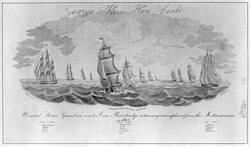
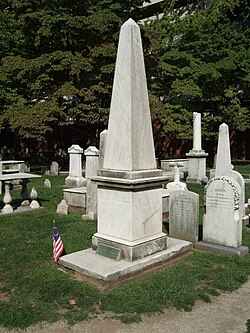
In his final years, Bainbridge served on the Board of Navy Commissioners from 1824 to 1827. He passed away in Philadelphia on July 27, 1833, at the age of 59.
Key Facts
- Highest Rank: Commodore.
- Major Victory: Defeat of HMS Java aboard the USS Constitution (1812).
- Notable Hardship: 19 months of imprisonment in Tripoli after the grounding of USS Philadelphia.
- Major Award: Congressional Gold Medal (1813).
- Key Commands: USS Constitution, USS Philadelphia, USS Columbus, and USS George Washington.
| Period/Conflict | Primary Ship(s) | Key Outcome |
|---|---|---|
| Quasi-War | USS Retaliation, USS Norfolk | First U.S. Navy surrender (Retaliation) |
| First Barbary War | USS George Washington, USS Philadelphia | Capture and 19-month imprisonment in Tripoli |
| War of 1812 | USS Constitution | Victory over HMS Java; Congressional Gold Medal |
| Second Barbary War | Bainbridge Squadron | Enforced blockade and peace in Algiers |
Frequently Asked Questions
Why was William Bainbridge imprisoned in Tripoli?
Bainbridge was imprisoned after the USS Philadelphia ran aground on an uncharted reef in 1803. Unable to refloat the ship, he surrendered to the Pasha of Tripoli to avoid the vessel being captured intact.
What was Bainbridge's most significant victory?
His most celebrated victory occurred during the War of 1812, when he commanded the USS Constitution in the defeat of the British frigate HMS Java off the coast of Brazil.
Did Bainbridge face punishment for surrendering his ships?
Despite surrendering both the USS Retaliation during the Quasi-War and the USS Philadelphia during the First Barbary War, a Naval Court of Inquiry found no evidence of misconduct regarding the latter, and he was not disciplined for the former.
How is Commodore Bainbridge remembered today?
He is honored through several U.S. Navy ships named in his memory, including the Navy's first destroyer (DD-1) and the Arleigh Burke-class destroyer USS Bainbridge (DDG-96), as well as a former naval training center in Maryland.