Commodore: The Evolution of a Naval Rank and Title
The term Commodore has long occupied a unique and sometimes contentious space in American maritime history. From its origins as a courtesy title for senior captains to its formal establishment as a one-star flag officer rank, the role of the commodore has shifted alongside the needs of the United States Navy and Coast Guard. While no longer a formal commissioned rank for active-duty officers, the title persists today as an honorary designation for leaders of operational organizations.
Key Facts
- Current Status: Not a formal rank since 1985; used as an honorary title for senior captains (O-6) in command of multiple units.
- Historical Pay Grade: O-7 (one-star).
- NATO Rank Code: OF-6.
- Equivalent Ranks: Rear Admiral (lower half) and Brigadier General.
- Service Branches: Historically used by the US Navy, US Coast Guard, US Public Health Service Commissioned Corps, and NOAA Commissioned Officer Corps.
The Early Era: A Courtesy Title
The use of "commodore" dates back to 1775 within the Continental Navy. Initially, it was not a permanent rank but a courtesy title reserved for captains who were given command of a fleet or squadron. John Barry became the first U.S. naval officer appointed as a commodore in 1794 following the reorganization of the Navy.
For decades, the U.S. Congress limited the number of authorized officer ranks, which created professional frustration. Captain Isaac Hull noted in 1814 that the lack of formal advancement led to a situation where almost any midshipman commanding a gunboat might claim the title of commodore. During this period, the position was a temporary assignment rather than a permanent promotion.
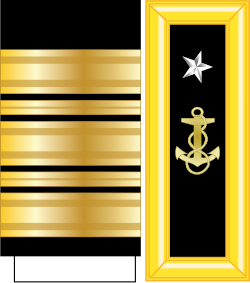
The Rise of the Flag Officer
In 1857, Congress introduced the grade of flag officer—an officer entitled to fly a personal flag to indicate their command. Charles Stewart was the first to be appointed as a "Senior Flag Officer." By 1862, the president was granted authority to appoint squadron commanders with the rank and title of flag officer, leading to the promotion of figures such as David Farragut.
This specific "flag officer" title was short-lived, as it was replaced by the rank of commodore in July 1862. The American Civil War necessitated a rapid increase in leadership, leading the Navy to ignore tradition and establish commodore as a permanent commissioned rank for the first time.
![Broad Pennant of a US Commodore 1812[3]](/images/1a/3d/1a3df02d8e6361bd2381c6e12f03135803b2e02afa1a9ac5d39ae6631a90a534.png)
![Flag of a Navy Senior Flag Officer (later Commodore) 1857-1865[4]](/images/27/2a/272a191c0706fe53822bd6d0ce33bce70359d5518c1d478d36d89a1bfba99087.png)
Disestablishment and International Friction
The rank of commodore was effectively abolished for active line officers on March 3, 1899. This decision was driven by international diplomacy; the Navy Department found that U.S. commodores were not receiving the same respect or recognition as flag officers in foreign navies, which was viewed as detrimental to the nation's dignity.
This removal created a gap in the rank structure, as the U.S. Navy no longer had a direct equivalent to the Army's brigadier general. This led to years of inter-service controversy regarding seniority and pay, particularly concerning "rear admirals in the lower half" of seniority.
![Flag of a US Commodore 1865[7]](/images/87/3a/873a365f2350e752479b3587acc12ec2011c1e5c65a45b4d71082a3b38800dc1.webp)
World War II and the Cold War Era
The rank was re-established in April 1943 to meet the massive scaling requirements of World War II. By August 1945, over 100 commodores served in the U.S. Navy and Coast Guard. Following the war, the rank saw a rapid decline; promotions ceased in 1947, and by 1950, nearly all wartime commodores had either retired or been promoted to rear admiral.
During the Cold War, the Navy expanded again. While the formal rank was gone, the title of commodore returned as a designation for senior captains commanding "flotillas" or "air groups"—units comprising multiple ships or aviation squadrons.
![Short lived Broad Pennant of a US Navy Commodore 1870-[9]](/images/f3/5b/f35bb5627753824e78652b1f45f27c5fc61c8f9a59753f78e1b9c87bbfbce8e8.png)
The 1980s Transition to Rear Admiral (Lower Half)
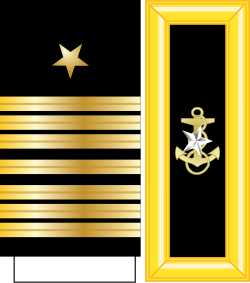
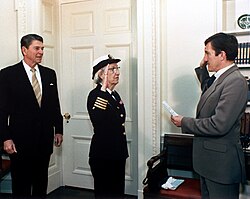
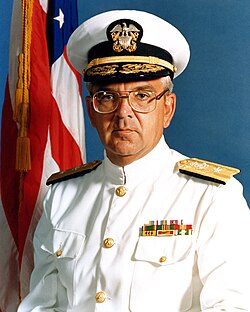
In 1982, the Navy and Coast Guard attempted to resolve seniority disputes with the Army, Air Force, and Marine Corps by officially reintroducing the rank of commodore at the O-7 pay grade. Initially termed "commodore admiral," it was quickly simplified to "commodore."
However, this caused confusion because the title was already being used as a position title for senior captains. To resolve this, the one-star rank was changed in 1983 to Rear Admiral (lower half), with the abbreviation RDML. The formal rank of commodore was officially abolished in 1985.
Modern Usage and Civilian Traditions
Today, the U.S. Navy uses "commodore" as an honorary title for O-6 captains who command operational organizations consisting of multiple independent subordinate units, such as submarine squadrons or special warfare groups.
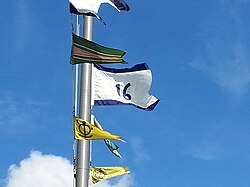
Outside of active military service, the title remains prominent in other sectors:
- Coast Guard Auxiliary: The title "Honorary Commodore" is bestowed upon individuals of high esteem, including figures like Al Roker and Lloyd Bridges.
- Yachting: In civilian yacht clubs, Commodores, Vice-Commodores, and Rear-Commodores serve as flag officers. These roles often involve formal ceremonies including cannon shots, trumpet fanfares, and the raising of specific maritime flags.
| Period | Status | Key Characteristic |
|---|---|---|
| 1775–1862 | Courtesy Title | Temporary assignment for captains in command of squadrons. |
| 1862–1899 | Permanent Rank | Established as a commissioned rank during the Civil War. |
| 1899–1943 | Abolished | Removed due to international diplomatic complications. |
| 1943–1947 | Re-established | One-star rank used extensively during World War II. |
| 1982–1985 | Brief Reintroduction | Reintroduced as O-7 before becoming Rear Admiral (lower half). |
| 1985–Present | Honorary Title | Used for senior captains commanding multiple naval units. |
Frequently Asked Questions
Is a commodore still a formal rank in the US Navy?
No. Since 1985, it has not been a formal commissioned rank. It is now used as an honorary title for senior captains (pay grade O-6) who command operational organizations made up of multiple subordinate units.
What is the difference between a Commodore and a Rear Admiral (lower half)?
Historically, both were one-star (O-7) positions. Today, Rear Admiral (lower half) is the official commissioned rank for a one-star flag officer, while Commodore is a title given to certain captains.
Why was the rank of commodore abolished in 1899?
The rank was removed because U.S. commodores were not being treated as flag officers by other nations' navies, which the U.S. Navy Department viewed as a slight to the nation's honor and dignity.
Who is a civilian commodore?
In the context of yachting, a commodore is a civilian flag officer who leads a yacht club. This role is often accompanied by formal regalia, epaulettes, and specific maritime flags.
Which other services used the rank of commodore?
In addition to the US Navy and US Coast Guard, the rank was used by the US Public Health Service Commissioned Corps and the NOAA Commissioned Officer Corps.