Armored Cruisers: The Evolution of Long-Range Naval Power
The armored cruiser was a pivotal class of warship that dominated the seas during the late 19th and early 20th centuries. Designed for long-range, independent operations, these vessels were engineered to be the ultimate versatile predators of the ocean: powerful enough to defeat almost any ship except a pre-dreadnought battleship, and fast enough to outrun any battleship they encountered.
For decades, naval architects struggled to balance the conflicting requirements of heavy protection, high speed, and long-range endurance. This tension led to a period of experimentation, shifting from lightly protected vessels to heavily armored behemoths before the eventual rise of the battlecruiser.
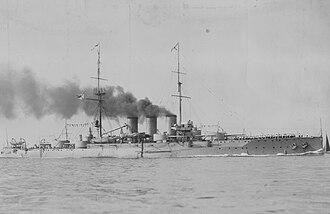
Key Facts
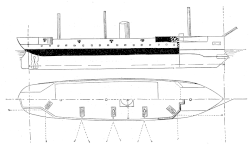
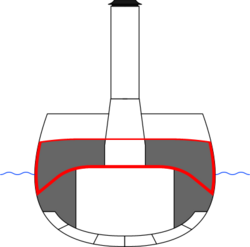
- Defining Feature: Distinguished by a belt armor (thick iron or steel plating) along the hull to protect against shellfire.
- Primary Role: Long-range independent operations and commerce raiding.
- First Vessel: The Imperial Russian Navy's General-Admiral, launched in 1873.
- Technological Shift: The invention of case-hardened armor in the mid-1890s allowed for better protection with less weight.
- Obsolescence: Supplanted by the battlecruiser in 1908 and later restricted by the Washington Naval Treaty of 1922.
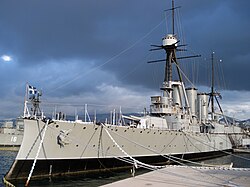
- Sole Survivor: The Greek cruiser Georgios Averof is the only armored cruiser remaining today as a museum ship.
The Technological Struggle: Armored vs. Protected Cruisers
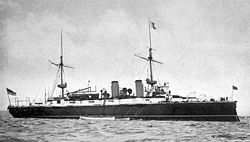
In the 1880s and 1890s, many navies opted for protected cruisers. These ships lacked a side armor belt, relying instead on a lightly armored internal deck to shield vital machinery and magazines from plunging fire.
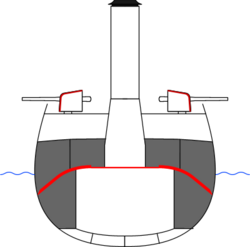
However, the introduction of modern rapid-fire breech-loading cannons and high-explosive shells made side armor a necessity. The development of case-hardened armor in the mid-1890s provided the breakthrough needed to reintroduce heavy side plating without sacrificing too much speed or range.
Early Development and the Russian Influence

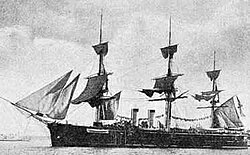
The Russian Navy pioneered the concept with the General-Admiral in 1873. While it featured a narrow waterline belt, the armor was so heavy it often sat below the waterline, limiting its effectiveness. These early ships still relied on a combination of steam and sail propulsion due to high coal consumption.
The French and British Approaches
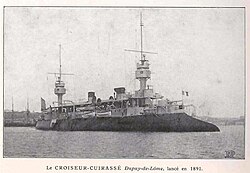
France initially embraced the Jeune Ecole (Young School) philosophy, focusing on fast protected cruisers for commerce raiding. It wasn't until the Dupuy de Lôme (laid down in 1888) that France produced a revolutionary armored cruiser that abandoned masts entirely in favor of steel armor.
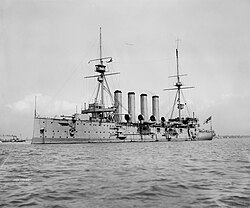
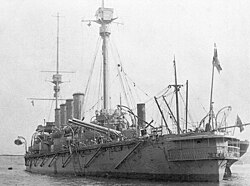
The British Royal Navy remained undecided for years. The Imperieuse class (1881) featured a thick belt, but it covered only a small portion of the hull and was often submerged. By 1898, Britain shifted toward a massive expansion of armored cruisers, starting with the Cressy class, which utilized Krupp steel to defend against 6-inch quick-firing guns.
Global Expansion in the Pre-Dreadnought Era
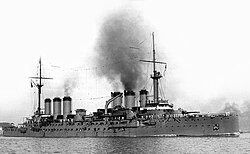
Japan's Naval Build-up
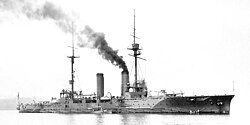
Following the First Sino-Japanese War, Japan launched a ten-year build-up known as the "Six-Six Program." This aimed to create a fleet of six battleships and eight armored cruisers, such as the Yakumo, to augment their battle squadrons.
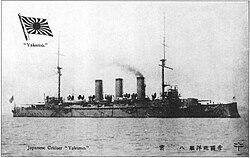
The American Experience
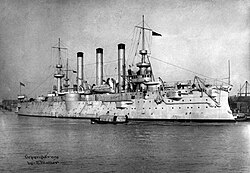
The USS Maine (1889) was the first U.S. armored cruiser, though it was later redesignated a "second-class battleship" due to its slow speed. Later, the Pennsylvania class represented a shift toward "light battleships," featuring massive displacements of 14,500 tons and firepower comparable to first-line battleships.
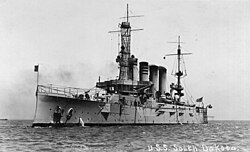
The Peak and Decline of the Armored Cruiser
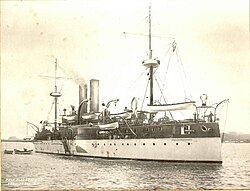
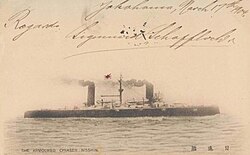
The armored cruiser's effectiveness was proven at the Battle of Tsushima in 1905, where Japanese cruisers like the Nisshin survived heavy hits and remained battle-ready. This success led to even more powerful designs, such as the Tsukuba class, which carried 12-inch guns.
The pinnacle of the type included the Russian Rurik (1908), a British-built masterpiece with advanced magazine protection, and the British Minotaur class. However, the arrival of the battlecruiser—which combined battleship-grade armament with cruiser speed—rendered the armored cruiser obsolete.
World War I and the End of an Era
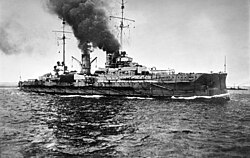
During World War I, armored cruisers were still used due to their range, but they proved vulnerable to modern dreadnoughts. At the Battle of Jutland, ships like HMS Warrior and HMS Defence were destroyed because their armor could not withstand 11-inch and 12-inch shells, and they were too slow to escape.
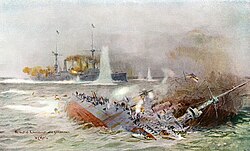
The final blow came from the development of capped armor-piercing (AP) shells, which easily penetrated the Harvey and Krupp armor that had once seemed impenetrable.
Summary of Cruiser Types
| Feature | Protected Cruiser | Armored Cruiser | Battlecruiser |
|---|---|---|---|
| Primary Protection | Armored internal deck | Side belt armor + armored deck | Heavy belt armor + armored deck |
| Armament | Light to Medium | Medium to Heavy | Battleship-grade (Heavy) |
| Speed | High | Moderate to High | Very High |
| Primary Role | Scouting / Commerce Raiding | Independent Ops / Fleet Support | Fast Wing of Battle Fleet |
Frequently Asked Questions
What is the main difference between an armored cruiser and a protected cruiser?
The primary difference is the side armor. An armored cruiser features a belt armor—a thick strip of iron or steel plating along the hull—whereas a protected cruiser relies solely on an internal armored deck to protect its vitals.
Why did armored cruisers become obsolete?
They were supplanted by the battlecruiser, which offered superior speed and much heavier armament. Additionally, the development of capped armor-piercing shells made the armored cruiser's belt protection insufficient against modern dreadnoughts.
What was the significance of the Washington Naval Treaty of 1922?
The treaty imposed strict limits on warship tonnage and armament. It defined cruisers as ships of 10,000 tons or less with guns of 8-inch caliber or less, which forced the decommissioning and scrapping of many large armored cruisers.
Which armored cruiser is still available to see today?
The Georgios Averof of the Greek Navy is the only armored cruiser that has survived to the modern day and currently serves as a museum ship.